477 posters, 14 topics, 2,065 authors, 1,055 institutions
ePostersLive by SciGen Technologies S.A. All rights reserved.
The Joint EBJIS-MSIS 2026 Conference
17 - 19 September, 2026 | Porto, Portugal

EP213
Carcinomatous degeneration of chronic tibial osteomyelitis: a retrospective study of five cases
Poster Presenter
Authors
Jawhar Ben Dhief, Mohamed ben jemaa, achraf Lajmi, khaled keskes, Mohamed ali Rekik, hedi Chaabouni, wassim zribi, zoubaier Ellouz, hassib Keskes
Affiliations
The Orthopedics and Traumatology Department, Habib Bourguiba University Hospital, Sfax, The Orthopedics and Traumatology Department, Habib Bourguiba University Hospital, Tunisia
Part of Topic
Osteomyelitis/ Spondylitis
Introduction : Squamous cell carcinoma (SCC) arising from chronic osteomyelitis, also known as Marjolin's ulcer when occurring on the skin, is a rare but grave complication of long-standing chronic bone infection. This neoplastic transformation typically occurs after prolonged suppuration, chronic fistulization, and repeated cicatrization, particularly affecting long bones such as the tibia.The diagnosis is often delayed due to normalization of chronic local symptoms.
Objectives : To describe the epidemiological, clinical, radiological, histopathological, therapeutic, and evolutionary characteristics of squamous cell carcinoma complicating chronic tibial osteomyelitis.
Methods : Retrospective descriptive study of patients managed for squamous cell carcinoma complicating chronic bone infection at the Orthopedic and Trauma Surgery Department of CHU Habib Bourguiba, Sfax, over a 16-year period (January 1, 2005 – December 31, 2020). Data collection included: socio-epidemiological characteristics, clinical data, imaging findings (standard and advanced), histopathological examination, surgical and medical management modalities, as well as clinical, biological, and radiological evolution.
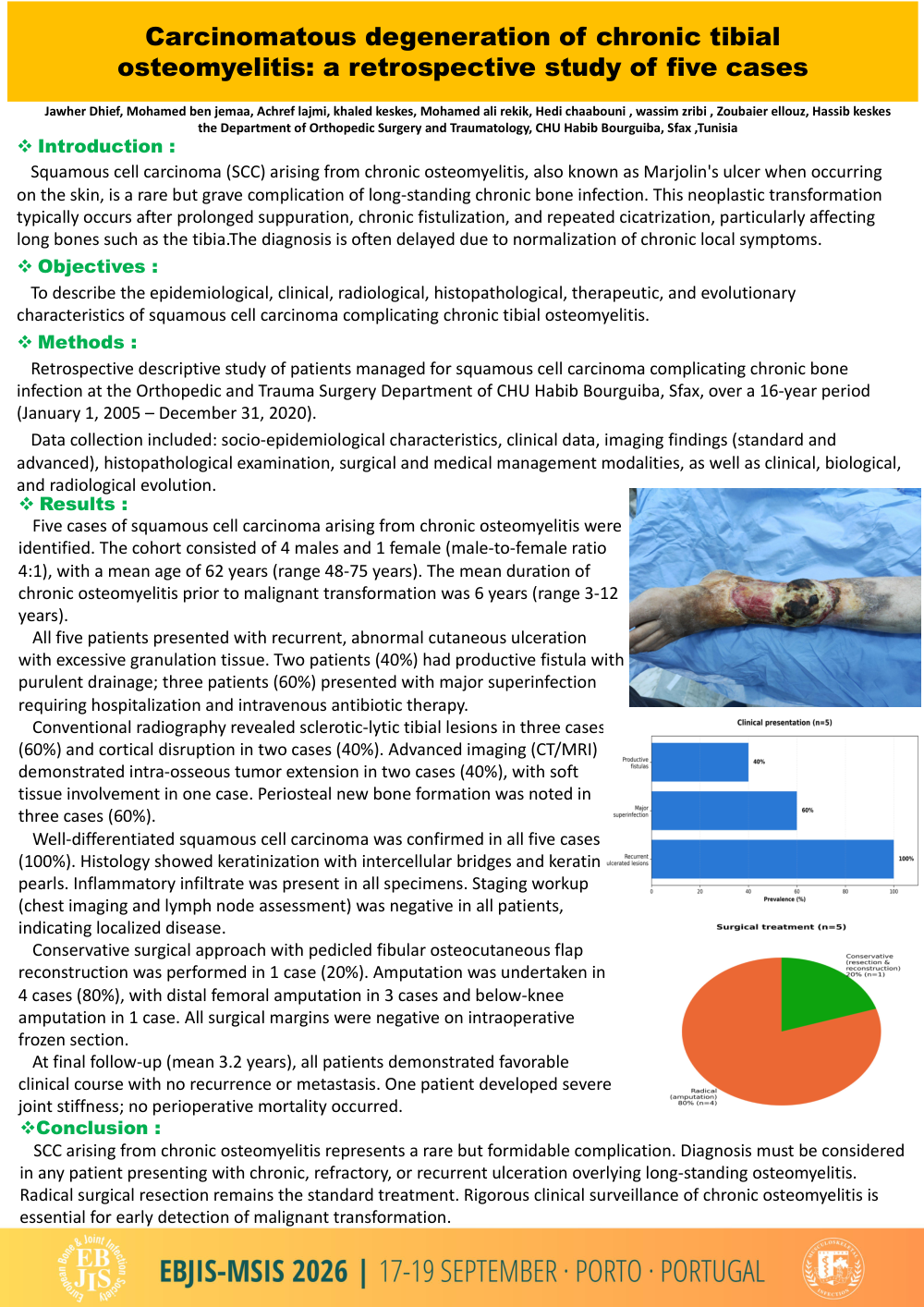
Results : Five cases of squamous cell carcinoma arising from chronic osteomyelitis were identified. The cohort consisted of 4 males and 1 female (male-to-female ratio 4:1), with a mean age of 62 years (range 48-75 years). The mean duration of chronic osteomyelitis prior to malignant transformation was 6 years (range 3-12 years). All five patients presented with recurrent, abnormal cutaneous ulceration with excessive granulation tissue. Two patients (40%) had productive fistula with purulent drainage; three patients (60%) presented with major superinfection requiring hospitalization and intravenous antibiotic therapy. Conventional radiography revealed sclerotic-lytic tibial lesions in three cases (60%) and cortical disruption in two cases (40%). Advanced imaging (CT/MRI) demonstrated intra-osseous tumor extension in two cases (40%), with soft tissue involvement in one case. Periosteal new bone formation was noted in three cases (60%). Well-differentiated squamous cell carcinoma was confirmed in all five cases (100%). Histology showed keratinization with intercellular bridges and keratin pearls. Inflammatory infiltrate was present in all specimens. Staging workup (chest imaging and lymph node assessment) was negative in all patients, indicating localized disease. Conservative surgical approach with pedicled fibular osteocutaneous flap reconstruction was performed in 1 case (20%). Amputation was undertaken in 4 cases (80%), with distal femoral amputation in 3 cases and below-knee amputation in 1 case. All surgical margins were negative on intraoperative frozen section. At final follow-up (mean 3.2 years), all patients demonstrated favorable clinical course with no recurrence or metastasis. One patient developed severe joint stiffness; no perioperative mortality occurred.
Conclusion : SCC arising from chronic osteomyelitis represents a rare but formidable complication. Diagnosis must be considered in any patient presenting with chronic, refractory, or recurrent ulceration overlying long-standing osteomyelitis. Radical surgical resection remains the standard treatment. Rigorous clinical surveillance of chronic osteomyelitis is essential for early detection of malignant transformation.