477 posters, 14 topics, 2,052 authors, 1,056 institutions
ePostersLive by SciGen Technologies S.A. All rights reserved.
The Joint EBJIS-MSIS 2026 Conference
17 - 19 September, 2026 | Porto, Portugal
EP164
Improving Outcomes With A Novel Orthopaedic/Inclusion Health Service For Patients Experiencing Homelessness: A Retrospective Cohort Study and Systematic Review
Poster Presenter
Authors
William Dawson-Howe, Conor Medlar, Maria McWalter, Niamh Allen, Cl?ona N? Cheallaigh, Andrew Hughes, Jean-Michel Leclere
Affiliations
Department of Orthopaedic Surgery, St. James�s Hospital, Dublin 8, Ireland, Department of Infectious Diseases, St. James�s Hospital, Dublin 8, Ireland, St. James's Hospital
Part of Topic
Infectious Diseases
Improving Outcomes With A Novel Orthopaedic/Inclusion Health Service For Patients Experiencing Homelessness: A Retrospective Cohort Study and Systematic Review
William Dawson-Howe1, Conor Medlar1, Jean-Michel Leclere1, Maria McWalter2, Niamh Allen2, Clíona Ní Cheallaigh2, Andrew J. Hughes1
1 Department of Orthopaedic Surgery, St. James’s Hospital, Dublin 8, Ireland 2 Department of Infectious Diseases, St. James’s Hospital, Dublin 8, Ireland
Background
Patients experiencing homelessness (PEH) sustain disproportionately higher rates of orthopaedic injuries, often requiring surgical intervention and generating relatively high rates of emergency department utilisation. Existing literature demonstrates poor adherence to follow-up in this patient group, elevated complication rates, and high rates of self-directed discharge. This study aims to quantify the published outcomes and evaluate the functionality of a novel, dedicated Inclusion Health/Orthopaedic surgical service – the first of its kind at the time of its inception.
Methods
A PRISMA-guided systematic review of Embase, Scopus and PubMed was completed. In parallel, a retrospective cohort study was performed of patients attending a dedicated Inclusion Health/Orthopaedic surgical service at our tertiary hospital between January 2024 and March 2026. Cohort outcomes were benchmarked against pooled comparator rates derived from directly comparable systematic review studies, using Fisher's exact or chi-squared testing, with Wilson score 95% confidence intervals reported given small denominators.
Results
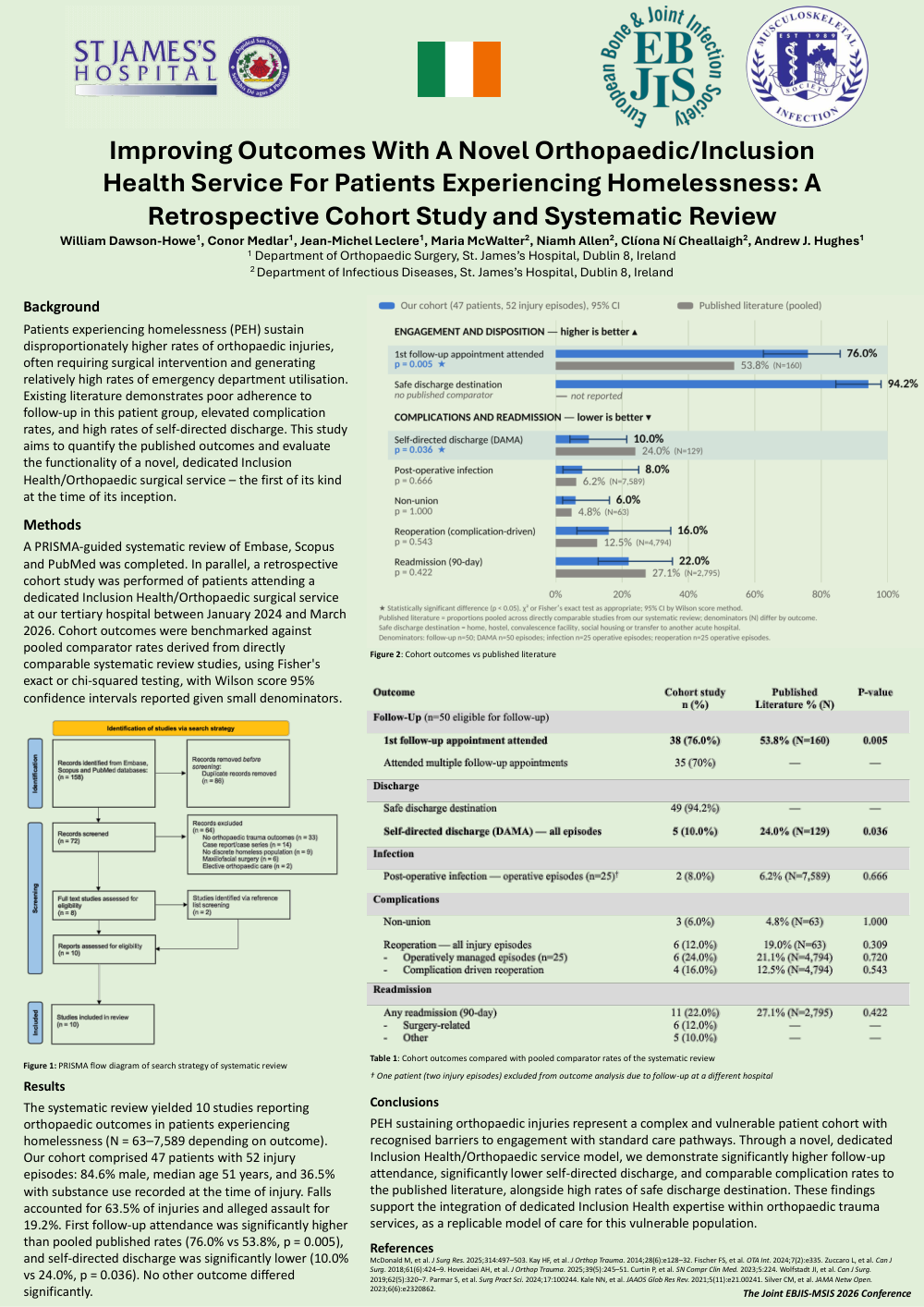
The systematic review yielded 10 studies reporting orthopaedic outcomes in patients experiencing homelessness (N = 63–7,589 depending on outcome). Our cohort comprised 47 patients with 52 injury episodes: 84.6% male, median age 51 years, and 36.5% with substance use recorded at the time of injury. Falls accounted for 63.5% of injuries and alleged assault for 19.2%. First follow-up attendance was significantly higher than pooled published rates (76.0% vs 53.8%, p = 0.005), and self-directed discharge was significantly lower (10.0% vs 24.0%, p = 0.036). No other outcome differed significantly.
Conclusions
PEH sustaining orthopaedic injuries represent a complex and vulnerable patient cohort with recognised barriers to engagement with standard care pathways. Through a novel, dedicated Inclusion Health/Orthopaedic service model, we demonstrate significantly higher follow-up attendance, significantly lower self-directed discharge, and comparable complication rates to the published literature, alongside high rates of safe discharge destination. These findings support the integration of dedicated Inclusion Health expertise within orthopaedic trauma services, as a replicable model of care for this vulnerable population.
References
McDonald M, et al. J Surg Res. 2025;314:497–503. Kay HF, et al. J Orthop Trauma. 2014;28(6):e128–32. Fischer FS, et al. OTA Int. 2024;7(2):e335. Zuccaro L, et al. Can J Surg. 2018;61(6):424–9. Hoveidaei AH, et al. J Orthop Trauma. 2025;39(5):245–51. Curtin P, et al. SN Compr Clin Med. 2023;5:224. Wolfstadt JI, et al. Can J Surg. 2019;62(5):320–7. Parmar S, et al. Surg Pract Sci. 2024;17:100244. Kale NN, et al. JAAOS Glob Res Rev. 2021;5(11):e21.00241. Silver CM, et al. JAMA Netw Open. 2023;6(6):e2320862.
The Joint EBJIS-MSIS 2026 Conference