477 posters, 14 topics, 2,065 authors, 1,055 institutions
ePostersLive by SciGen Technologies S.A. All rights reserved.
The Joint EBJIS-MSIS 2026 Conference
17 - 19 September, 2026 | Porto, Portugal

EP152
Lower limb arthroplasties in HCV and HIV coinfected patients: a matched retrospective cohort study
Poster Presenter
Part of Topic
Infectious Diseases
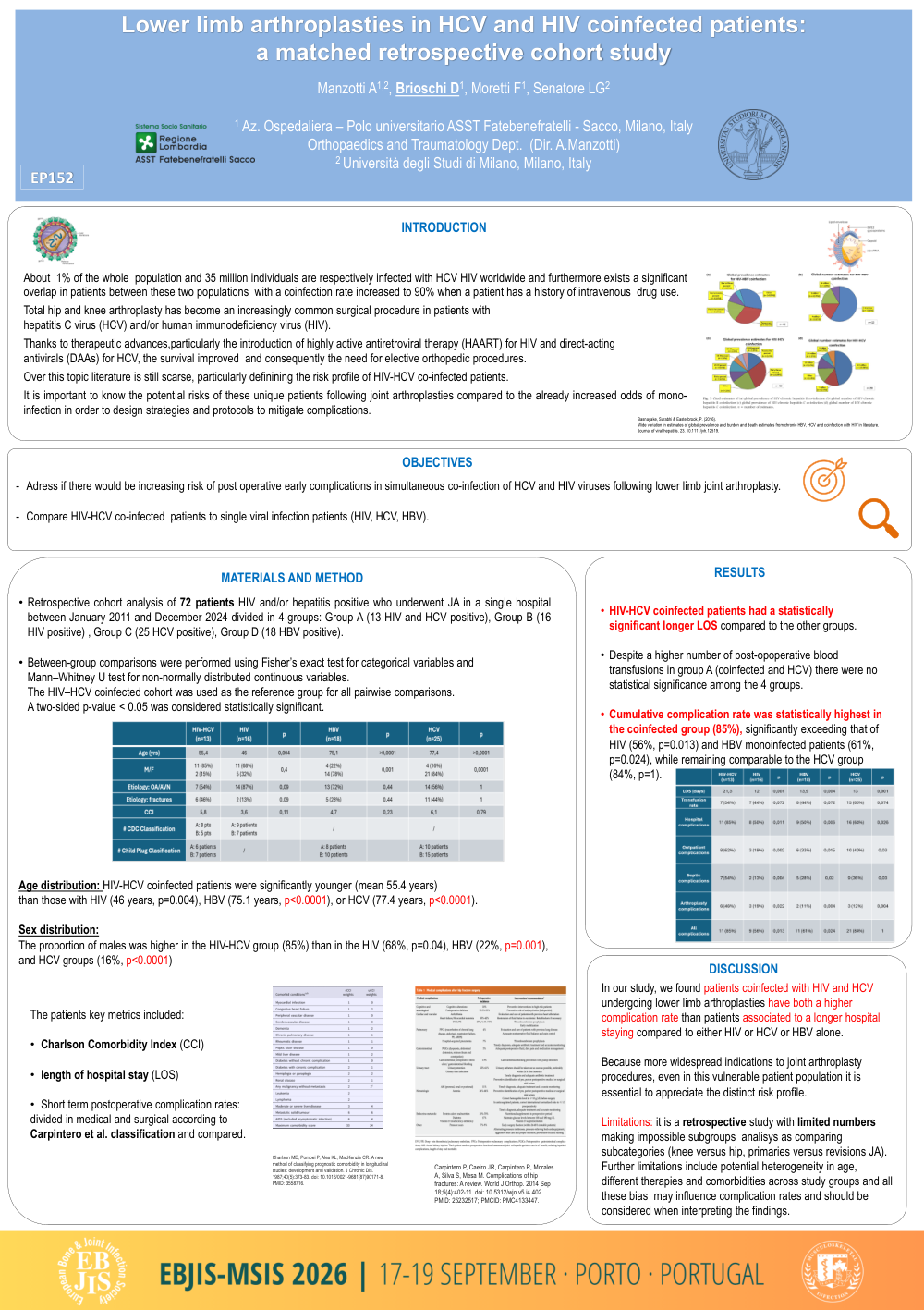
Lower limb arthroplasties in HCV and HIV coinfected patients:
a matched retrospective cohort study
Manzotti A1,2, Brioschi D1, Moretti F1, Senatore L2
1Ospedale L Sacco, Milano, , Italy, 2Università degli Studi di Milano, MIlano, Italy
AIM: About 1% of the whole population and 35 million individuals are respectively infected with HCV HIV worldwide, and furthermore exists a significant overlap in patients between these two populations with a coinfection rate increased to 90% when a patient has a history of intravenous drug use. With the more frequents requests of arthroplasties procedure with extended indications, therefore it could be important to understand the potential complication risks of this unique patients following joint arthroplasties compared to the already increased odds of mono-infection. Aim of the the study was to understant if the simultaneous confection of HCV and HIV virues could increase the risk of post operative early complication following in lower limb total joint arthroplasties compared to patient positive either to Hiv or to Hepatitis (HCV and HBV)
METHODS: A retrospective analysis of 85 patients HIV and/or hepatis positive who underwent to a total joint arthroplasty reconstruction in a single hospital between 2011 and 2022 were included in the study. 18 patients were simultaneously HIV and HCV positive, 23 were HIV positive, 27 were HCV positive and 17 were HBV positive. HIV-HCV coinfected patients were significantly younger (mean 55.4 years) than those with HIV (46 years, p=0.004), HBV (75.1 years, p<0.0001), or HCV (77.4 years, p<0.0001). The proportion of males was higher in the HIV-HCV group (85%) than in the HIV (68%, p=0.04), HBV (22%, p=0.001), and HCV groups (16%, p<0.0001)The patients were key metrics included the Charlson Comorbidity Index (CCI), length of hospital stay (LOS). Short term postoperative complication rates divided in medical and surgical according to Carpintero’ et al. classification and compared.
RESULTS: There were no statistical differences in pre-operative Charlson Comorbidity Index among the 3 groups Length of Stay (LOS): HIV-HCV coinfected patients had a significantly longer LOS (21.3 days) than those both with HIV and Hepatitis coinfection. Futhermore our results indicated that HIV-HCV coinfected patients experienced statistically significant higher rates of septic and early complications,
CONCLUSION: In our study, we found patients coinfected with HIV and HCV undergoing lower limb arthroplasties have both a higher complication rate than patients associated to a longer hospital staying compared to either HIV or HCV or HBV alone. Because more widespread indications to joint arthroplasty procedures even in this vulnerable patient population it is essential to appreciate the distinct risk profile. Our findings highlight the importance of dedicated perioperative strategies for this population to avoid or mitigate complications