477 posters, 14 topics, 2,052 authors, 1,056 institutions
ePostersLive by SciGen Technologies S.A. All rights reserved.
The Joint EBJIS-MSIS 2026 Conference
17 - 19 September, 2026 | Porto, Portugal
EP162
Therapeutic drug monitoring of dalbavancin: a step forward in personalized long-term therapy
Poster Presenter
Authors
Joan Torra Garcia, Joan Gomez Junyent, Felipe Moreira Borim, Maria Luisa Sorli Redo, Rosario Bueno Uceda, Cristina Raich Gual, Grethel Rodriguez Cabale, Manuela Sanz de Mena, Sonia Luque Pardos, Daniel Perez-Prieto
Affiliations
Hospital Del Mar, Hospital del Mar, Passeig Maritim 25-29, 08003, Barcelona, Spain, Hospital of Sabadell, Parc Tauli, 1, 08208, Sabadell, Spain
Part of Topic
Infectious Diseases
Title: Therapeutic drug monitoring of dalbavancin: a step forward in personalized long-term therapy
Authors: J. Torra Garcia1, J. Gómez-Junyent1, F. Moreira Borim1, M.L. Sorli Redo1, R. Bueno Uceda2, C. Raich-Gual1, Grethel, Manuela, S. Luque1,D. Perez Prieto1,
Affiliations:
-
Hospital del Mar, Passeig Marítim 25-29, 08003, Barcelona, Spain.
-
Hospital of Sabadell, Parc Taulí, 1, 08208, Sabadell, Spain.
Word count: 395 words
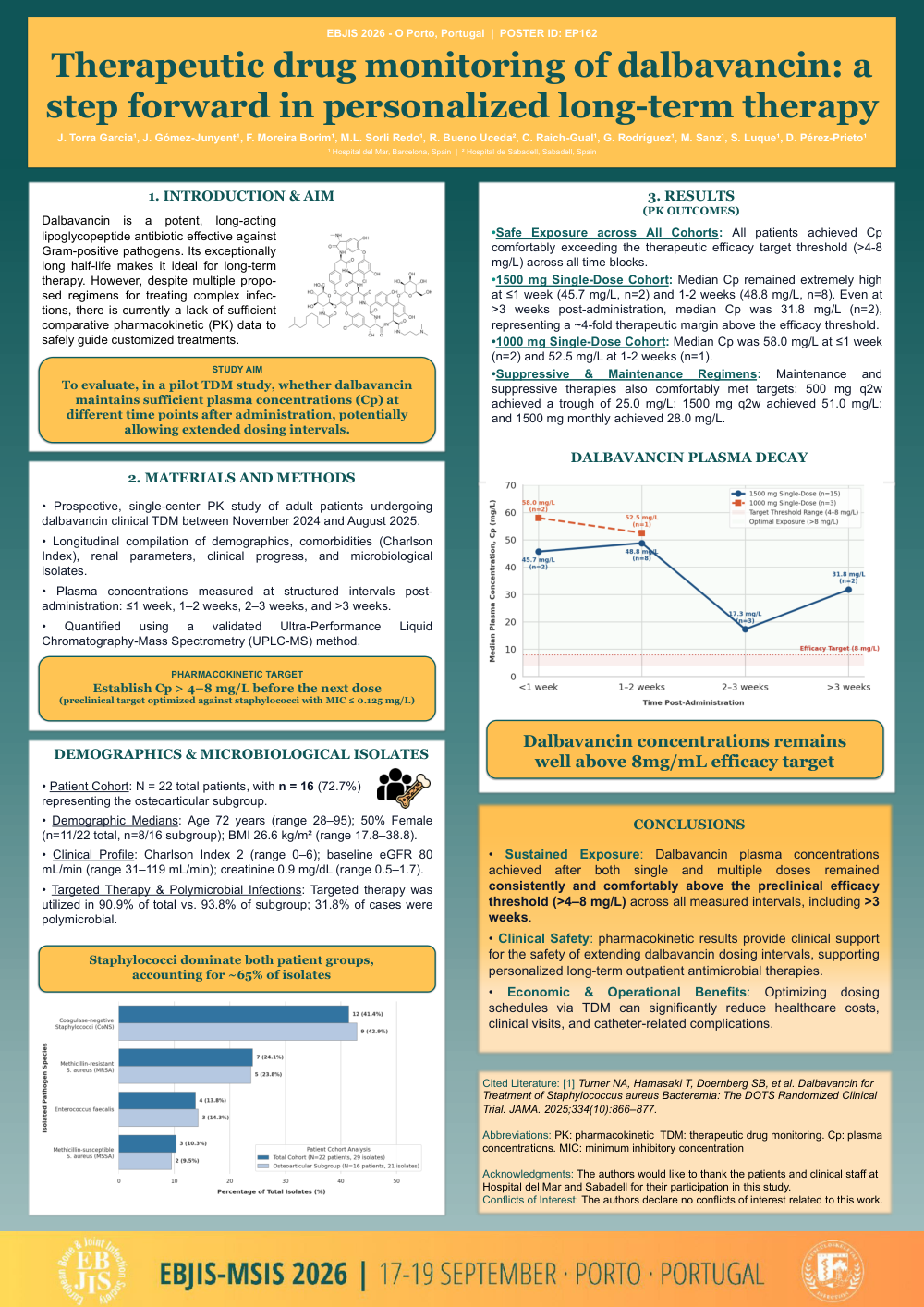
Introduction & Aim: Dalbavancin is a long-acting lipoglycopeptide active against Gram-positive bacteria, exhibiting rapid bactericidal activity. For difficult-to-treat infections, different dosing regimens have been proposed, but limited comparative clinical pharmacokinetic (PK) data are available. Therapeutic drug monitoring (TDM) has been employed to extend dosing intervals while ensuring optimal drug exposure. The aim of this pilot study is to evaluate whether dalbavancin achieves sufficient plasma concentrations (Cp) at different time points after an initial dose, potentially allowing for extended dosing intervals.
Methods: A prospective PK study was conducted including all patients treated with dalbavancin at a tertiary hospital who underwent TDM between November 2024 and August 2025. Demographic, clinical, PK, and microbiological data were collected. Blood samples were obtained at various post-administration time points: ≤1 week, 1–2 weeks, 2–3 weeks, and >3 weeks. A validated ultra-performance liquid chromatography-mass spectrometry method was used. Preclinical data suggest a pharmacokinetic/pharmacodynamic (PK/PD) target Cp above 4–8 mg/L before the next dose ensures efficacy against staphylococci with a minimum inhibitory concentration (MIC) ≤0.125 mg/L.
Results: Twenty-two patients were included (50% female). The median age was 72 years (range 28–95), Body Mass Index 26.6 kg/m² (17.8–38.8), Charlson Index 2 (0–6), baseline glomerular filtration rate 80 mL/min (31–119), and serum creatinine 0.9 mg/dL (0.5–1.7). Infection sites were osteoarticular (72.7%) and endovascular (27.3%). Targeted therapy was used in 20 patients (90.9%), with 7 (31.8%) having polymicrobial infections. Main microorganisms included coagulase-negative staphylococci in 12 patients (41.4%), methicillin-resistant Staphylococcus aureus (MRSA) in 7 (24.1%), Enterococcus faecalis in 4 (13.8%), and methicillin-susceptible S. aureus (MSSA) in 3 (10.3%). MIC data were available for 8 isolates, of which 87.5% showed an MIC <0.125 mg/L. Eighteen patients (81.8%) received a single dose, and 4 received multiple doses. For the 1500 mg single-dose group (n=15), the median Cp was 45.7 mg/L at <1 week (n=2), 48.8 mg/L at 1–2 weeks (n=8), 17.3 mg/L at 2–3 weeks (n=3), and 31.8 mg/L at >3 weeks (n=2). For the 1000 mg single-dose group (n=3), the median Cp was 58.0 mg/L at <1 week (n=2) and 52.5 mg/L at 1–2 weeks (n=1). Three patients on suppressive regimens (500 mg/2 weeks, 1500 mg/2 weeks, and 1500 mg/month) achieved a Cp of 25, 51, and 28 mg/L, respectively, before the next administration. One patient received two 1500 mg doses one week apart, reaching a Cp of 55.8 mg/L two weeks after the second dose.
Sixteen patients with osteoarticular infections were included (50% female). The median age was 72 years (range 28–95), Body Mass Index 26.6 kg/m² (17.8–38.8), Charlson Index 2 (0–6), baseline glomerular filtration rate 80 mL/min (31–119), and serum creatinine 0.9 mg/dL (0.5–1.7).
Targeted therapy was utilized in 15 patients (93.8%), with 5 (31.3%) having polymicrobial infections. A total of 21 microorganisms were isolated. Main pathogens included coagulase-negative staphylococci in 9 isolates (42.9%), methicillin-resistant Staphylococcus aureus (MRSA) in 5 (23.8%), Enterococcus faecalis in 3 (14.3%), and methicillin-susceptible S. aureus (MSSA) in 2 (9.5%). MIC data were available for 6 isolates, of which 5 (83.3%) showed an MIC <0.125 mg/L.
Thirteen patients (81.3%) received a single dose, and 3 received multiple doses. Within the 1500 mg single-dose group ($n=11$), the median $C_p$ was 45.7 mg/L at <1 week ($n=1$), 48.8 mg/L at 1–2 weeks ($n=6$), 17.3 mg/L at 2–3 weeks ($n=2$), and 31.8 mg/L at >3 weeks ($n=2$). For the 1000 mg single-dose group ($n=2$), the median $C_p$ was 58.0 mg/L at <1 week ($n=1$) and 52.5 mg/L at 1–2 weeks ($n=1$). Two patients on suppressive regimens (estimated at 1500 mg/2 weeks and 1500 mg/month) achieved $C_p$ values of 51 and 28 mg/L, respectively, before the next administration. One patient received two 1500 mg doses one week apart, reaching a $C_p$ of 55.8 mg/L two weeks after the second dose.
Conclusions: In this pilot study of dalbavancin TDM, the achieved Cp after single or multiple doses remained well above the established efficacy threshold (Cp 8 mg/L). These findings support the potential to safely extend dosing intervals, optimizing personalized long-term therapy and reducing associated costs.