477 posters, 14 topics, 2,052 authors, 1,056 institutions
ePostersLive by SciGen Technologies S.A. All rights reserved.
The Joint EBJIS-MSIS 2026 Conference
17 - 19 September, 2026 | Porto, Portugal
EP089
Chemical-Enzymatic Biofilm Dispersal Matches Sonication in Periprosthetic Joint Infection Diagnosis
Poster Presenter
Authors
Andrew Gordon, Samuelson Osifo, Adrian Santana, Eduardo Drummond, Christian Cisneros, Caroline Tyndall, Jewelia Rempuszewski, Neel Shah, Douglas Pluta, Jessica Gilbertie, Kenneth L. Urish
Affiliations
Department of Orthopaedic Surgery, University of Pittsburgh, Pittsburgh, USA, null, Department of Orthopaedic Surgery, University of Pittsburgh, Pittsburgh, USA; University of Pittsburgh School of Medicine, Pittsburgh, USA
Part of Topic
Diagnosis
Introduction
Culture-negative periprosthetic joint infection (PJI) has an incidence of approximately 20%. Often, PJI may be culture-negative because of the altered metabolic state of bacteria in biofilm, an organized extracellular polymeric matrix that is the normal pathologic state of the bacteria. Sonication improves diagnostic yield by disrupting biofilms, but it often requires specialized equipment and explanted components. Chemical–enzymatic dispersal of tissue offers a simpler alternative. This study compared the diagnostic accuracy of chemical-enzymatic versus mechanical dispersal by sonication.
Methods
Prospective diagnostic accuracy study of 35 cases undergoing revision or resection arthroplasty. The Musculoskeletal Infection Society (MSIS) and the 2018 International Consensus Meeting (ICM) criteria served as the diagnostic reference standard. Cultures were obtained via three methods:Periprosthetic tissue culture, Sonicate fluid culture, Chemical–enzymatic dispersal culture. Primary outcome: microbiological diagnostic yield. Secondary outcomes: included sensitivity, specificity, positive predictive value (PPV), and negative predictive value (NPV) compared to sonication.
Results
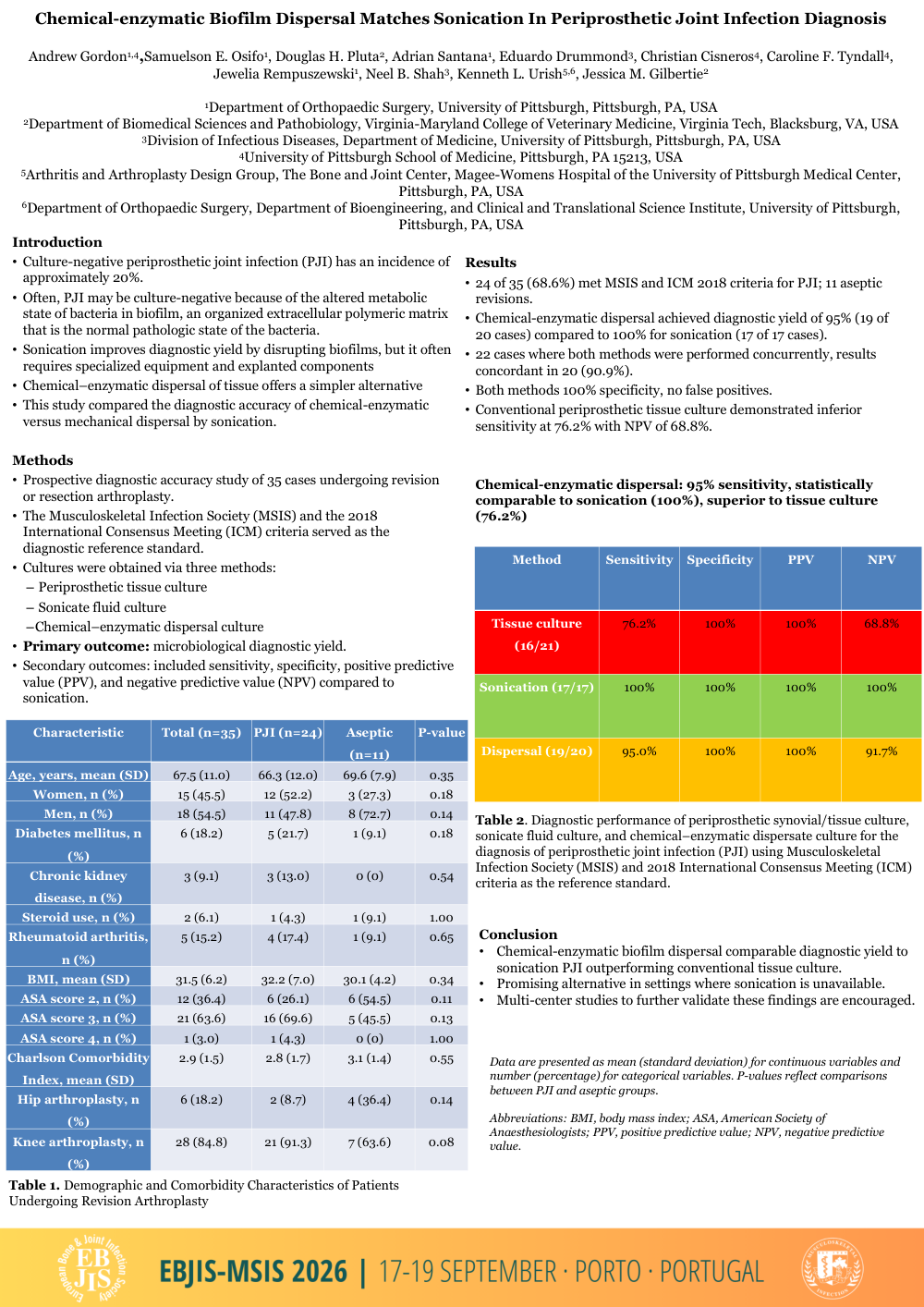
24 of 35 (68.6%) met MSIS and ICM 2018 criteria for PJI; 11 aseptic revisions. Chemical-enzymatic dispersal achieved diagnostic yield of 95% (19 of 20 cases) compared to 100% for sonication (17 of 17 cases). 22 cases where both methods were performed concurrently, results concordant in 20 (90.9%). Both methods 100% specificity, no false positives. Conventional periprosthetic tissue culture demonstrated inferior sensitivity at 76.2% with NPV of 68.8%.
Conclusion
Chemical-enzymatic biofilm dispersal comparable diagnostic yield to sonication PJI outperforming conventional tissue culture. Promising alternative in settings where sonication is unavailable. Multi-center studies to further validate these findings are encouraged.