477 posters, 14 topics, 2,065 authors, 1,055 institutions
ePostersLive by SciGen Technologies S.A. All rights reserved.
The Joint EBJIS-MSIS 2026 Conference
17 - 19 September, 2026 | Porto, Portugal

EP088
Diagnostic challenge of wrist tuberculosis without pulmonary involvement, in non-endemic area
Poster Presenter
Authors
Periklis Pelantis, Marina Athanasopoulou, Maria Pavlaki, Evangelos Sakellariou, Angelos Kontos, Christina Delavinia, Vasiliki Giannou, Panagiotis Karampinas
Affiliations
Third Department of Orthopaedic Surgery, School of Medicine, National and Kapodistrian University of Athens, KAT Hospital, Athens, Greece, Department of Microbiology, General Hospital of Argos, Argos, Greece, Department of Internal Medicine, General Hospital of Argos, Argos, Greece, Third Department of Orthopaedic Surgery, School of Medicine, National and Kapodistrian University of Athens, KAT Hospita
Part of Topic
Diagnosis
Aim
Aim of this study is to present a case of an elderly man who was diagnosed with tuberculosis of the right wrist, with a delayed onset and without a systematic disease infection.
Methods
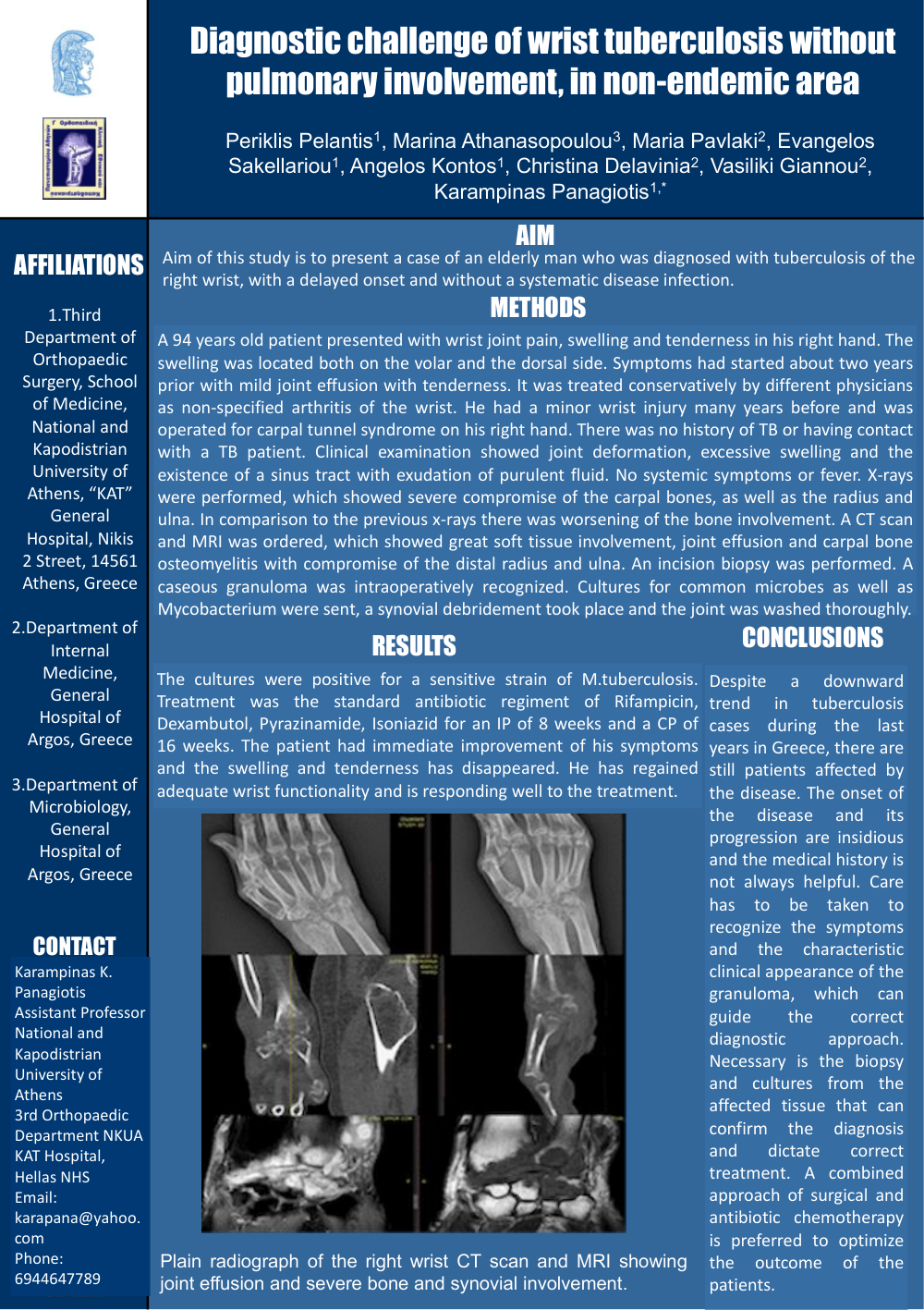
A 94 years old patient presented with wrist joint pain, swelling and tenderness in his right hand. The swelling was located both on the volar and the dorsal side. Symptoms had started about two years prior with mild joint effusion with tenderness. It was treated conservatively by different physicians as non-specified arthritis of the wrist. He had a minor wrist injury many years before and was operated for carpal tunnel syndrome on his right hand. There was no history of TB or having contact with a TB patient. Clinical examination showed joint deformation, excessive swelling and the existence of a sinus tract with exudation of purulent fluid. No systemic symptoms or fever. X-rays were performed, which showed severe compromise of the carpal bones, as well as the radius and ulna. In comparison to the previous x-rays there was worsening of the bone involvement. A CT scan and MRI was ordered, which showed great soft tissue involvement, joint effusion and carpal bone osteomyelitis with compromise of the distal radius and ulna. An incision biopsy was performed. A caseous granuloma was intraoperatively recognized. Cultures for common microbes as well as Mycobacterium were sent, a synovial debridement took place and the joint was washed thoroughly.
Results
The cultures were positive for a sensitive strain of M.tuberculosis. Treatment was the standard antibiotic regiment of Rifampicin, Dexambutol, Pyrazinamide, Isoniazid for an IP of 8 weeks and a CP of 16 weeks. The patient had immediate improvement of his symptoms and the swelling and tenderness has disappeared. He has regained adequate wrist functionality and is responding well to the treatment.
Conclusions
Despite a downward trend in tuberculosis cases during the last years in Greece, there are still patients affected by the disease. The onset of the disease and its progression are insidious and the medical history is not always helpful. Care has to be taken to recognize the symptoms and the characteristic clinical appearance of the granuloma, which can guide the correct diagnostic approach. Necessary is the biopsy and cultures from the affected tissue that can confirm the diagnosis and dictate correct treatment. A combined approach of surgical and antibiotic chemotherapy is preferred to optimize the outcome of the patients.