99 posters, 2 videos, 5 audios, 13 topics, 7 sessions, 418 authors, 180 institutions
ePostersLive by SciGen Technologies S.A. All rights reserved.
The 21st Meeting of the Diabetic Foot Study Group 2026
24-26 September, 2026 | Florence, Italy

EP88
Broken Wing Sign and Diabetic Foot: Association with Ulceration and Amputation in a Case-Control Study
Poster Presenter
Authors
Lavinia Cacciatore, LUCIA Smeraldi, Giorgio Arnaldi, Giuseppe Messina
Affiliations
IRCCS Galeazzi Sant-Ambrogio Hospital, Milan, Italy University of Milan, Department of Biomedical, Surgical and Dental Sciences, Milan, Italy, Milan, MI, Italia, Podokynamic, Centro Integrato di Podologia e Postura, Licata, AG, Italy
Part of Topic
Biomechanics
Audio
Broken Wing Sign and Diabetic Foot: Association with Ulceration and Amputation in a Case-Control Study
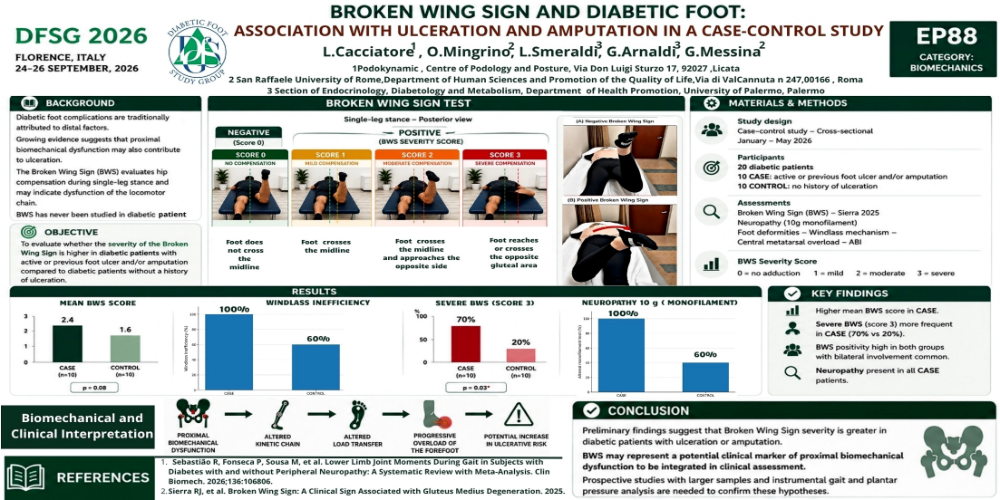
Diabetic foot complications have traditionally been interpreted through a predominantly foot-centered biomechanical model, focusing on distal factors such as peripheral neuropathy, structural foot deformities, altered plantar pressure distribution, and repetitive mechanical overload. However, evidence from gait analysis suggests that diabetic peripheral neuropathy may also be associated with broader alterations in locomotor control, dynamic stability, gait biomechanics, and compensatory proximal strategies.
The Broken Wing Sign (BWS) is a recently described clinical test associated with gluteus medius pathology. Given the important role of the gluteus medius in pelvic stabilization and medio-lateral control during gait, the BWS may provide a clinical perspective on proximal biomechanical function. To the best of our knowledge, the Broken Wing Sign has not previously been investigated in patients with diabetic foot disease.
The aim of this exploratory study was to evaluate whether BWS severity was greater in patients with diabetes and active or previous ulceration and/or amputation compared with diabetic patients without a history of ulceration.
A cross-sectional case-control pilot study was conducted between January and May 2026. Twenty patients with diabetes were included: 10 CASE patients with active or previous diabetic foot ulceration and/or amputation and 10 CONTROL patients without a history of ulceration. Clinical assessment included the Broken Wing Sign, peripheral neuropathy using a 10-g monofilament, foot deformities, Windlass mechanism, and vascular assessment. As no validated BWS grading system currently exists, a preliminary ordinal BWS Severity Score from 0 to 3 was used, ranging from no compensation to severe compensation.
The mean BWS severity score was 2.4 in CASE patients compared with 1.6 in CONTROL patients. A severe BWS (Score 3) was observed in 70% of CASE patients versus 20% of CONTROLS. Distal impairment was also more frequent in the CASE group: Windlass mechanism inefficiency was present in 100% of CASE patients compared with 60% of CONTROLS, and peripheral neuropathy showed the same distribution, 100% versus 60%.
These preliminary findings suggest the possible coexistence of proximal and distal biomechanical alterations in patients with more severe diabetic foot complications. Rather than considering these abnormalities as isolated findings, the results support the exploration of an integrated biomechanical model of diabetic foot disease.
Within this framework, the Broken Wing Sign may represent a clinical window into proximal biomechanical dysfunction, while neuropathy, Windlass mechanism inefficiency, and forefoot overload represent important distal components of the locomotor chain. This concept provides the basis for a proposed progressive overload hypothesis, in which alterations across the kinetic chain may contribute to abnormal load transfer and potentially create biomechanical conditions favourable to plantar ulceration.
Because of the small sample size and cross-sectional design, these findings do not establish causality or demonstrate that BWS predicts future ulceration. Larger prospective studies combining instrumental gait analysis, quantitative plantar pressure assessment, and evaluation of proximal biomechanics are required.
Nevertheless, BWS may represent a potential clinical marker of proximal biomechanical dysfunction to be investigated alongside established diabetic foot assessment.
Take-home message: Look beyond the foot. The diabetic foot may reflect not only distal impairment, but a broader alteration of the locomotor chain.
Keywords: Broken Wing Sign; BWS; diabetic foot; diabetic foot ulcer; diabetic peripheral neuropathy; ulceration; amputation; biomechanics; proximal biomechanics; gait analysis; gait stability; gluteus medius; pelvic stabilization; Windlass mechanism; plantar pressure; forefoot overload; kinetic chain; progressive overload.