99 posters, 2 videos, 5 audios, 13 topics, 7 sessions, 418 authors, 180 institutions
ePostersLive by SciGen Technologies S.A. All rights reserved.
The 21st Meeting of the Diabetic Foot Study Group 2026
24-26 September, 2026 | Florence, Italy

EP24
Achilles Tendon and Plantar Fascia in Diabetic Foot: Biomechanical and Ultrasound Predictors of Ulcer Risk
Part of Topic
Biomechanics
ABSTRACT
Background:
Diabetic foot ulcers (DFUs) are among the most severe complications of diabetes mellitus, significantly impacting morbidity, quality of life, and risk of lower-limb amputation. Increasing evidence highlights the role of soft tissue structures—particularly the Achilles tendon (AT) and plantar fascia (PF)—as key biomechanical contributors to plantar pressure overload and potential predictors of ulceration risk.
Methods:
A systematic review was conducted in accordance with PRISMA 2020 guidelines. A literature search was performed on PubMed between May and August 2025. Original studies involving adult patients with diabetes were included if they investigated:
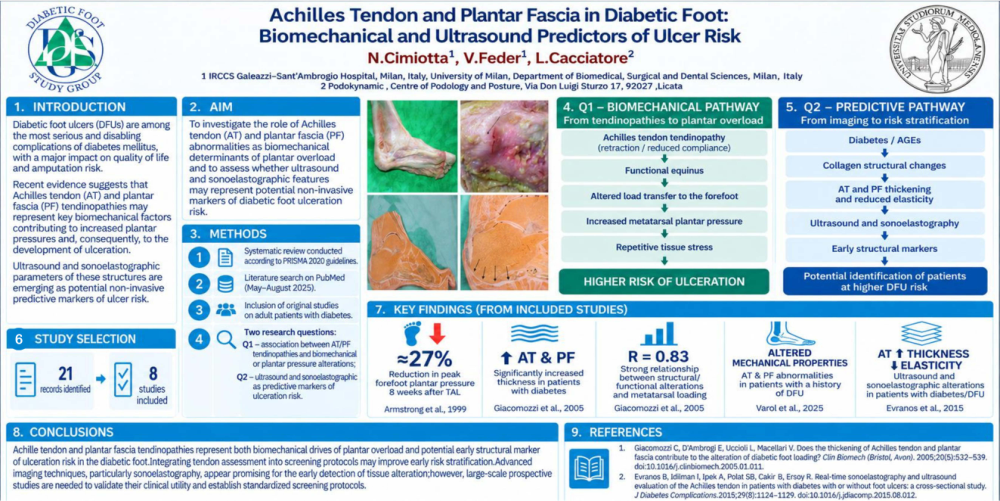
(Q1) the association between AT/PF tendinopathies and biomechanical or plantar pressure alterations;
(Q2) ultrasound and sonoelastographic features as predictive markers of ulceration risk.
Results:
Out of 21 identified records, 8 studies were included in the final qualitative analysis.
For Q1, AT and PF tendinopathies were associated with increased forefoot plantar pressures and reduced tendon compliance. Achilles tendon lengthening (TAL) was shown to significantly reduce plantar loading and improve ulcer healing, although long-term effectiveness remains variable.
For Q2, ultrasound and sonoelastography consistently demonstrated tendon thickening and reduced elasticity in diabetic patients, supporting their potential role as predictive biomarkers of ulceration risk.
Conclusions:
Alterations of the Achilles tendon and plantar fascia represent key biomechanical and structural factors in the pathogenesis of diabetic foot ulcers. Integrating tendon assessment into screening protocols may enhance early risk stratification. Advanced imaging techniques, particularly sonoelastography, appear promising for early detection, although large-scale prospective studies are needed to validate their clinical utility and establish standardized screening protocols.