99 posters, 2 videos, 5 audios, 13 topics, 7 sessions, 418 authors, 180 institutions
ePostersLive by SciGen Technologies S.A. All rights reserved.
The 21st Meeting of the Diabetic Foot Study Group 2026
24-26 September, 2026 | Florence, Italy

EP25
Postural Control in Patients with a History of Diabetic Foot Ulcers: A Pilot Study
Poster Presenter
Authors
Sylwia Bęcławska, Nachiappan Chockalingam, Michalina B?a?kiewicz
Affiliations
PHD School, the J?zef Pi?sudski University of Physical Education, Warsaw, Poland, Faculty of Rehabilitation, the J?zef Pi?sudski University of Physical Education, Warsaw, Poland, Staffordshire University, Stoke-on-Trent, Great Britain, Reading Central PCN, Reading, Great Britain, Faculty of Rehabilitation, the J?zef Pi?sudski University of Physical Education, Warsaw, Poland
Part of Topic
Biomechanics
Interpretation
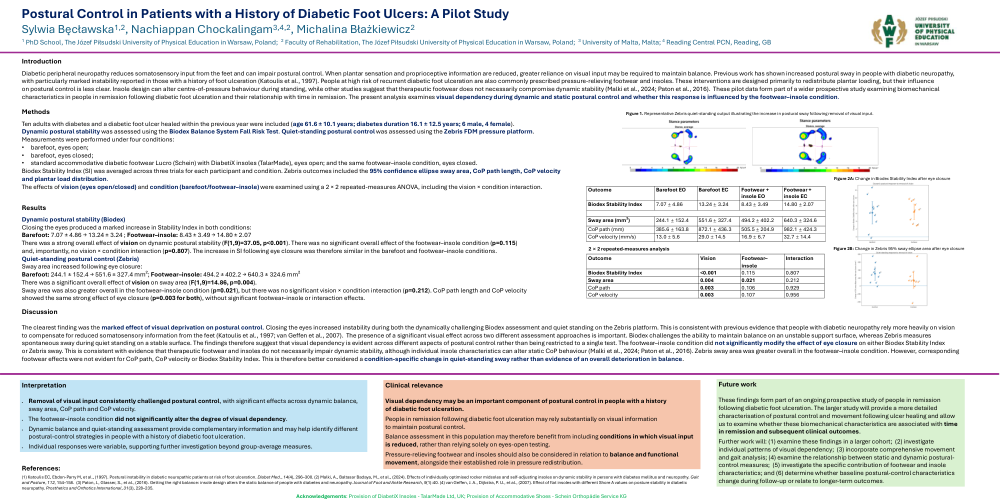
• Removal of visual input consistently challenged postural control, with significant effects across dynamic balance, sway area, CoP path and CoP velocity.
• The footwear–insole condition did not significantly alter the degree of visual dependency.
• Dynamic balance and quiet-standing assessment provide complementary information and may help identify different postural-control strategies in people with a history of diabetic foot ulceration.
• Individual responses were variable, supporting further investigation beyond group-average measures.
Clinical relevance
(1) Visual dependency may be an important component of postural control in people with a history of diabetic foot ulceration.
(2) People in remission following diabetic foot ulceration may rely substantially on visual information to maintain postural control.
(3) Balance assessment in this population may therefore benefit from including conditions in which visual input is reduced, rather than relying solely on eyes-open testing.
(4) Pressure-relieving footwear and insoles should also be considered in relation to balance and functional movement, alongside their established role in pressure redistribution.
Future work
These findings form part of an ongoing prospective study of people in remission following diabetic foot ulceration. The larger study will provide a more detailed characterisation of postural control and movement following ulcer healing and allow us to examine whether these biomechanical characteristics are associated with time in remission and subsequent clinical outcomes.
Further work will: (1) examine these findings in a larger cohort; (2) investigate individual patterns of visual dependency; (3) incorporate comprehensive movement and gait analysis; (4) examine the relationship between static and dynamic postural-control measures; (5) investigate the specific contribution of footwear and insole characteristics; and (6) determine whether baseline postural-control characteristics change during follow-up or relate to longer-term outcomes.