99 posters, 2 videos, 5 audios, 13 topics, 7 sessions, 418 authors, 180 institutions
ePostersLive by SciGen Technologies S.A. All rights reserved.
The 21st Meeting of the Diabetic Foot Study Group 2026
24-26 September, 2026 | Florence, Italy

EP75
An Outpatient Parenteral Antimicrobial Therapy (OPAT) service saves significant bed-days and admission avoidance even in patients with complex Diabetic Foot Infections: Results from a service evaluation
Poster Presenter
Part of Topic
Infection
Background & Aim:
The OVIVA trial demonstrated non-inferiority of oral compared to IV antibiotics for osteomyelitis.
What is the role for an OPAT service for a DF clinic?
Method:
Retrospective cohort review of consecutive patients with DFI, referred to our OPAT service 12/2023 – 12/2025. Data was obtained from the OPAT service database, and the hospital electronic health records were reviewed for patient demographics, treatment given and clinical outcomes.
Results:
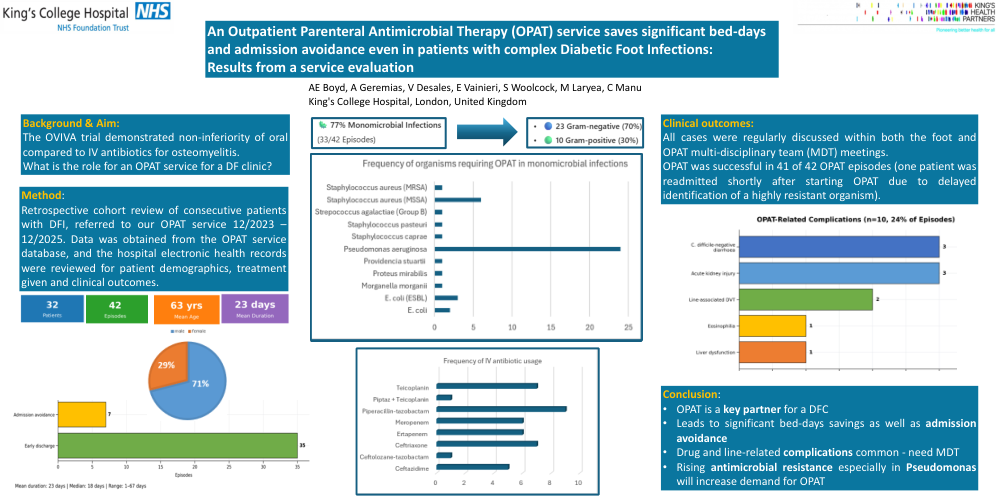
There were 42 OPAT episodes by 32 patients (mean age 63 years, 71% male), with six patients having more than one episode over the two years.
Patients received OPAT for a mean duration of 23 days (range 1-67, median 18).
35 episodes enabled early discharge from hospital and 7 episodes enabled admission-avoidance by initiation of OPAT within the clinic.
A total of 972 hospital bed-days were saved.
Thirty-three of the episodes (77%) were for treatment of a monomicrobial infection; 10 Gram-positive organisms, predominantly Staph aureus (1 MRSA), and 23 Gram-negative infections (17 Pseudomonas aeruginosa and 3 ESBL E-coli). No anaerobe infections were specifically targeted.
Clinical outcomes:
All cases were regularly discussed within both the foot and OPAT multi-disciplinary team (MDT) meetings.
OPAT was successful in 41 of 42 OPAT episodes (one patient was readmitted shortly after starting OPAT due to delayed identification of a highly resistant organism).
Ten episodes (24%) were associated with an OPAT related complication including three C. difficile-negative diarrhoea, three with acute kidney injury, two with line-associated deep-vein thrombosis, one eosinophilia and one liver dysfunction. These were managed without re-admission.
Conclusion:
An OPAT service is a key partner in the successful management of complex DFI, particularly those caused by Pseudomonas. It delivers significant bed-days savings as well as admission avoidance. Drug and line-related complications are common so patients should have close follow-up within an MDT . The demand for OPAT is likely to increase with rising antimicrobial resistance.