99 posters, 2 videos, 5 audios, 13 topics, 7 sessions, 418 authors, 180 institutions
ePostersLive by SciGen Technologies S.A. All rights reserved.
The 21st Meeting of the Diabetic Foot Study Group 2026
24-26 September, 2026 | Florence, Italy

EP68
Prevalence of antibiotic resistance in diabetic foot infections and reassessment of empiric antibiotic therapy protocols
Poster Presenter
Part of Topic
Infection
Prevalence of antibiotic resistance in diabetic foot infections and reassessment of empiric antibiotic therapy protocols (Abstract)
Udovichenko Oleg, Gurevich Maxim, Lipman-Arens Shelly2, Maree Elmalek Tarek, Grimblat Mila, Abu Mock Fadi, Modlig Amir, Avrumov Milana, Behrbalk Eyal.
1Orthopedic Division, Hillel Yaffe Medical Center. Hadera, Israel.
2Infectious Diseases Unit, Hillel Yaffe Medical Center. Hadera, Israel.
Background:
Antibiotic (AB) resistance of causative pathogens in diabetic foot infections (DFI) is well known problem that needs constant monitoring.
Methods:
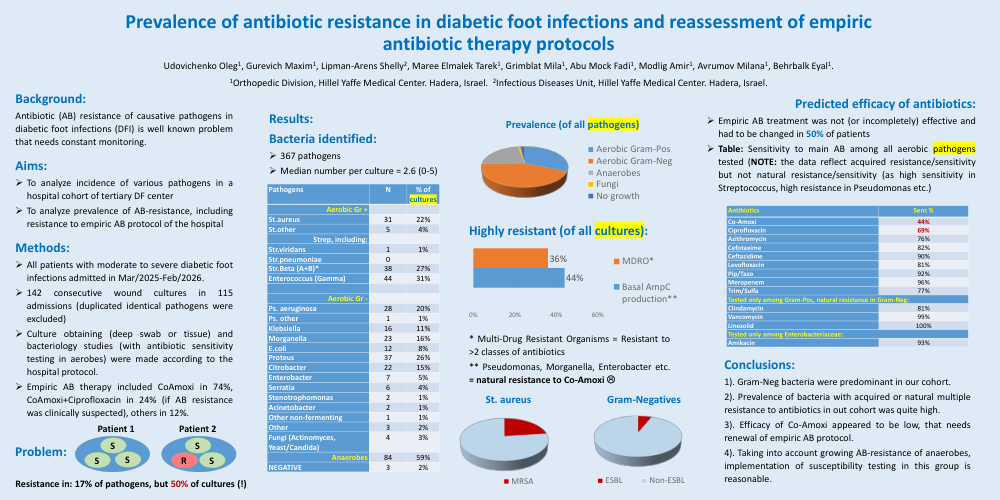
We analyzed 142 consecutive wound cultures in 115 admissions with moderate to severe diabetic foot infections in tertiary DF center in Mar/2025-Feb/2026. Culture obtaining (deep swab or tissue) and bacteriology studies (with antibiotic sensitivity testing in aerobes) were made according to the hospital protocol. Empiric AB therapy included Amoxicillin/clavulanate (CoAmoxi) in 74%, CoAmoxi+Ciprofloxacin (if AB resistance was clinically suspected) in 24%, others in 12%.
Results:
367 pathogens were revealed, median 2.6 (0-5) per culture. 32% of pathogens were Aerobic Gram-Pos, 44% - Gram-Neg, 23% - Anaerobes, 1% - Fungi. Negative were 2% of cultures.
Of all patients 36% had Multidrug-Resistant Organisms (MDRO). Species with basal AmpC production (Pseudomonas, Morganella, Enterobacter etc.) – 19% of all pathogens (73/367) and 44% of all patients. MRSA represented 23% of all Staphylococcus aureus, ESBL – 6% of all Gram-Negatives.
Empiric AB therapy was changed/modified upon the culture results in 50% patients (for Co-Amoxi – in 45%, for CoAmoxi+Cipro – in 54%)
Second-line AB (cephalosporines 3rd generation, carbapenems, Pip/Tazo) demonstrated high degree of sensitivity (from 82% in Cefotaxime to 96% in Meropenem, 100% in Linezolid), while Co-Amoxi was effective only against 44% of tested (estimation for all pathogens – 61%), Ciprofloxacin - against 69%.
Susceptibility to Azitromycin was 76%, Levofloxacin – 81%, Trim/Sulfamethoxazole – 77%, Clindamycin (in Staph) - 81%, Vancomycin (in Staph, Strep, Enterococcus) – 99%
Conclusions:
1). Gram-Neg bacteria were predominant in our cohort.
2). Prevalence of bacteria with acquired or natural multiple resistance to antibiotics in our cohort was quite high.
3). Efficacy of Co-Amoxi appeared to be low, that needs renewal of empiric AB protocol.
4). Taking into account growing AB-resistance of anaerobes, implementation of susceptibility testing in this group is reasonable.