99 posters, 2 videos, 5 audios, 13 topics, 7 sessions, 416 authors, 181 institutions
ePostersLive by SciGen Technologies S.A. All rights reserved.
The 21st Meeting of the Diabetic Foot Study Group 2026
24-26 September, 2026 | Florence, Italy

EP09 - Top 10 E-Poster
The relationship between the screening examination of large and small nerve fibers and the risk of diabetes-related foot disease
Poster Presenter
Authors
Alexandra Jirkovska, Jarmila Jirkovska, Vladimira Fejfarova, Magdalena Lejskova, Ivana H?jkov?, Jan Pol?k, Michal Machava, Lenka Barto?ov?, Jana ?T?chov?, Veronika Jansen, Jelena Skibov?
Affiliations
Thomayer University Hospital, Prague, Czech Republic, First Faculty of Medicine and Military University Hospital , Prague, Czech Republic, Institute for Clinical and Experimental Medicine, Prague, Czech Republic,
Part of Topic
Diagnostics
Background and aim: The prerequisite for determining the risk of diabetic foot syndrome (DFS) is the examination of diabetic neuropathy. For its screening, methods focused on assessing large nerve fibres using a 10g monofilament and a 128 Hz tuning fork are especially recommended. Recently, recommendations have also appeared to screen small nerve fibres, which may reveal an earlier stage of diabetic neuropathy. The aim of our study was to compare screening examinations of large and small nerve fibres with the risk levels of DFS in diabetic patients who were consecutively examined at a single workplace over a 12-month period.
Methods: The study included 92 persons, who were consecutively examined for the risk of DFS during 2025, with a mean age of 65 ± 12 years, 63% men, and 78% with Type 2 diabetes. The DFS risk stratification was determined according to the IWGDF Guidelines, just like the examination with 10g monofilaments and a 128 Hz tuning fork. Examination of small nerve fibres was carried out using the NeurotipsTM 40g pressure test – the differentiation of sharpness sensation was considered abnormal if the patient correctly responded to 6 or fewer out of 10 stimulations on the foot.
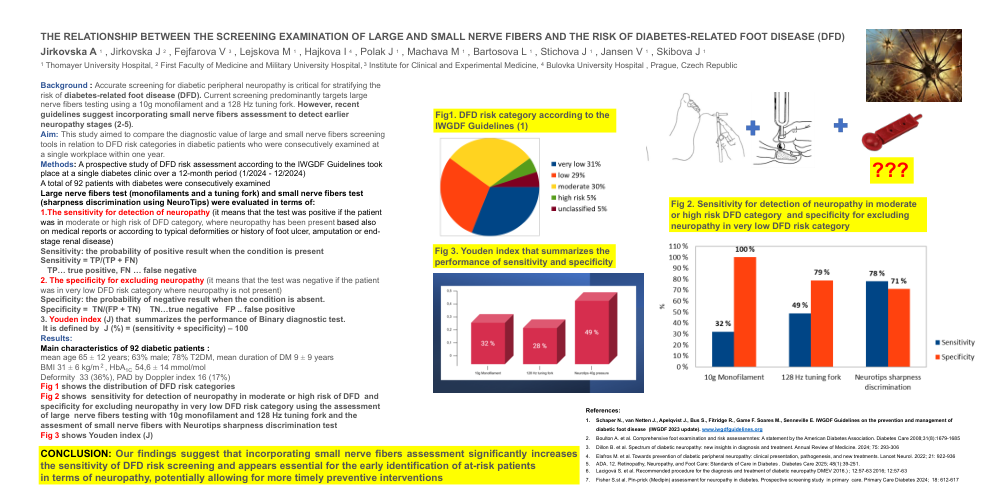
Results: the following percentage occurrence of patients in individual DFS risk categories was determined: 31 % in very low, 29% in low, 30% in moderate, 5% in high, and unclassified in 5%. Sensitivity for diagnosing DFS moderate or high risk was 32% with monofilament testing, 49% with a tuning fork, and 78% using NeurotipsTM. Specificity for diagnosing neuropathy was 100% with a monofilament, 79% with a tuning fork, and 71% using NeurotipsTM.
Conclusion: Examination of small nerve fibres using sharpness sensation appears, based on the results of our study, to be very useful for diagnosing diabetic neuropathy and determining DFS risk.