250 posters, 68 videos, 55 audios, 5 topics, 3 sessions, 367 authors, 223 institutions
ePostersLive by SciGen Technologies S.A. All rights reserved.
6th Commonwealth Chemistry Posters
United Kingdom | 1 - 2 October 2025

P10
Cellulose-Derived Adsorbent for Effective Chromium and Iron Ion Removal from Water: Preparation, Characterization, and Performance Assessment
Poster Presenter
Part of Topic
Clean Water and Sanitation (SDG 6)
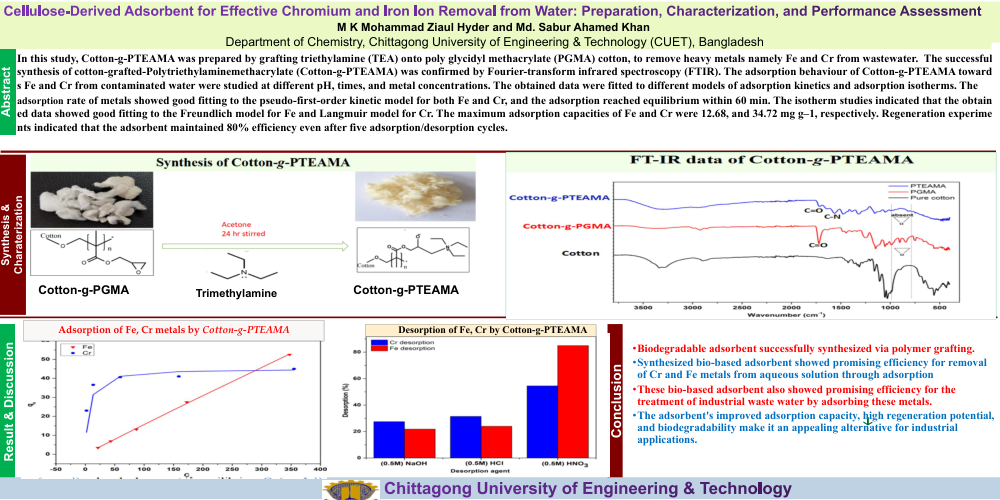
Heavy metal containing industrial effluents represent a substantial hazard to the environment and human health. Heavy metal removal from wastewater is critical for mitigating its negative consequences. In this study, poly triethylamine-methacrylate (Cotton-g-PTEAMA) was prepared by grafting triethylamine (TEA) onto poly glycidyl methacrylate (PGMA) cotton, to remove heavy metals namely Fe and Cr from industrial effluent using pure cotton as the base material. The successful synthesis of cotton-grafted-Polytriethylaminemethacrylate (Cotton-g-PTEAMA) was confirmed by Fourier-transform infrared spectroscopy (FTIR). The adsorption behaviour of Cotton-g-PTEAMA towards Fe and Cr from contaminated water were studied at different pH, times, and metal concentrations. The obtained data were fitted to different models of adsorption kinetics and adsorption isotherms. The adsorption rate of metals showed good fitting to the pseudo-first-order kinetic model for both Fe and Cr, and the adsorption reached equilibrium within 60 min. The isotherm studies indicated that the obtained data showed good fitting to the Freundlich model for Fe and Langmuir model for Cr. The maximum adsorption capacities of Fe and Cr were 12.68, and 34.72 mg g–1, respectively. Regeneration experiments indicated that the adsorbent maintained 80% efficiency even after five adsorption/desorption cycles. The adsorbent was effectively utilized to remove Fe and Cr from samples of industrial effluent. By utilizing biodegradable materials, this study contributes to resolving environmental problems connected with heavy metal pollution in industrial effluents. The findings may have consequences for long-term wastewater treatment practices, encouraging healthier water resources, and protecting human health. Additional research is needed to optimize the synthesis process parameters and evaluate the long-term performance and reusability of the produced metal adsorbent.