250 posters, 68 videos, 55 audios, 5 topics, 3 sessions, 367 authors, 223 institutions
ePostersLive by SciGen Technologies S.A. All rights reserved.
6th Commonwealth Chemistry Posters
United Kingdom | 1 - 2 October 2025

P05
Quantitative Health Risk Assessment of Heavy Metal Contamination in Groundwater Proximal to Metal Recycling Facilities in Nigeria
Poster Presenter
Authors
Affiliations
Part of Topic
Clean Water and Sanitation (SDG 6)
Video
Presentation
Quantitative Health Risk Assessment of Heavy Metal Contamination in Groundwater Proximal to Metal Recycling Facilities in Nigeria
Groundwater is a vital drinking water source in Nigeria, but industrial and recycling activities are raising concerns about heavy metal contamination (Owamah, 2013).
Heavy metals (Pb, Cd, Cr, Fe, Zn) are non-biodegradable, persist in water systems, and cause severe health effects including neurotoxicity, kidney damage, and cancer (Jaishankar et al., 2014; WHO, 2017).
In Nigeria, metal recycling plants often lack safeguards, leading to leaching of Pb and Cd into soils and aquifers (Ilemobayo & Kolade, 2008; USEPA, 1989).
Few studies have assessed groundwater health risks near metal recycling facilities.
Research Aims
This study aims to evaluate the health risks of heavy metals in groundwater proximal to Metal Recycling Facilities in Nigeria. using WHO standards, aiming to guide policy, monitoring, and public health interventions.
The concentrations of selected heavy metals in the water samples were determined using Atomic Absorption Spectrophotometry (AAS) for precise quantification.
Conclusion
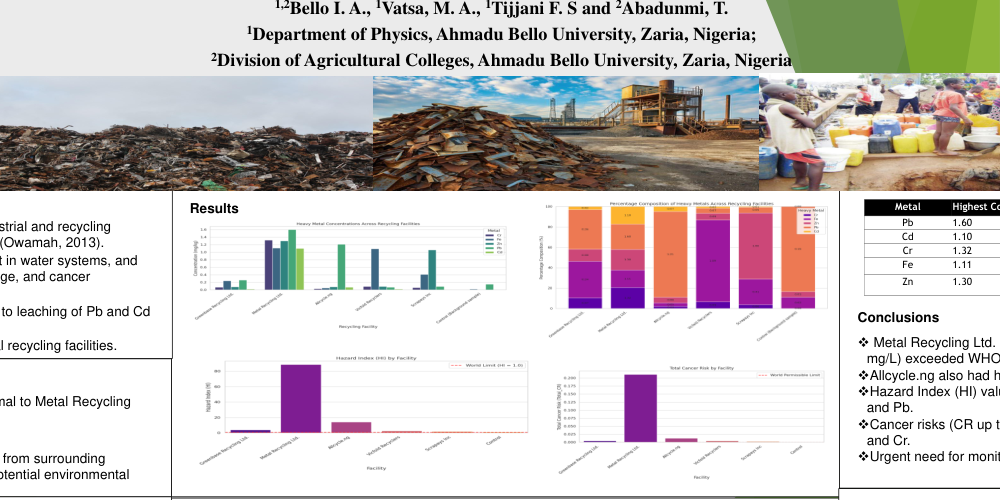
Metal Recycling Ltd. showed the highest overall contamination; Pb (1.60 mg/L) & Cd (1.10 mg/L) exceeded WHO limits (0.01 & 0.003 mg/L) by wide margins.
Allcycle.ng also had high Pb (1.21 mg/L) exceeded WHO limits (0.01)
Hazard Index (HI) values (1.226–88.659) indicated severe non-cancer risks, mainly from Cd and Pb.
Cancer risks (CR up to 0.21096) far above safe range (1×10⁻⁶–1×10⁻⁴), dominated by Cd and Cr.
Urgent need for monitoring, community health action, and stricter environmental regulation.