250 posters, 68 videos, 55 audios, 5 topics, 3 sessions, 367 authors, 223 institutions
ePostersLive by SciGen Technologies S.A. All rights reserved.
6th Commonwealth Chemistry Posters
United Kingdom | 1 - 2 October 2025

P02
Application Of Zirconium-EDTA Mixed Ligand Complexes For Anion Removal: A Theoretical Evaluation
Poster Presenter
Part of Topic
Clean Water and Sanitation (SDG 6)
Video
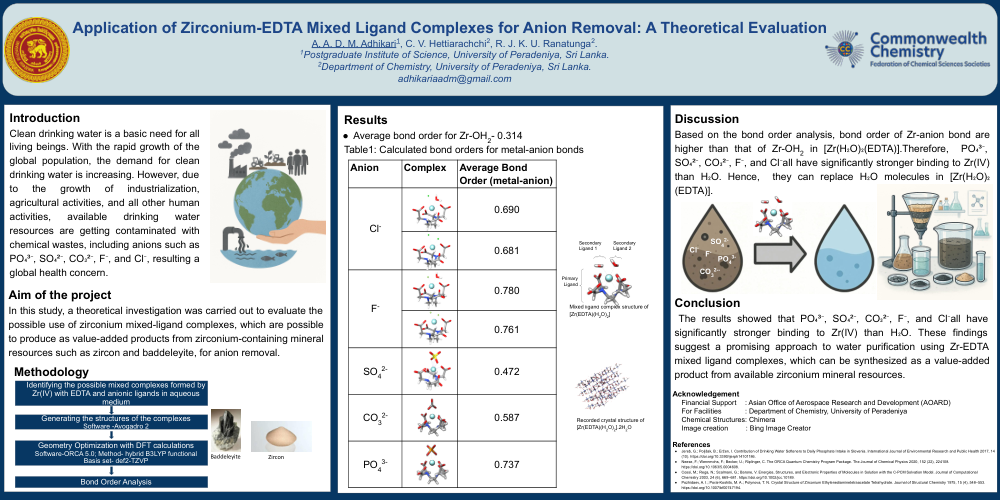
Clean drinking water is a basic need for all living beings. With the rapid growth of the global population, demand for clean drinking water is increasing. However, due to the growth of industrialization, agricultural activities, and all other human activities, available drinking water resources are getting contaminated with chemical wastes, including anions such as PO₄³⁻, SO₄²⁻, CO₃²⁻, F⁻, and Cl⁻, resulting a global health concern. In this study, a theoretical investigation was carried out to evaluate the possible use of zirconium mixed-ligand complexes, possible to produce as value-added products from zirconium-containing mineral resources such as zircon and baddeleyite available, for anion removal. The focus was on zirconium(IV) complexes containing ethylenediaminetetraacetic acid (EDTA) as one ligand. Zr(IV) can form an eight-coordinate mixed-ligand complex with EDTA and two water molecules, [Zr(H₂O)₂(EDTA)]. If contaminant anions exhibit a higher binding affinity towards Zr(IV) than that of water, they can replace H₂O molecules in [Zr(H₂O)₂(EDTA)]. Here, Density Functional Theory (DFT) calculations were carried out for all possible EDTA mixed ligand complexes formed with PO₄³⁻, SO₄²⁻, CO₃²⁻, F⁻, and Cl⁻, with ORCA 5.0.4, using the hybrid B3LYP functional, and def2-TZVP basis set with CPCM solvation model, to determine the binding affinities of the target anions toward Zr(IV) in the complex. The results showed that PO₄³⁻, SO₄²⁻, CO₃²⁻, F⁻, and Cl⁻all have significantly stronger binding to Zr(IV) than H₂O. These findings suggest a promising approach to water purification using Zr-EDTA mixed ligand complexes, which can be synthesized as a value-added product from available zirconium mineral resources.