250 posters, 68 videos, 55 audios, 5 topics, 3 sessions, 367 authors, 223 institutions
ePostersLive by SciGen Technologies S.A. All rights reserved.
6th Commonwealth Chemistry Posters
United Kingdom | 1 - 2 October 2025

P88
Design and synthesis of oxadiazole and indole-based allosteric cyclin dependent kinase 2 inhibitor for non-toxic ovarian cancer chemotherapy
Poster Presenter
Authors
Affiliations
Part of Topic
Good Health and Wellbeing (SDG 3)
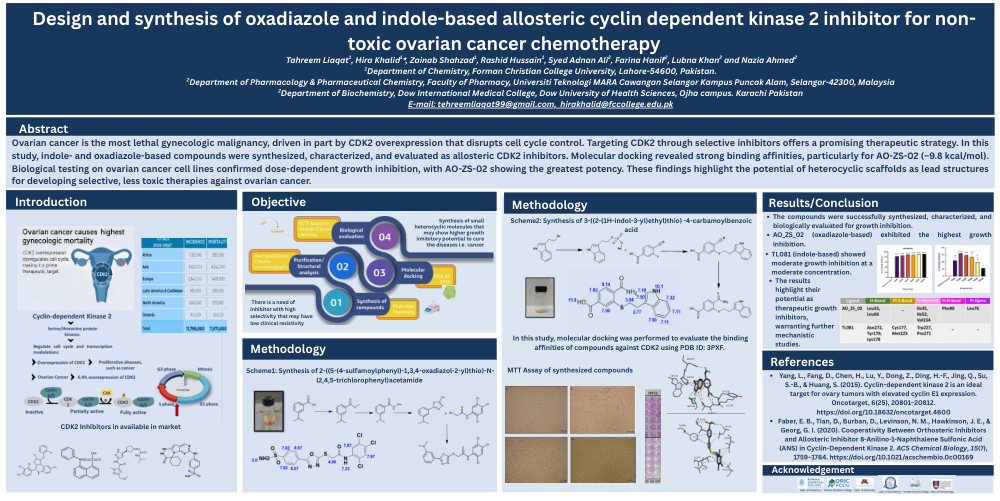
Ovarian cancer is the most lethal gynecologic malignancy, driven in part by CDK2 overexpression that disrupts cell cycle control. Targeting CDK2 through selective inhibitors offers a promising therapeutic strategy. In this study, indole- and oxadiazole-based compounds were synthesized, characterized, and evaluated as allosteric CDK2 inhibitors. Molecular docking revealed strong binding affinities, particularly for AO-ZS-02 (–9.8 kcal/mol). Biological testing on ovarian cancer cell lines confirmed dose-dependent growth inhibition, with AO-ZS-02 showing the greatest potency. These findings highlight the potential of heterocyclic scaffolds as lead structures for developing selective, less toxic therapies against ovarian cancer.
References
- Yang, L., Fang, D., Chen, H., Lu, Y., Dong, Z., Ding, H.-F., Jing, Q., Su, S.-B., & Huang, S. (2015). Cyclin-dependent kinase 2 is an ideal target for ovary tumors with elevated cyclin E1 expression. Oncotarget, 6(25), 20801–20812. https://doi.org/10.18632/oncotarget.4600
- Faber, E. B., Tian, D., Burban, D., Levinson, N. M., Hawkinson, J. E., & Georg, G. I. (2020). Cooperativity Between Orthosteric Inhibitors and Allosteric Inhibitor 8-Anilino-1-Naphthalene Sulfonic Acid (ANS) in Cyclin-Dependent Kinase 2. ACS Chemical Biology, 15(7), 1759–1764. https://doi.org/10.1021/acschembio.0c00169
Abstract
Ovarian cancer is the most lethal gynecologic malignancy, driven in part by CDK2 overexpression that disrupts cell cycle control. Targeting CDK2 through selective inhibitors offers a promising therapeutic strategy. In this study, indole- and oxadiazole-based compounds were synthesized, characterized, and evaluated as allosteric CDK2 inhibitors. Molecular docking revealed strong binding affinities, particularly for AO-ZS-02 (–9.8 kcal/mol). Biological testing on ovarian cancer cell lines confirmed dose-dependent growth inhibition, with AO-ZS-02 showing the greatest potency. These findings highlight the potential of heterocyclic scaffolds as lead structures for developing selective, less toxic therapies against ovarian cancer.
CDK2 Inhibitors in available in market
Introduction
Design and synthesis of oxadiazole and indole-based allosteric cyclin dependent kinase 2 inhibitor for non-toxic ovarian cancer chemotherapy
Tahreem Liaqat1, Hira Khalid1*, Zainab Shahzad1, Rashid Hussain1, Syed Adnan Ali2, Farina Hanif2, Lubna Khan2 and Nazia Ahmed2
1Department of Chemistry, Forman Christian College University, Lahore-54600, Pakistan.
2Department of Pharmacology & Pharmaceutical Chemistry, Faculty of Pharmacy, Universiti Teknologi MARA Cawangan Selangor Kampus Puncak Alam, Selangor-42300, Malaysia
2Department of Biochemistry, Dow International Medical College, Dow University of Health Sciences, Ojha campus. Karachi Pakistan
E-mail: tehreemliaqat99@gmail.com, hirakhalid@fccollege.edu.pk
Objective
Synthesis of small heterocyclic molecules that may show higher growth inhibitory potential to cure the diseases i.e. cancer
There is a need of inhibitor with high selectivity that may have low clinical resistivity
Methodology
Scheme1: Synthesis of 2-((5-(4-sulfamoylphenyl)-1,3,4-oxadiazol-2-yl)thio)-N-(2,4,5-trichlorophenyl)acetamide
Scheme2: Synthesis of 3-((2-(1H-indol-3-yl)ethyl)thio) -4-carbamoylbenzoic acid
Methodology
In this study, molecular docking was performed to evaluate the binding affinities of compounds against CDK2 using PDB ID: 3PXF.
PHE80
LEU66
LEU55
ILE52
ILE35
VAL154
LEU76
TYR179
LYS178
CYS177
ASN272
PRO271
TRP227
MET233
MTT Assay of synthesized compounds
Results/Conclusion
References
- TL081 (indole-based) showed moderate growth inhibition at a moderate concentration.
- The compounds were successfully synthesized, characterized, and biologically evaluated for growth inhibition.
- AO_ZS_02 (oxadiazole-based) exhibited the highest growth inhibition.
- The results highlight their potential as therapeutic growth inhibitors, warranting further mechanistic studies.
Acknowledgement