250 posters, 68 videos, 55 audios, 5 topics, 3 sessions, 367 authors, 223 institutions
ePostersLive by SciGen Technologies S.A. All rights reserved.
6th Commonwealth Chemistry Posters
United Kingdom | 1 - 2 October 2025

P102
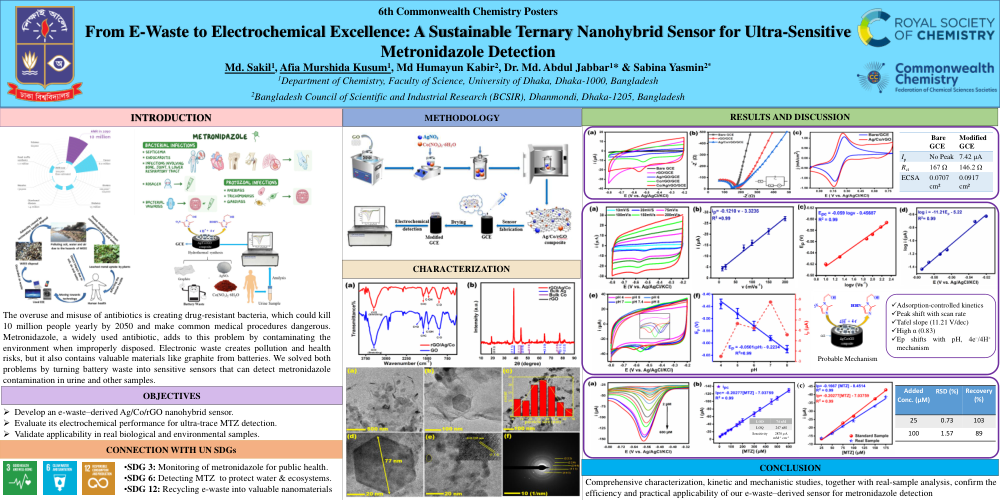
From E-Waste to Electrochemical Excellence: A Sustainable Ternary Nanohybrid Sensor for Ultra-Sensitive Metronidazole Detection
Poster Presenter
Authors
Affiliations
Part of Topic
Good Health and Wellbeing (SDG 3)
Video
Title: From E-Waste to Electrochemical Excellence: A Sustainable Ternary Nanohybrid Sensor for Ultra-Sensitive Metronidazole Detection
Md. Sakil1, AfiaMurshida Kusum1, Md Humayun Kabir2, Dr. Md. Abdul Jabbar1* & Sabina Yasmin2*
1Department of Chemistry, Faculty of Science, University of Dhaka, Dhaka-1000, Bangladesh
2Bangladesh Council of Scientific and Industrial Research (BCSIR), Dhanmondi, Dhaka-1205, Bangladesh
Introduction:
The overuse and misuse of antibiotics is creating drug-resistant bacteria, which could kill 10 million people yearly by 2050 and make common medical procedures dangerous. Metronidazole, a widely used antibiotic, adds to this problem by contaminating the environment when improperly disposed. Electronic waste creates pollution and health risks, but it also contains valuable materials like graphite from batteries. We solved both problems by turning battery waste into sensitive sensors that can detect metronidazole contamination in urine and other samples.
Objectives:
CONNECTION WITH UN SDGs:
In summary, a hexagonal Ag/Co bimetallic nanoparticle–anchored reduced graphene oxide (Ag/Co/rGO) nanocomposite has been successfully fabricated through a sustainable synthesis route using e-waste as the carbon source. The proposed sensor exhibited outstanding electrocatalytic activity toward the reduction of metronidazole, delivering a low detection limit (74 nM), a wide linear range (2–600 µM), and excellent sensitivity (2870 µAmM⁻¹cm⁻²). Moreover, the Ag/Co/rGO-modified electrode demonstrated superior stability, reproducibility (RSD < 2%), and selectivity against common interferents. The sensor was further validated in human urine samples, achieving recovery rates of 88–103%, confirming its practical applicability. This work highlights a promising and eco-friendly electroanalytical platform for pharmaceutical monitoring while simultaneously addressing environmental challenges through the valorization of electronic waste.