250 posters, 68 videos, 55 audios, 5 topics, 3 sessions, 367 authors, 223 institutions
ePostersLive by SciGen Technologies S.A. All rights reserved.
6th Commonwealth Chemistry Posters
United Kingdom | 1 - 2 October 2025

P87
Synergistic Antibacterial and Antibiofilm Activities of 3- and 6-Shogaol Against Staphylococcus aureus
Poster Presenter
Authors
Affiliations
Part of Topic
Good Health and Wellbeing (SDG 3)
Video
Title
Synergistic Antibacterial and Antibiofilm Activities of 3- and 6-Shogaol Against Staphylococcus aureus
Authors List
Ngai Peng Lau1, Shawn Kai Jie Leong1, Yee Ling Yong1, Lu Syeun Lim1, Yun Khoon Liew2, Yoon Yee Then3, Lai Chun Wong3
1School of Pharmacy, IMU University, 57000 Kuala Lumpur, Malaysia
2Department of Life Sciences, School of Pharmacy, IMU University, 57000 Kuala Lumpur, Malaysia
3Department of Pharmaceutical Chemistry, School of Pharmacy, IMU University, 57000 Kuala Lumpur, Malaysia
Background
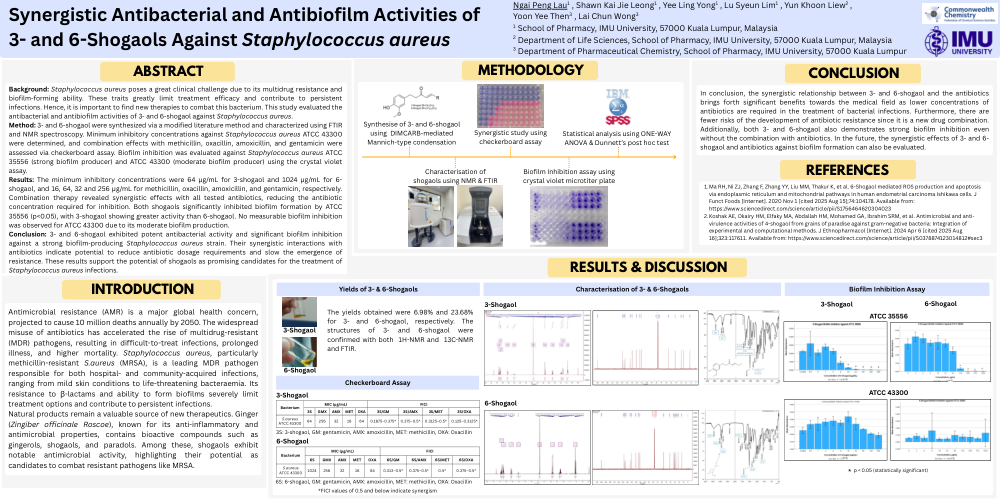
Staphylococcus aureus poses a great clinical challenge due to its multidrug resistance and biofilm-forming ability. These traits greatly limit treatment efficacy and contribute to persistent infections. Hence, it is important to find new therapies to combat this bacterium. This study evaluated the antibacterial and antibiofilm activities of 3- and 6-shogaol against Staphylococcus aureus.
Method
3- and 6-shogaol were synthesized via a modified literature method and characterized using FTIR and NMR spectroscopy. Minimum inhibitory concentrations against Staphylococcus aureus ATCC 43300 were determined, and combination effects with methicillin, oxacillin, amoxicillin, and gentamicin were assessed via checkerboard assay. Biofilm inhibition was evaluated against Staphylococcus aureus ATCC 35556 (strong biofilm producer) and ATCC 43300 (moderate biofilm producer) using the crystal violet assay.
Results
The minimum inhibitory concentrations were 64 μg/mL for 3-shogaol and 1024 μg/mL for 6-shogaol, and 16, 64, 32 and 256 μg/mL for methicillin, oxacillin, amoxicillin, and gentamicin, respectively. Combination therapy revealed synergistic effects with all tested antibiotics, reducing the antibiotic concentration required for inhibition. Both shogaols significantly inhibited biofilm formation by ATCC 35556 (P<0.05), with 3-shogaol showing greater activity than 6-shogaol. No measurable biofilm inhibition was observed for ATCC 43300 due to its moderate biofilm production.
Conclusion
3- and 6-shogaol exhibited potent antibacterial activity and significant biofilm inhibition against a strong biofilm-producing Staphylococcus aureus strain. Their synergistic interactions with antibiotics indicate potential to reduce antibiotic dosage requirements and slow the emergence of resistance. These results support the potential of shogaols as promising candidates for the treatment of Staphylococcus aureus infections.