250 posters, 68 videos, 55 audios, 5 topics, 3 sessions, 367 authors, 223 institutions
ePostersLive by SciGen Technologies S.A. All rights reserved.
6th Commonwealth Chemistry Posters
United Kingdom | 1 - 2 October 2025

P85
In silico and in vitro investigation of the molecular mechanisms of antiviral compounds for potentially inhibiting dengue virus NS2B-NS3 protease
Poster Presenter
Authors
Affiliations
Part of Topic
Good Health and Wellbeing (SDG 3)
Video
Audio
In silico and In vitro Investigation of the Molecular Mechanisms of Antiviral Compounds for Potentially Inhibiting Dengue Virus NS2B-NS3 Protease
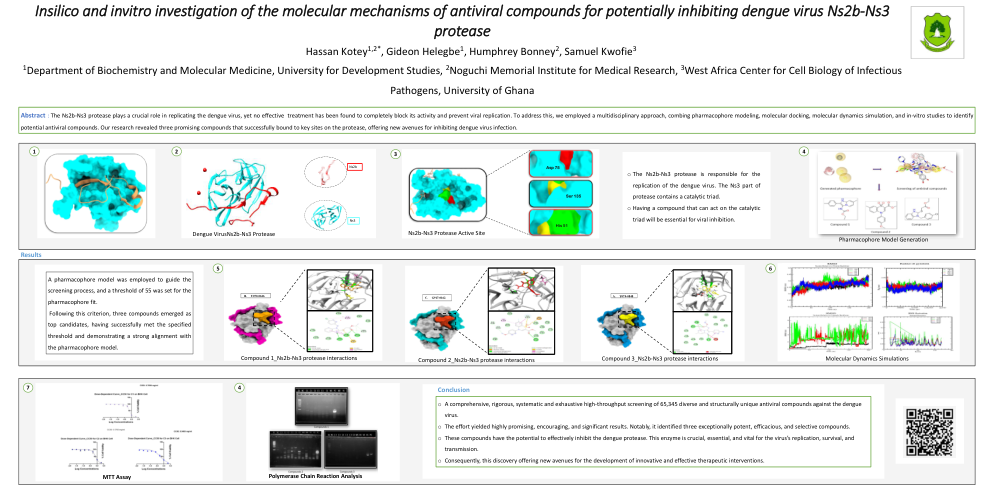
The escalating global health threat posed by dengue virus necessitates a concerted effort to discover novel therapeutic agents. This study employed a synergistic approach, integrating in silico and in vitro methodologies, to identify promising synthetic antiviral compounds targeting the DENV NS2B-NS3 protease. A pharmacophore model was generated using six known inhibitors and used to screen 64,958 synthetic compounds. Through this process, 25 compounds with high pharmacophore fit scores were selected for molecular docking analysis, revealing three potential hit molecules: Y070-0848, Y070-0626, and G917-0162.These compounds demonstrated robust binding affinities and predicted pharmacological profiles. Molecular dynamics simulation further elucidated the critical role of residues Asp75, Ser135, and His51 in ligand binding. The in vitro evaluation of the three lead compounds revealed that Y070-0848 exhibited the most potent inhibitory activity, followed by Y070-0626 and G917-0162, as evidenced by PCR analysis. The findings suggest that these synthetic antiviral compounds hold promise as potential therapeutic agents against dengue virus infection, warranting further optimization and development. The study showcases the efficacy of combining in silico and in vitro approaches in identifying novel antiviral compounds targeting the DENV NS2B-NS3 protease. By leveraging computational and experimental methodologies, this research paves the way for the discovery of innovative therapeutic solutions to combat this significant global health threat. Further research and development are necessary to fully realize the potential of these compounds as effective treatments against dengue virus