250 posters, 68 videos, 55 audios, 5 topics, 3 sessions, 367 authors, 223 institutions
ePostersLive by SciGen Technologies S.A. All rights reserved.
6th Commonwealth Chemistry Posters
United Kingdom | 1 - 2 October 2025

P80
Urea Intercalated Kaolinite : A Sustainable Pathway for Formaldehyde Mitigation
Poster Presenter
Authors
Affiliations
Part of Topic
Good Health and Wellbeing (SDG 3)
Video
Urea intercalated kaolinite: a Sustainable Pathway for Formaldehyde Mitigation.
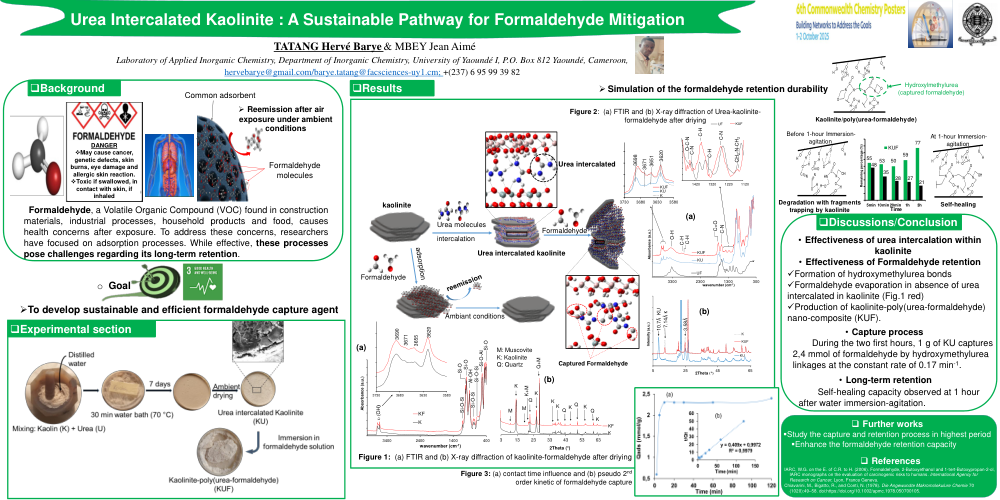
Formaldehyde, a Volatile Organic Compound (VOC) found in construction materials, industrial processes, household products and food, causes health concerns (cancer, genetic defects, skin burns, eye damage and allergic skin reaction) after exposure. To address these concerns, researchers have focused on adsorption processes. While effective for removal,these processes pose challenges regarding its long-term retention.
Goal : To develop sustainable and efficient formaldehyde capture agent.
Experimental methodology to synthetise urea intercalated kaolinite :
Kaolin and urea were mixed in presence of distilled water following by water bath. After 7 days of rest, the slurry was air-dried (cracks filled by urea are formed after drying). After immersion in formaldehyde solutions, the compound becomes more compact due to the presence of poly(urea-formaldehyde).
Results show kaolinite as the major clay mineral in the clay and after urea intercalation a shift of the kaolinite peak to 10.7 A is observed according to a monolayer insersion of urea molecules in the interfoliar space of kaolinite. After immersion in formaldehyde solution, hydroxylmethylurea bonds are observed clearly indicated the effectiveness of the formaldehyde capture process. In absence of urea intercalation, kaolinite well adsorbes formaldehyde molecules but after exposure, a reemission occurs as shown by the absence of formaldehyde bonds in FTIR spectra. The study of the capture process well indicated that the capture kinetic well obey to the pseudo second order and that, after the first 2 hours, 1g of urea intercalated kaolinite captures 2.4 mmol of formaldehyde during hydroxymethylation. The simulation of the durability of the formaldehyde rentention by water immersion-agitation in varying times shown that: before 1 hours the hydroxylmethylurea bonds are broken and trapped by kaolinite layers. After this time, a recombinaison of the trapped fragments lead to seft-healing capacity which is of interest for Formaldehyde retention processes.
For further works, it will question to : study the capture and retention process in highest period and enhance the formaldehyde rentention capacity of this material.