250 posters, 68 videos, 55 audios, 5 topics, 3 sessions, 367 authors, 223 institutions
ePostersLive by SciGen Technologies S.A. All rights reserved.
6th Commonwealth Chemistry Posters
United Kingdom | 1 - 2 October 2025

P70
Toxic or Not? ProTox‑3.0 Prediction of Dioscorine & Diosgenin in Dioscorea hispida
Poster Presenter
Part of Topic
Good Health and Wellbeing (SDG 3)
Video
Audio
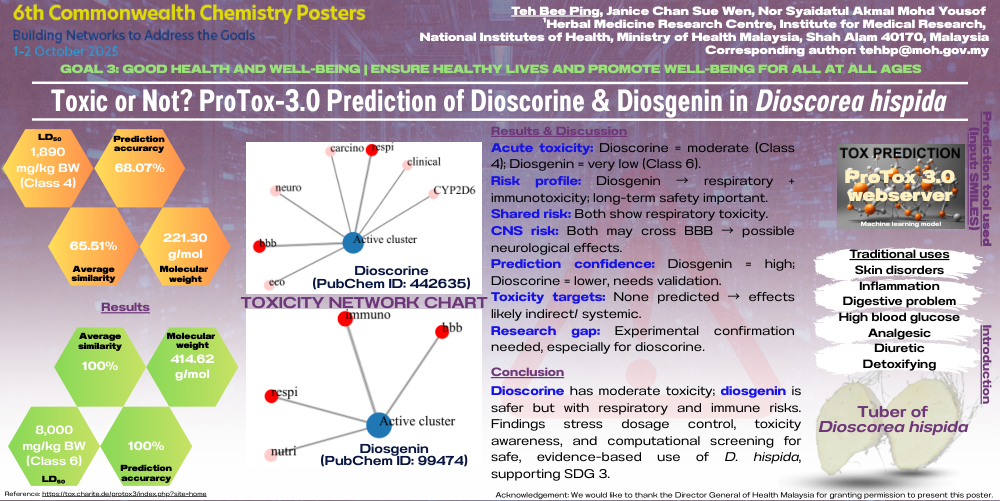
Dioscorea hispida (‘ubi gadong’) is a wild yam traditionally consumed and used in folk medicine. It contains key compounds such as dioscorine and diosgenin. Diosgenin has therapeutic potential, whereas dioscorine is linked to neurotoxicity. To evaluate the toxicity profiles of these compounds, we used ProTox-3.0, an in silico toxicity prediction platform. Both compounds were assessed for acute toxicity (LD₅₀), organ toxicity, specific endpoints, adverse outcome pathways, off-target effects, and metabolic toxicity. The predictions revealed a distinct variation in toxicity profiles. Dioscorine was classified as toxicity class 4 (LD₅₀: 1,890 mg/kg), while diosgenin was class 6 (LD₅₀: 8,000 mg/kg). No binding to human proteins associated with toxicity was predicted for either compound. In ProTox-3.0, a probability score above 0.70 is considered high, indicating strong model confidence based on robust training data and high correlation with experimentally validated outcomes. Dioscorine had seven active toxicity endpoints, with respiratory toxicity and blood-brain barrier (BBB) permeability exceeding this threshold. Diosgenin had four active toxicity endpoints, with three endpoints (respiratory toxicity, immunotoxicity, and BBB permeability) showing high probability scores. Findings can be visualised using toxicity maps and radar charts. Compared to other tools, ProTox-3.0 offers several strengths, including a comprehensive endpoint library, multi-model integration, and clear visual outputs, although limitations include dataset coverage and possible mispredictions for rare toxicity mechanisms. These results align with the literature, emphasising the need to process D. hispida to manage dioscorine content and exploring diosgenin as a promising bioactive compound.
Keywords: Dioscorea hispida; ubi gadong; dioscorine; diosgenin; ProTox; toxicity prediction