250 posters, 68 videos, 55 audios, 5 topics, 3 sessions, 367 authors, 223 institutions
ePostersLive by SciGen Technologies S.A. All rights reserved.
6th Commonwealth Chemistry Posters
United Kingdom | 1 - 2 October 2025

P63
Antimalarial Potential of Salacia debilis: Isolation and Preliminary Characterization of Bioactive Stem Bark Constituents
Poster Presenter
Authors
Affiliations
Part of Topic
Good Health and Wellbeing (SDG 3)
Video
Audio
-
Background
Malaria continue to claim vulnerable lives in the hundreds of thousands every year in the world’s poorest regions. Medicinal plants in Ghana and most West African countries are employed in folklore medicine for the treatment of various ailment including malaria. Salacia debilis is a local West African medicinal plant, long recognized in folklore medicine for its role in managing malaria. This study seeks to isolate and evaluate additional compounds from the ethanolic extract of S. debilis for their antiplasmodial properties.
Methods
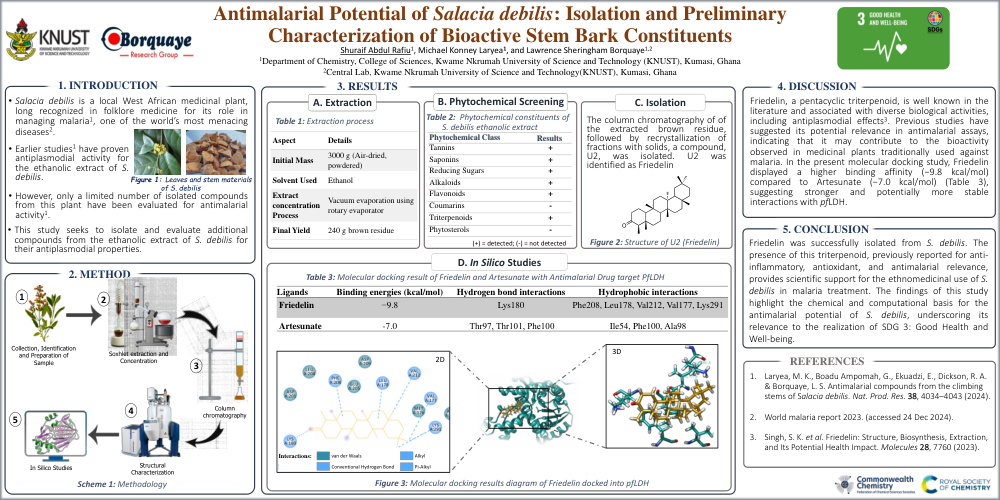
Extraction was performed using a Soxhlet apparatus with methanol as the solvent, followed by phytochemical screening conducted according to standard protocols. Column chromatography was employed to isolate compounds from the extract, and molecular docking studies of the isolated compound against P. falciparum lactate dehydrogenase (pfLDH) completed the investigation.
Results
Isolation and Identification
From the ethanolic extract of Salacia debilis, Friedelin, a pentacyclic triterpenoid, was successfully isolated and identified through chromatographic separation and spectroscopic analysis.In Silico Evaluation
Molecular docking studies revealed that Friedelinol displayed a higher binding affinity (−9.8 kcal/mol) towards P. falciparum lactate dehydrogenase (pfLDH) compared to Artesunate (−7.0 kcal/mol), suggesting stronger and potentially more stable interactions with the enzyme.Discussion
Friedelin, a pentacyclic triterpenoid, is well known in the literature and associated with diverse biological activities, including antiplasmodial effects3. Previous studies have suggested its potential relevance in in vitro antimalarial assays, indicating that it may contribute to the bioactivity observed in medicinal plants traditionally used against malaria. In the present molecular docking study, Friedelin displayed a higher binding affinity (−9.8 kcal/mol) compared to Artesunate (−7.0 kcal/mol) (Table 3), suggesting stronger and potentially more stable interactions with pfLDH.
Conclusion
Friedelin was successfully isolated from S. debilis. The presence of this triterpenoid, previously reported for anti-inflammatory, antioxidant, and antimalarial relevance, provides scientific support for the ethnomedicinal use of S. debilis in malaria treatment. The findings of this study highlight the chemical and computational basis for the antimalarial potential of S. debilis, underscoring its relevance to the realization of SDG 3: Good Health and Well-being.