250 posters, 68 videos, 55 audios, 5 topics, 3 sessions, 367 authors, 223 institutions
ePostersLive by SciGen Technologies S.A. All rights reserved.
6th Commonwealth Chemistry Posters
United Kingdom | 1 - 2 October 2025

P07
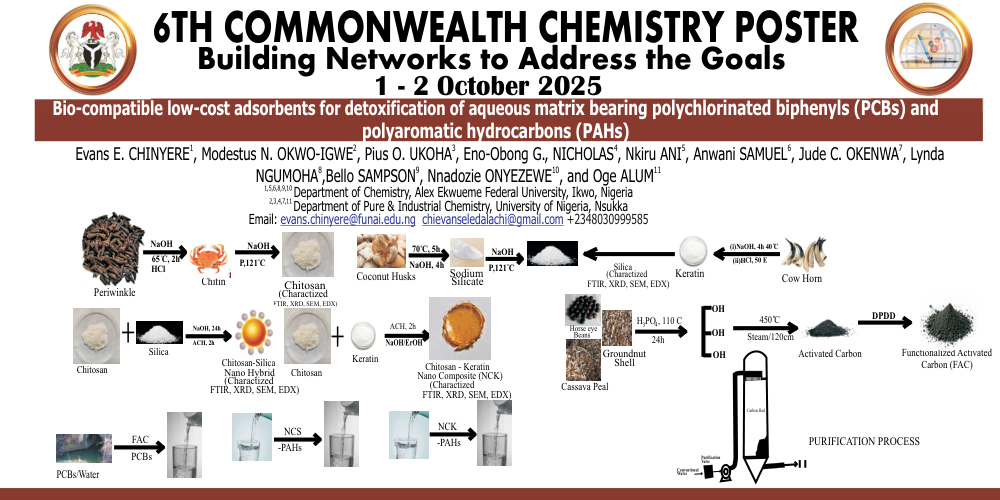
Bio-compatible low-cost adsorbents for detoxification of aqueous matrix bearing polychlorinated biphenyls (PCBs) and polyaromatic hydrocarbons (PAHs)
Poster Presenter
Authors
Evans Eledalachi CHINYERE, Modestus Ndubuisi OKWO-IGWE, Pius Oziri UKOHA, Eno-Obong G. NICHOLAS, Nkiru ANI, Anwani SAMUEL, Lynda NGUMOHA, Bello SAMPSON, Nnadozie ONYEZEWE, , Jude Chukwudi OKENWA, Oge Lilian ALUM
Affiliations
Alex Ekwueme Federal University, Ndufu-Alike, Ikwo, Department of Chemistry, Alex Ekwueme Federal University, Ndufu-Alike, Ikwo, Nigeria, Department of Pure & Industrial Chemistry, University of Nigeria, Nsukka, Institute of Management and Technology, Enugu, Nigeria
Part of Topic
Clean Water and Sanitation (SDG 6)
Audio
Bio-compatible low-cost adsorbents for detoxification of aqueous matrix bearing polychlorinated biphenyls (PCBs) and polyaromatic hydrocarbons (PAHs)
Evans E. CHINYERE1, Modestus N. OKWO-IGWE2, Pius O. UKOHA3, Eno-Obong G. NICHOLAS4, Nkiru ANI5, Anwani SAMUEL6, Jude C. OKENWA7, Lynda NGUMOHA8,Bello SAMPSON9, Nnadozie ONYEZEWE10, and Oge ALUM11
1,5,6,8,9,10 Department of Chemistry, Alex Ekwueme Federal University, Ikwo, Nigeria
2,3,4,7,11 Department of Pure & Industrial Chemistry, University of Nigeria, Nsukka
Email: evans.chinyere@funai.edu.ng chievanseledalachi@gmail.com +2348030999585
ABSTRACT
Two set of adsorbents were prepared: chitosan-silica nano-composite and 4-aminoantipyrine-based functionalized activated carbons. Chitosan was obtained by removal of acetyl groups from chitin using NaOH according to a previously described procedure. Silica was extracted by the placement of coconut husks pieces (100 g) in a silica crucible and heated in muffle furnace for 5 h at 700 oC to obtain coconut husk ash (CHA) which was processed and chemically treated to recover silica nanoparticles. The Silica (1g) was then added to a solution of chitosan (2g) in 100 cm3 acetic acid (2%) and magnetically stirred for 1 h to obtain chitosan-silica nano-composite. It was characterized by FTIR, XRD, SEM/EDX and was found to achieve between 90 and 93% PAHs removal at acidic pH and up to 85.74 % removal of PAHs with increasing dosage. 4-aminoantipyrine based ligand was synthesized by coupling diazotized 1-phenyl-2,3-dimethyl-4-aminopyrazole-5-one and 1H-indole-2,3-dione. It was characterized via ultraviolet visible (UV-vis), infrared (IR) and nuclear magnetic resonance (NMR) spectroscopic techniques. Activated carbons (ACs) were obtained at 250, 350, 400 and 450 oC respectively from phosphoric acid treated samples of the shell of Achatina achatina, egg shell of Gallus gallus, seed shell of Afzelia Africana SM, husk of Arachis hypogaea L, peel of Musa paradisca L, cob of Zea mays L, seed shell of Mucuna urense and peel of Manihot esculentum. The ACs and FACs were characterized using FTIR, SEM/EDX techniques. Twenty two samples of ACs were produced from the agro-based materials at 250, 350, 400 and 450 oC respectively. Twenty two FACs were further obtained after modifications. SEM micrographs of the FACs showed surface corrugation. EDX analysis gave 100, 86.69 and 68.29 % carbon for FACs obtained at 450 oC with the seed shell of Mucuna urense (FACSHMUR45), peel of Manihot esculentum (FACMESC45) and husk of Arachis hypogaea L (FACHGNUT45) respectively. PCBs removal (%) at equilibrium by the adsorbents were in the order 85.35 ± 1.77 > 84.24 ± 2.18 > 77.97 ± 1.59 for FACMESC45, FACHGNUT45 and FACSHMUR45 respectively. Mean (%) PCBs removal was 87.39 ± 1.81, 85.30 ± 1.84, 84.43 ± 3.53, 79.27 ± 2.21 and 76.21 ± 2.16 with 0.6, 0.8, 1.0, 0.4 and 0.2g adsorbent respectively.
Keywords: Adsorbents. Nano-composite. Polychlorinated biphenyls. Polyaromatic hydrocarbons. 4-aminoantipyrine. Isatin. Chitosan. Silica.
References:
Eman, H. A., Nadia, I. A., & Liqaa, A. J. (2017). Extraction of Chitosan from Kentish Snail Exoskeleton Shellʼs, Monacha cantiana (Montagu, 1803) for the Pharmaceutical Application. J. Int. Environmental Application & Science, 12, 2, 125-130
Fan, L., Zhang, Y., Luo, C., Qiu, H., Sun, M. (2012). Synthesis and characterization of magnetic b-cyclodextrin–chitosan nanoparticles as nano-adsorbents for removal of methyl blue. International Journal of Biology and Macromolecules, 50, 444–450.
Farahani, M., & Behbahaninia, A. (2014). Using natural adsorbents to reduce polycyclic aromatic hydrocarbons contamination of oily wastewater. Journal of Biodiversity and Environmental Sciences, 5, 6, 274-281.
Agbo, J. N. and Ukoha, P. O. (2010). Synthesis, characterization and biological activities of some azo ligands and their metal complexes I: 1, 2-dihydroy -1, 5-dimethyl [(E)-(2,3,4-trihydroxyl phenyl)-3H-Pyrazol-3-one (H3L) and its Co (II), Fe (III) and Os(VIII) complexes. Internatinal Journal of Chemistry. 20: 217-225.
Link to eposter:
https://postercors2.s3.amazonaws.com/cwcp2025.006000b.NORMAL.pdf?AWSAccessKeyId=AKIAUZD55IF36XFKYK63&Expires=1758098248&Signature=UtXoiNoTqecgxv0z0eJFnel5kyk%3D