Loading...

250 posters, 68 videos, 55 audios, 5 topics, 3 sessions, 367 authors, 223 institutions

ePostersLive by SciGen Technologies S.A. All rights reserved.

6th Commonwealth Chemistry Posters

United Kingdom | 1 - 2 October 2025

6th Commonwealth Chemistry Posters banner

P19

Pharmaceuticals and personal care products in sediments in Africa: Status, ecological risks, extraction and analytical techniques
Part of Topic

Clean Water and Sanitation (SDG 6)

Video

Pharmaceuticals and personal care products in sediments in Africa: Status, ecological risks, extraction and analytical techniques

Merolyne Natuhweraa Zaccheus Shehub ,Ivan Špánik c , George William Atwoki Nyakairu a, Edward Mubiru a, Florence Nantabaa, Douglas Sifuna d, Patrick Ssebugerea.

 aDepartment of Chemistry, Makerere University, P.O Box 7062, Kampala, Uganda| bDepartment of Chemistry, Gombe State University, P.M.B 127, Gombe, Nigeria| cInstitute of Analytical Chemistry, Faculty of Chemical and Food Technology, Slovak University of Technology in Bratislava, Radlinského 9, 812 37 Bratislava, Slovakia| dDepartment of Physical Sciences, Jaramogi Oginga Odinga University of Science and Technology, Bondo (Main) Campus, P.O Box 210 – 40601, Bondo, Kenya


INTRODUCTION

•Pharmaceuticals and personal care products (PPCPs) produced are dispersed in the environment through many ways e.g., disposals at landfills.
•There is a potential for them being a real problem in aquatic systems.
•The surface sediments have a high capacity to accumulate PPCPs overtime.
•Yet research on this pollution problem is not adequately covered.

The purpose of this study is to highlight the research that has been done and identify gaps that need to be bridged in further research.

MATERIALS AND METHODS

•Using  databases e.g. Google Scholar, ResearchGate, Web of Science, and PubMed, a total of 110 papers (2012–2024) were found.
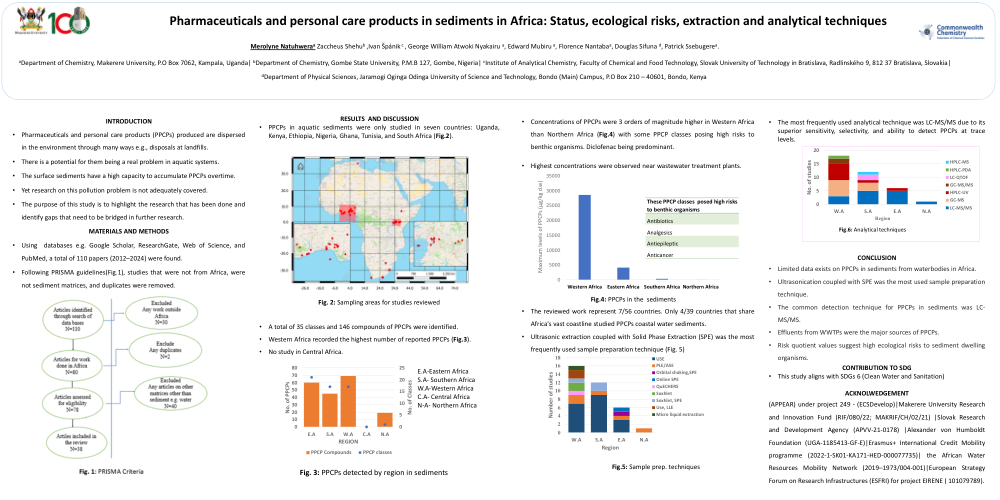
•Following PRISMA guidelines(Fig.1), studies that were not from Africa, were not sediment matrices, and duplicates were removed.

RESULTS  AND DISCUSSION

•PPCPs in aquatic sediments were only studied in seven countries: Uganda, Kenya, Ethiopia, Nigeria, Ghana, Tunisia, and South Africa (Fig.2).
•A total of 35 classes and 146 compounds of PPCPs were identified.
•Western Africa recorded the highest number of reported PPCPs (Fig.3).

No study in Central Africa

•Concentrations of PPCPs were 3 orders of magnitude higher in Western Africa than Northern Africa (Fig.4) with some PPCP classes posing high risks to benthic organisms. Diclofenac being predominant.
•Highest concentrations were observed near wastewater treatment plants.
•The reviewed work represent 7/56 countries. Only 4/39 countries that share Africa's vast coastline studied PPCPs coastal water sediments.
•Ultrasonic extraction coupled with Solid Phase Extraction (SPE) was the most frequently used sample preparation technique (Fig. 5)
•The most frequently used analytical technique was LC-MS/MS due to its superior sensitivity, selectivity, and ability to detect PPCPs at trace levels.
 

CONCLUSION

•Limited data exists on PPCPs in sediments from waterbodies in Africa.
•Ultrasonication coupled with SPE was the most used sample preparation technique.
•The common detection technique for PPCPs in sediments was LC-MS/MS.
•Effluents from WWTPs were the major sources of PPCPs.
•Risk quotient values suggest high ecological risks to sediment dwelling organisms.

CONTRIBUTION TO SDG

•This study aligns with SDGs 6 (Clean Water and Sanitation)
 

ACKNOLWEDGEMENT

(APPEAR) under project 249 - (ECSDevelop)|Makerere University Research and Innovation Fund (RIF/080/22; MAKRIF/CH/02/21) |Slovak Research and Development Agency (APVV-21-0178) |Alexander von Humboldt Foundation (UGA-1185413-GF-E)|Erasmus+ International Credit Mobility programme (2022-1-SK01-KA171-HED-000077735)| the African Water Resources Mobility Network (2019–1973/004-001)|European Strategy Forum on Research Infrastructures (ESFRI) for project EIRENE ( 101079789).

cwcp2025 banner
Copyright © 2015-2026, ePostersLive® SciGen is a registered trademark of SciGen Technologies S.A. Patent pending.

This website and third-party tools we use rely on cookies for the best user experience. By selecting "I agree", you agree to cookie usage as described in our Privacy Policy.