250 posters, 68 videos, 55 audios, 5 topics, 3 sessions, 367 authors, 223 institutions
ePostersLive by SciGen Technologies S.A. All rights reserved.
6th Commonwealth Chemistry Posters
United Kingdom | 1 - 2 October 2025

P43
Optimization and Modeling of Reactive Black 5 Dye Removal Using ZnO-Loaded Pupalia lappacea Adsorbent
Poster Presenter
Authors
Olawale, S. Dabo, Deborah, O. Aderibigbe, Kazeem, K. Salam, Mary, A. Oladipo, Abdur-Rahim Giwa
Affiliations
Ladoke Akintola University of Technology Ogbomoso, Department of Pure and Applied Chemistry, Ladoke Akintola University of Technology Ogbomoso, Department of Chemical Engineering, Ladoke Akintola University of Technology Ogbomoso
Part of Topic
Clean Water and Sanitation (SDG 6)
Introduction
The presence of reactive dyes such as Reactive Black 5 (RB5) have been reported in various environmental mediums such as water, sediments and in fishes. Due to their chemical structure, which comprises of aromatic amines, they also can undergo cleavage to produce toxic by-products (Kamati et al. 2024).
Different methods have been employed for RB5 removal from wastewater and varying degrees of success have been noted with each method. In this study, ZnO-nanoparticles incorporated acid-modified Pupalia lappacea adsorbent composite (Z-APL) was prepared from Pupalia lappacea stalks. Additionally, RSM and ANFIS modelling techniques were also used to investigate the adsorption process.
Discussion
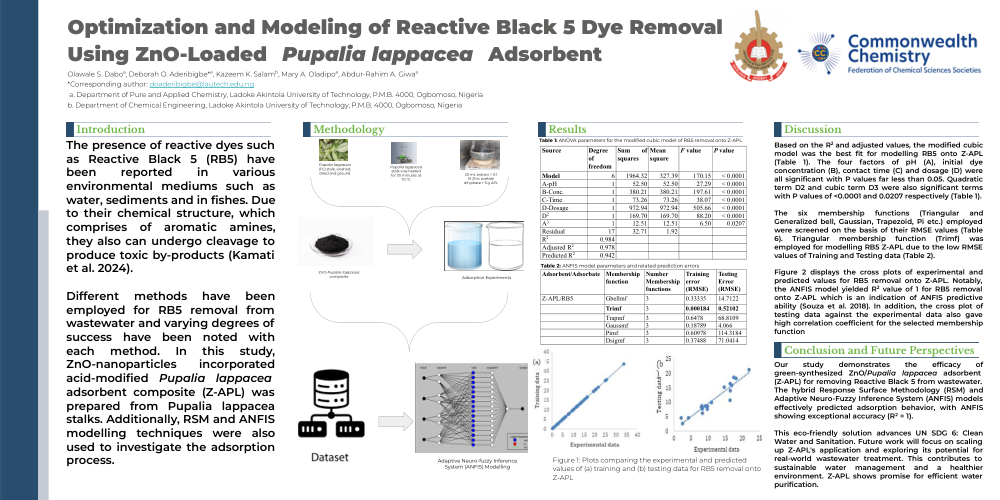
Based on the R2 and adjusted values, the modified cubic model was the best fit for modelling RB5 onto Z-APL (Table 1). The four factors of pH (A), initial dye concentration (B), contact time (C) and dosage (D) were all significant with P values far less than 0.05. Quadratic term D2 and cubic term D3 were also significant terms with P values of <0.0001 and 0.0207 respectively (Table 1).
The six membership functions (Triangular and Generalized bell, Gaussian, Trapezoid, Pi etc.) employed were screened on the basis of their RMSE values (Table 6). Triangular membership function (Trimf) was employed for modelling RB5 Z-APL due to the low RMSE values of Training and Testing data (Table 2).
Figure 2 displays the cross plots of experimental and predicted values for RB5 removal onto Z-APL. Notably, the ANFIS model yielded R2 value of 1 for RB5 removal onto Z-APL which is an indication of ANFIS predictive ability (Souza et al. 2018). In addition, the cross plot of testing data against the experimental data also gave high correlation coefficient for the selected membership function.
Conclusion and Future Perspectives
Our study demonstrates the efficacy of green-synthesized ZnO/Pupalia lappacea adsorbent (Z-APL) for removing Reactive Black 5 from wastewater. The hybrid Response Surface Methodology (RSM) and Adaptive Neuro-Fuzzy Inference System (ANFIS) models effectively predicted adsorption behavior, with ANFIS showing exceptional accuracy (R² = 1).
This eco-friendly solution advances UN SDG 6: Clean Water and Sanitation. Future work will focus on scaling up Z-APL's application and exploring its potential for real-world wastewater treatment. This contributes to sustainable water management and a healthier environment. Z-APL shows promise for efficient water purification.