250 posters, 68 videos, 55 audios, 5 topics, 3 sessions, 367 authors, 223 institutions
ePostersLive by SciGen Technologies S.A. All rights reserved.
6th Commonwealth Chemistry Posters
United Kingdom | 1 - 2 October 2025

P42
Eco-Friendly Silver Nanoparticles for Wastewater Remediation: Degradation of Para-Nitrophenol and Azo Dyes Using Rice Husk-Derived Silver Nanoparticles
Poster Presenter
Authors
Affiliations
Part of Topic
Clean Water and Sanitation (SDG 6)
Video
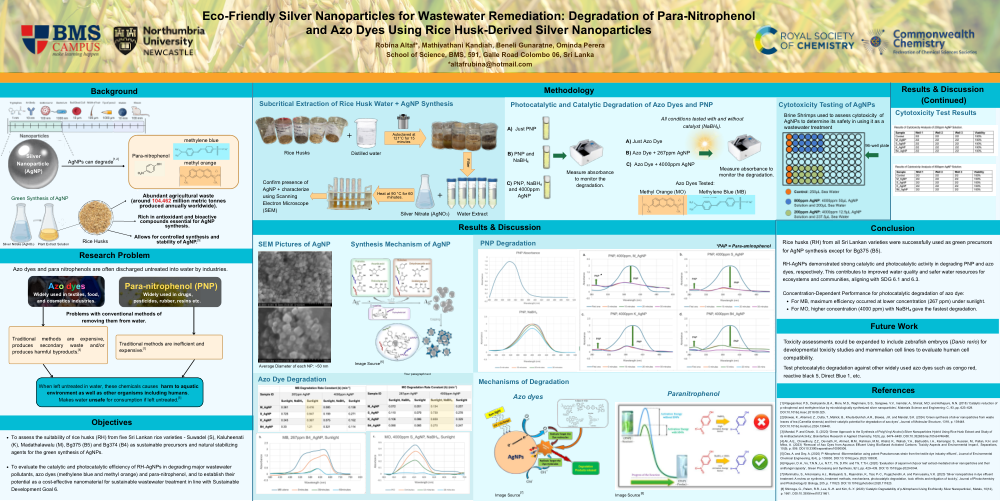
Rice is a staple food across Southeast Asia, generating large amounts of rice husks (RH) as agricultural waste, much of which is discarded or burned despite being rich in bioactive compounds. In this study, RH from five Sri Lankan rice varieties, Suwadel (S), Kaluheenati (K), Madathalawalu (M), Bg375 (B5), and Bg374 (B4), were used for the green synthesis of silver nanoparticles (AgNPs), providing a sustainable route to nanomaterial production. These AgNPs were applied in catalytic and photocatalytic degradation of industrial pollutants that are among the most persistent and hazardous contaminants in water systems. Para-nitrophenol (PNP), a toxic byproduct of pharmaceutical and chemical industries, was instantly degraded into para-aminophenol using 4000 ppm AgNPs, demonstrating rapid catalytic activity. Similarly, azo dyes such as methylene blue (MB) and methyl orange (MO), widely used in the textile industry and known for their carcinogenic and non-biodegradable nature, were effectively degraded. For MB, the most efficient degradation occurred at the lower AgNP concentration (267 ppm) under sunlight, while for MO, higher concentrations (4000 ppm) with NaBH₄ yielded the fastest rates. These results highlight that performance depend on both the concentration and pollutant type, with NaBH₄ acting as a catalyst enhancer in certain case. By converting agricultural waste into functional nanomaterials, this research demonstrates an eco-friendly and cost-effective approach to wastewater remediation, directly supporting Sustainable Development Goal 6: Clean Water and Sanitation.