250 posters, 68 videos, 55 audios, 5 topics, 3 sessions, 367 authors, 223 institutions
ePostersLive by SciGen Technologies S.A. All rights reserved.
6th Commonwealth Chemistry Posters
United Kingdom | 1 - 2 October 2025

P37
La-doped ATaO3 for the Photocatalytic Degradation of PFAS
Poster Presenter
Authors
Affiliations
Part of Topic
Clean Water and Sanitation (SDG 6)
Audio
La-doped ATaO3 for the Photocatalytic Degradation of PFAS
Rachael K. Matthews, Cameron J. Shearer
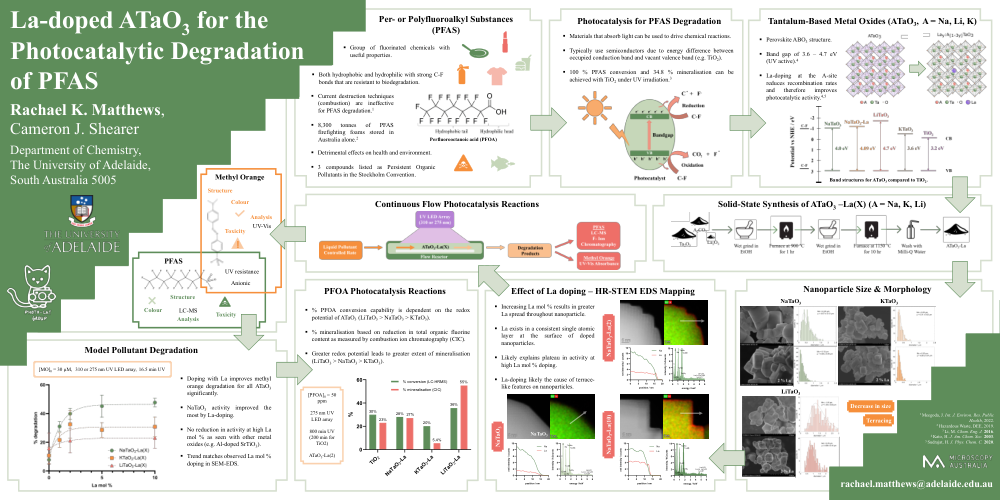
Per- or Polyfluoroalkyl Substances (PFAS)
- Group of fluorinated chemicals with useful properties.
- Both hydrophobic and hydrophilic with strong C-F bonds that are resistant to biodegradation.
- Current destruction techniques (combustion) are ineffective for PFAS degradation.1
- 8,300 tonnes of PFAS firefighting foams stored in Australia alone.2
- Detrimental effects on health and environment.
- 3 compounds listed as Persistent Organic Pollutants in the Stockholm Convention.
Photocatalysis for PFAS Degradation
- Materials that absorb light can be used to drive chemical reactions.
- Typically use semiconductors due to energy difference between occupied conduction band and vacant valence band (e.g. TiO2).
- 100 % PFAS conversion and 34.8 % mineralisation can be achieved with TiO2 under UV irradiation.3
Tantalum-Based Metal Oxides (ATaO3, A = Na, Li, K)
- Perovskite ABO3 structure.
- Band gap of 3.6 – 4.7 eV (UV active).4
- La-doping at the A-site reduces recombination rates and therefore improves photocatalytic activity.4,5
Effect of La doping – HR-STEM EDS Mapping
- Increasing La mol % results in greater La spread throughout nanoparticle.
- La exists in a consistent single atomic layer at the surface of doped nanoparticles.
- Likely explains plateau in activity at high La mol % doping.
- La-doping likely the cause of terrace-like features on nanoparticles.
Model Pollutant Degradation
- Doping with La improves methyl orange degradation for all ATaO3 significantly.
- NaTaO3 activity improved the most by La-doping.
- No reduction in activity at high La mol % as seen with other metal oxides (e.g. Al-doped SrTiO3).
- Trend matches observed La mol % doping in SEM-EDS.
PFOA Photocatalysis Reactions
- % PFOA conversion capability is dependent on the redox potential of ATaO3 (LiTaO3 > NaTaO3 > KTaO3).
- % mineralisation based on reduction in total organic fluorine content as measured by combustion ion chromatography (CIC).
- Greater redox potential leads to greater extent of mineralisation (LiTaO3 > NaTaO3 > KTaO3).