250 posters, 68 videos, 55 audios, 5 topics, 3 sessions, 367 authors, 223 institutions
ePostersLive by SciGen Technologies S.A. All rights reserved.
6th Commonwealth Chemistry Posters
United Kingdom | 1 - 2 October 2025

P161
Tailored Ni–CuO Nanostructures for Non-Enzymatic Glucose Sensing
Poster Presenter
Authors
Affiliations
Part of Topic
Good Health and Wellbeing (SDG 3)
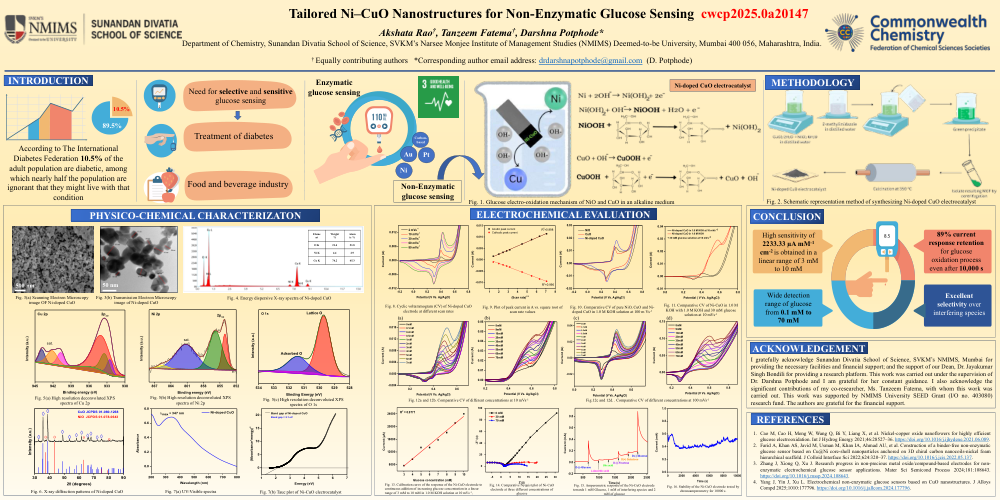
Creating efficient and cost-effective electrocatalysts for non-enzymatic glucose sensors has emerged as an important area of research, particularly to overcome the drawbacks of enzymatic glucose sensing devices.1 Synthesis of appropriate electrocatalysts hold potential to provide durability, stability and long-term reliability in non- enzymatic glucose sensors.2 Using 2-methylimidazole as a co-ordination ligand, we report a simple chemical precipitation method for synthesizing Ni-doped CuO electrocatalyst from Metal Organic Frameworks. Electron transfer kinetics, which are essential for glucose oxidation are greatly enhanced by the combination of nanostructured transition metals Ni and Cu and their synergistic interaction.3
Scanning Electron Microscopy and Transmission Electron Microscopy images show randomly distributed spherical-shaped particles with noticeable agglomeration ascribed to electrostatic interactions between Ni and Cu, resulting in a stable composite favourable for sensing applications. Energy-dispersive X-ay Spectroscopy confirms higher concentration of Cu indicating doping of Ni in the CuO lattice. X-ray Photoelectron Spectroscopy verifies Ni and Cu in +2 oxidation states, which can electrochemically transition to higher oxidation states in alkaline medium, enhancing glucose oxidation. X-ray Diffraction patterns confirm that the electrocatalyst is composed of CuO and NiO. The resulting Ni-doped CuO electrode offers high Electrochemical active surface area of 703.14 cm2 when deposited on nickel foam, providing large number of active sites for electro-oxidation of glucose. Electrode’s remarkable sensing ability over a wide concentration range from 0.1 mM to 70 mM ensures its clinical applications as well as detection of glucose in food and beverages. Additionally, the sensor exhibits exceptional stability by retaining 89% of its initial current response post 10,000 s. It provides outstanding sensitivity of 2233.33 µA mM-1 cm-2 in a linear range of 3 mM to 10 mM.
These findings demonstrate that the synergistic impact of Ni and Cu impacts the overall catalytical activity and stability of the electrocatalyst thereby making it an attractive option for next-generation non-enzymatic glucose sensors providing excellent sensing characteristics for practical applications.