250 posters, 68 videos, 55 audios, 5 topics, 3 sessions, 367 authors, 223 institutions
ePostersLive by SciGen Technologies S.A. All rights reserved.
6th Commonwealth Chemistry Posters
United Kingdom | 1 - 2 October 2025

P160
Comparative Evaluation of BAX Activators BAM7 and BTSA1: Binding Dynamics, Toxicity Profiles, and Modelling Insights Towards Targeted Cancer Therapy
Poster Presenter
Authors
Affiliations
Part of Topic
Good Health and Wellbeing (SDG 3)
Video
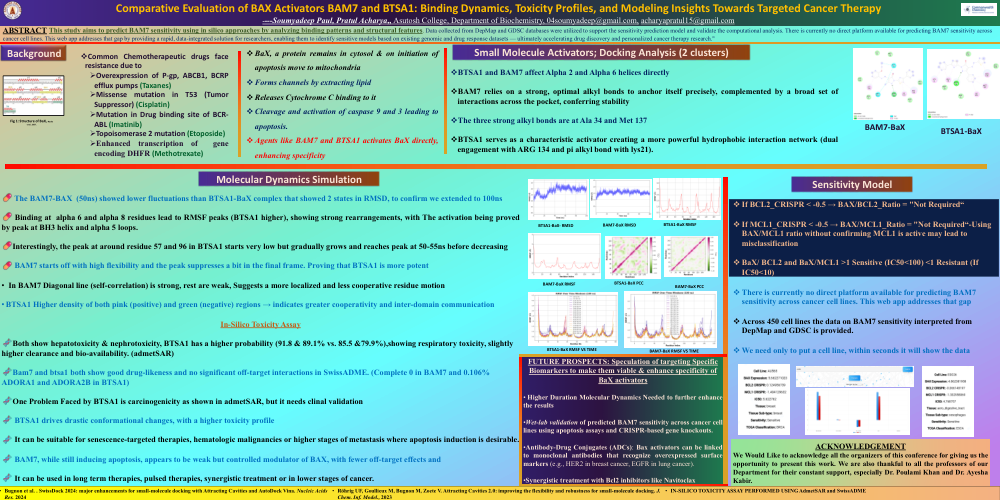
One of the major problems of the common chemotherapeutic drugs are the resistance faced as well as significant side effects.
BaX, a protein remains in cytosol & on initiation of apoptosis move to mitochondria and activates caspases through cytochrome c release.
Two of the major activators studied are BAM7 and BTSA1.
Through Docking analysis, we found BTSA1 and BAM7 affect Alpha 2 and Alpha 6 helices directly
v BAM7 relies on a strong, optimal alkyl bonds to anchor itself precisely, complemented by a broad set of interactions across the pocket, conferring stability
v The three strong alkyl bonds are at Ala 34 and Met 137
v BTSA1 serves as a characteristic activator creating a more powerful hydrophobic interaction network.
v Highlighted by its dual engagement with ARG 134 and pi alkyl bond with lys21.
In a 50ns MD simulation, The BAM7-BAX showed lower fluctuations than BTSA1-BaX complex that showed 2 distinct states, that’s why we decided to extend the run to 100ns to validate.
�� Binding at alpha 2 and alpha 6 residues lead to RMSF peaks (with BTSA1 showing higher peaks), showing strong rearrangements
�� The activation is proved by peak at BH3 helix and alpha 5 loops.
��Interestingly, the peak at around residue 57 and 96 in BTSA1 starts very low but gradually grows and reaches peak at arounf 50-55 ns before sunsiding
�� BAM7 starts off with high flexibility and the peak suppresses a bit in the final frame. Proving that BTSA1 is more potent
Pearson’s cross coefficient
- In BAM7 Diagonal line (self-correlation) is strong, rest are weak, Suggests a more localized and less cooperative residue motion
- BTSA1 Higher density of both pink (positive) and green (negative) regions → indicates greater cooperativity and inter-domain communication between residue groups.
In-Silico Toxicity Assay
��Both show hepatotoxicity & nephrotoxicity, BTSA1 has a higher probability (91.8 & 89.1% vs. 85.5 &79.9%),showing respiratory toxicity, slightly higher clearance and bio-availability. (admetSAR)
��Bam7 and btsa1 both show good drug-likeness and no significant off-target interactions in SwissADME. (Complete 0 in BAM7 and 0.106% ADORA1 and ADORA2B in BTSA1)
��One Problem Faced by BTSA1 is carcinogenicity as shown in admetSAR, but it needs clinal validation
�� BTSA1 drives drastic conformational changes, with a higher toxicity profile
We conclude that It can be suitable for senescence-targeted therapies, hematologic malignancies or higher stages of metastasis where apoptosis induction is desirable.
�� BAM7, while still inducing apoptosis, appears to be weak but controlled modulator of BAX, with fewer off-target effects and
�� It can be used in long term therapies, pulsed therapies, synergistic treatment or in lower stages of cancer.
We collected data related to BAM7 sensitivity from GDSC and depMAP and made a rule based classifier on the sensitivity of BAM7 across 488 cell lines.
This model will serve as a pioneer to study the BAM7 sensitivity across cell lines under one roof.