250 posters, 68 videos, 55 audios, 5 topics, 3 sessions, 367 authors, 223 institutions
ePostersLive by SciGen Technologies S.A. All rights reserved.
6th Commonwealth Chemistry Posters
United Kingdom | 1 - 2 October 2025

P158
De Novo Molecular Design and Bioactivity Prediction of Novel Hexahydroquinolines as Transmission-Blocking PfCDPK4 Inhibitors
Poster Presenter
Part of Topic
Good Health and Wellbeing (SDG 3)
Video
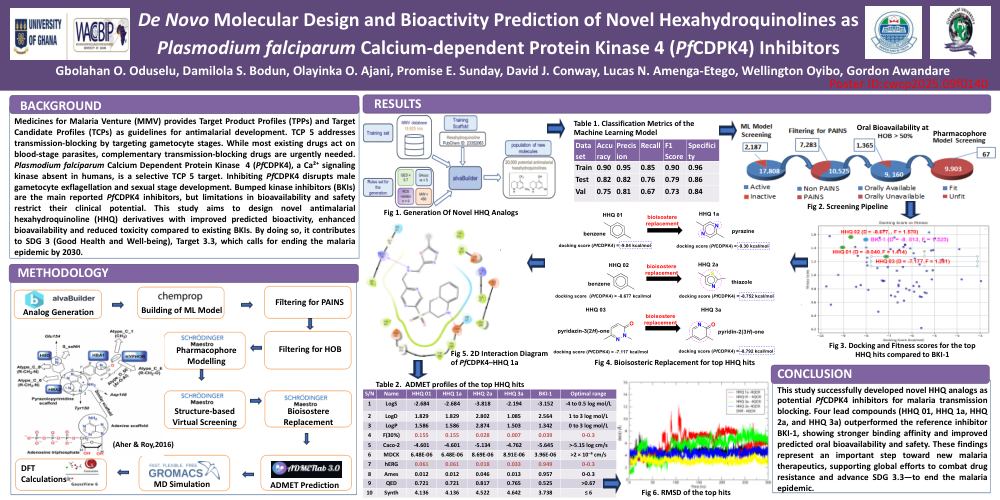
Abstract: Plasmodium falciparum Calcium-Dependent Protein Kinase 4 (PfCDPK4) is a crucial enzyme involved in gametogenesis, a key stage in malaria parasite transmission from humans to mosquitoes. With the growing resistance to current antimalarial drugs, there is an urgent need to develop novel therapeutics with alternative mechanisms of action. Hexahydroquinolines (HHQs), a class of nitrogen-containing heterocyclic compounds, have emerged as promising gametocytocidal agents due to their transmission-blocking potential. This study aims to identify novel hexahydroquinoline analogs as potential PfCDPK4 inhibitors with strong binding affinity, favorable pharmacokinetic properties, and structural stability for transmission-blocking antimalarial therapy. A library of 20,000 hexahydroquinoline (HHQ) novel analogs was generated, employing de novo molecular design with genetic algorithms using AlvaBuilder. The compounds were systematically filtered through a pipeline comprising machine learning-based bioactivity prediction, human oral bioavailability (HOB) estimation, PAINS evaluation, pharmacophore modeling, ADMET filters, and structure-based virtual screening. The top-ranking compounds were further optimized through bioisosteric replacement, assessed for structural stability using 300 ns molecular dynamics simulations, and evaluated for key electronic properties using density functional theory (DFT) calculations. Four lead compounds (HHQ 1a, HHQ 01, HHQ 3a, and HHQ 2a) exhibited strong binding affinities ranging from -9.30 to 8.752 kcal/mol and MMGBSA binding energies between -52.51 and -47.37 kcal/mol, comparable to the known PfCDPK4 inhibitor, Bumped Kinase Inhibitor-1 (BKI-1; docking score: -8.01 kcal/mol; binding energy: -61.95 kcal/mol), and the co-crystallized ligand, DXR (docking score: -11.87 kcal/mol; binding energy: -39.18 kcal/mol). These compounds also exhibited favorable ADMET profiles, maintained structural stability during the molecular dynamic simulation, and formed more hydrogen bonds than the reference ligand. The HHQ scaffold, a previously underexplored scaffold in malaria drug discovery, shows promising potential as a PfCDPK4 inhibitor with transmission-blocking capabilities. Further in vitro and in vivo studies are recommended to validate their antimalarial potential.
Keywords: Hexahydroquinolines, pfCDPK4, Malaria, Message Passing Neural Networks, Molecular Dynamic Simulation