250 posters, 68 videos, 55 audios, 5 topics, 3 sessions, 367 authors, 223 institutions
ePostersLive by SciGen Technologies S.A. All rights reserved.
6th Commonwealth Chemistry Posters
United Kingdom | 1 - 2 October 2025

P144
Ensuring food safety and religious compliance: Amino acid-based authentication of gelatin sources using advanced mass spectrometry tools
Poster Presenter
Authors
Affiliations
Part of Topic
Good Health and Wellbeing (SDG 3)
Audio
Ensuring Food Safety and Religious Compliance: Amino Acid-Based Authentication of Gelatin Sources Using Advanced Mass Spectrometry Tools
Mahjabeen Hassan, Tehreem Kanwal, Syed Ghulam Musharraf*
HEJ Research Institute of Chemistry, International Center for Chemical and Biological Sciences (ICCBS), University of Karachi, Karachi-75270, Pakistan.
Email: mah.jabeen@iccs.edu
Background
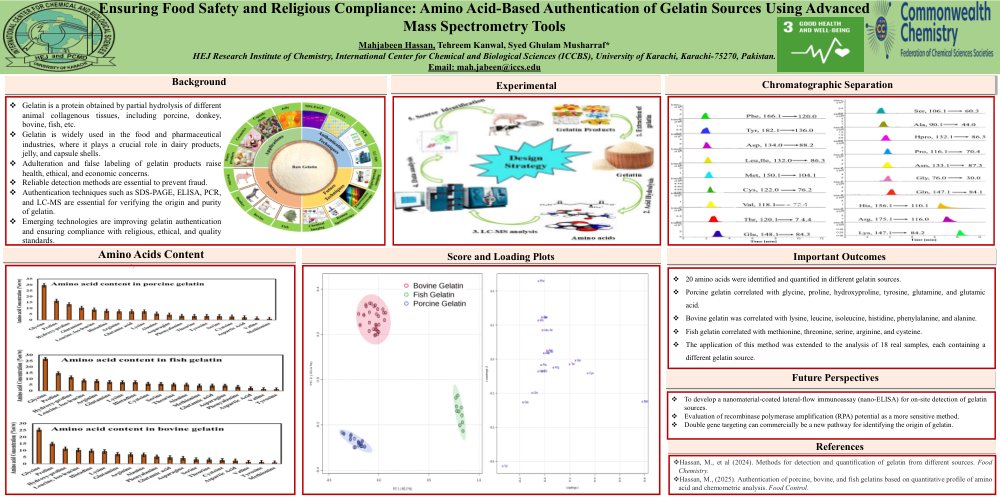
Gelatin is a protein obtained by partial hydrolysis of different animal collagenous tissues, including porcine, donkey, bovine, fish, etc. Gelatin is widely used in the food and pharmaceutical industries, where it plays a crucial role in dairy products, jelly, and capsule shells. Adulteration and false labeling of gelatin products raise health, ethical, and economic concerns. Reliable detection methods are essential to prevent fraud. Authentication techniques such as SDS-PAGE, ELISA, PCR, and LC-MS are essential for verifying the origin and purity of gelatin. Emerging technologies are improving gelatin authentication and ensuring compliance with religious, ethical, and quality standards.
Important Outcomes
20 amino acids were identified and quantified in different gelatin sources. Porcine gelatin correlated with glycine, proline, hydroxyproline, tyrosine, glutamine, and glutamic acid. Bovine gelatin was correlated with lysine, leucine, isoleucine, histidine, phenylalanine, and alanine. Fish gelatin correlated with methionine, threonine, serine, arginine, and cysteine. The application of this method was extended to the analysis of 18 real samples, each containing a different gelatin source.
Future Perspectives