250 posters, 68 videos, 55 audios, 5 topics, 3 sessions, 367 authors, 223 institutions
ePostersLive by SciGen Technologies S.A. All rights reserved.
6th Commonwealth Chemistry Posters
United Kingdom | 1 - 2 October 2025

P116
E-aptasensors for detection of cocaine on the roadside
Poster Presenter
Authors
Thakshila Dayananda, Bruce Chilton, Yasmin Liu, Onyekachi Raymond, Elena Harjes, Geoffrey B. Jameson, Vyacheslav V. Filichev
Affiliations
Massey University, Palmerston North, Massey University, Palmerston North & New Zealand Institute for Public Health and Forensic Science, Wellington, New Zealand Institute for Public Health and Forensic Science, Wellington
Part of Topic
Good Health and Wellbeing (SDG 3)
Video
Audio
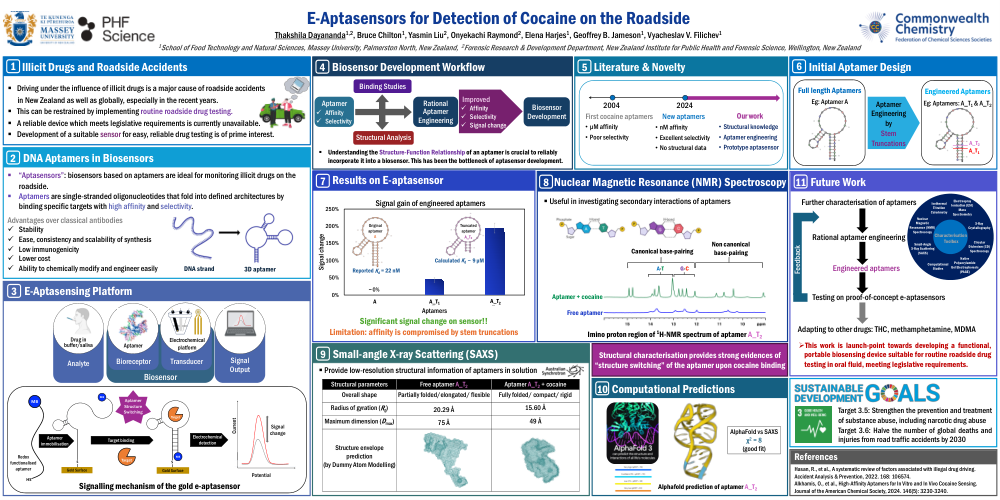
Driving under the influence of illicit drugs is a leading cause of roadside accidents in New Zealand, as well as globally1. This can be restrained by implementing routine roadside drug testing, but a reliable device which meets legislative requirements is currently unavailable. Hence, development of a suitable sensor for simple, rapid and reliable drug testing is urgently required. Our research aims to develop a novel “e-aptasensor”, i.e., electrochemical aptamer-based biosensor, for roadside detection of cocaine. “Aptamers” are single-stranded oligonucleotides that fold into defined architectures that bind targets with high affinity and selectivity. Their advantages such as high biostability, scalable synthesis, regenerability and cost-effectiveness together with the potential for chemical modulation and engineering make them ideal bioreceptors for biosensor applications.
Cocaine-binding aptamers developed through “systematic evolution of ligands by exponential enrichment” (SELEX) were identified from recent literature2 and engineered via a semi-rational approach to induce “structure switching”, a key feature required for a measurable signal generation. In the presence of cocaine, these engineered aptamers demonstrated signal change on the gold e-aptasensor, with the best candidate yielding a remarkable ~200% signal increase. To further enhance the performance of aptamers on the sensor, understanding the structure-function relationship of aptamers is crucial. Lack of structural information has been the bottleneck in aptasensor development, prompting our focus on investigating the binding interactions and structural changes of aptamers upon cocaine binding. A multi-analytical approach using biophysical and computational tools was employed.
Nuclear magnetic resonance (NMR) spectroscopy revealed new interactions which arise when cocaine binds to the aptamer, while 2D NMR spectroscopy can be used to resolve the full aptamer structure. Small-angle X-ray scattering (SAXS) predicted substantial changes in structural parameters of the aptamers upon binding cocaine and generated 3D envelopes indicative of significant conformational switch. These envelopes were further used to validate atomic models of aptamers predicted by AlphaFold. Together, these techniques revealed a partially-folded, complex secondary structure of the free aptamer, which is stabilised upon cocaine binding, providing strong evidences of structure switching.
Other biophysical techniques including isothermal titration calorimetry (ITC), electrospray ionisation mass spectrometry (ESI-MS), polyacrylamide gel electrophoresis (PAGE), and X-ray crystallography are being incorporated to provide complementary insights. Combined with computational methods such as structure prediction and molecular modelling, this approach will deepen our understanding of the molecular basis of the aptamer’s specificity and affinity for cocaine. This will guide “rational aptamer engineering” to develop aptamers with enhanced or novel properties, making them better suited to be incorporated in biosensors. The disposable gold chip serves as a proof-of-concept e-aptasensor, which is a launch-point towards developing a functional, portable biosensing device suitable for routine roadside cocaine sensing in oral fluid. The workflow will be extended to other high-priority illicit drugs including methamphetamine, delta-9-tetrahydrocannabinol (THC) and 3,4-methylenedioxymethamphetamine (MDMA).