250 posters, 68 videos, 55 audios, 5 topics, 3 sessions, 367 authors, 223 institutions
ePostersLive by SciGen Technologies S.A. All rights reserved.
6th Commonwealth Chemistry Posters
United Kingdom | 1 - 2 October 2025

P13
Quantification of Chloride Inhibition of Oxygen Reduction in Bilirubin Oxidases Using Protein Film Electrochemistry
Poster Presenter
Authors
Affiliations
Part of Topic
Clean Water and Sanitation (SDG 6)
Video
Title: Quantification of Chloride Inhibition of Oxygen Reduction in Bilirubin Oxidases using Protein Film Electrochemistry
Authors: Amirah F. Kamaruddin, Nicolas Mano, Christopher F. Blanford
Affiliations: Universiti Teknologi Malaysia, CNRS, Université de Bordeaux, University of Manchester
Keywords: Bilirubin oxidase, chloride inhibition, oxygen reduction reaction, protein film electrochemistry, bioelectrocatalysis, enzyme kinetics
Background:
Bilirubin oxidases (BODs) are multicopper oxidase enzymes catalyzing oxygen reduction with broad applications in biosensors and biofuel cells. However, chloride ions, common in seawater and biological fluids, inhibit BOD activity and limit practical device performance. Understanding chloride inhibition mechanisms and kinetics is critical for designing robust bioelectrocatalytic systems.
Objectives:
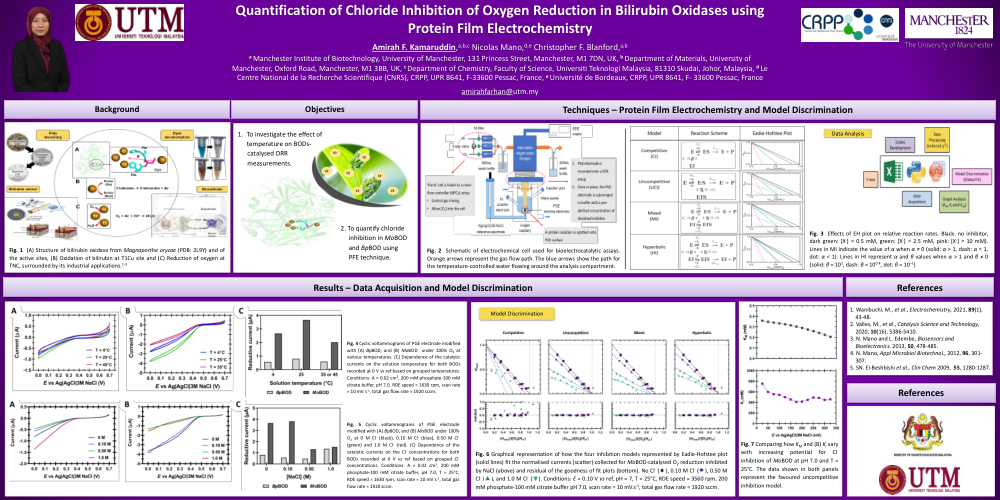
1. Investigate the effect of temperature on BOD-catalyzed oxygen reduction reaction (ORR).
2. Quantify chloride ion inhibition on MoBOD (Magnaporthe oryzae) and BpBOD (Bacillus pumilus) using protein film electrochemistry (PFE).
Methods:
- Enzyme immobilization on pyrolytic graphite edge (PGE) electrodes.
- Cyclic voltammetry under controlled oxygen atmosphere, varying temperature and chloride concentration.
- Use of a temperature-controlled electrochemical cell with regulated gas flow.
- Analysis of inhibition kinetics through Eadie-Hofstee plots and model discrimination.
Results:
- Catalytic currents increased with temperature, confirming enhanced enzyme activity.
- Chloride ions caused concentration-dependent inhibition for both MoBOD but activation for BpBOD (discuss separately using activation models).
- Data best fitted by an uncompetitive inhibition model for MoBOD.
- Kinetic parameters KM and Ki showed dependency on applied electrode potential, indicating complex enzyme-inhibitor interactions.
Significance:
This study provides quantitative insight into chloride inhibition mechanisms on bilirubin oxidases mediated oxygen reduction. The findings facilitate optimization of enzymatic bioelectrocatalytic systems in chloride-rich environments such as seawater and biological fluids.