253 posters, 14 videos, 27 audios, 14 topics, 392 authors, 132 institutions
ePostersLive by SciGen Technologies S.A. All rights reserved.
4th Commonwealth Chemistry Posters
October 4 - 5, 2023 | Online, United Kingdom

P93
Computational Study on Hydration Motifs of Atmospheric Sulphuric Acid-Ammonia Clusters
Poster Presenter
Part of Topic
Climate action
Computational Study on Hydration Motifs of Atmospheric Sulphuric Acid-Ammonia Clusters
Introduction
Methods
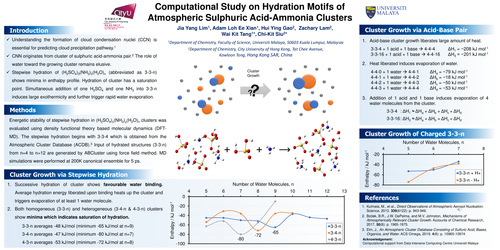
Energetic stability of stepwise hydration in (H2SO4)x(NH3)y(H2O)n clusters was evaluated using density functional theory based molecular dynamics (DFT-MD). The stepwise hydration begins with 3-3-4 which is obtained from the Atmospheric Cluster Database (ACDB).3 Input of hydrated structures (3-3-n) from n=4 to n=12 are generated by ABCluster using force field method. MD simulations were performed at 200K canonical ensemble for 5 ps.
Cluster Growth via Stepwise Hydration
3-3-n averages -48 kJ/mol (minimum -65 kJ/mol at n=9)
3-4-n averages -47 kJ/mol (minimum -80 kJ/mol at n=7)
4-3-n averages -53 kJ/mol (minimum -72 kJ/mol at n=8)
Cluster Growth via Acid-Base Pair
3-3-4 + 1 acid + 1 base -> 4-4-4 ΔH1 = −208 kJ mol-1
3-3-16 + 1 acid + 1 base -> 4-4-16 ΔH3 = −201 kJ mol-1
4-4-0 + 1 water -> 4-4-1 ΔHa = −79 kJ mol-1
4-4-1 + 1 water -> 4-4-2 ΔHb = −18 kJ mol-1
4-4-2 + 1 water -> 4-4-3 ΔHc = −50 kJ mol-1
4-4-3 + 1 water -> 4-4-4 ΔHd = −53 kJ mol-1
3-3-4 : ΔH1 ≈ ΔHa + ΔHb + ΔHc + ΔHd
3-3-16 : ΔH3 ≈ ΔHa + ΔHb + ΔHc + ΔHd
Cluster Growth of Charged 3-3-n
References
1. Kulmala, M., et al., Direct Observations of Atmospheric Aerosol Nucleation. Science, 2013. 339(6122): p. 943-946.
2. Bzdek, B.R., J.W. DePalma, and M.V. Johnston, Mechanisms of Atmospherically Relevant Cluster Growth. Accounts of Chemical Research, 2017. 50(8): p. 1965-1975.
3. Elm, J., An Atmospheric Cluster Database Consisting of Sulfuric Acid, Bases, Organics, and Water. ACS Omega, 2019. 4(6): p. 10965-10974.