253 posters, 14 videos, 27 audios, 14 topics, 392 authors, 132 institutions
ePostersLive by SciGen Technologies S.A. All rights reserved.
4th Commonwealth Chemistry Posters
October 4 - 5, 2023 | Online, United Kingdom

P90
Physicochemical Characterisation and Potential Health Effects of Non-Exhaust Particle Emissions
Poster Presenter
Part of Topic
Climate action
Audio
Physicochemical Characterisation and Potential Health Effects of Non-Exhaust Particle Emissions
Introduction
Until now, research into the health effects of particulate emissions from vehicles has mainly focused on exhaust (tailpipe) emissions. However, non-exhaust particulate emissions due to brake, tyre, and road wear are produced by electric and combustion-engine vehicles and contribute significantly to airborne particles from road traffic.
Brake wear is the most prevalent constituent of roadside PM, accounting for around 55% by mass. Resuspended material represents 38%, and tyre wear makes up around 11%. Data submitted by the UK Government to the United Nations Convention on Long-range Transboundary Air Pollution forecasts that non-exhaust emissions are expected to rise to 9 kilotonnes by 2030, while exhaust emissions continue to fall
Objective
To gain a simultaneous understanding of the composition, size, and morphology of non-exhaust PM, and an insight into their potential adverse human health effects.
Health Context
The potential health effects of non-exhaust particles are poorly understood with experiments ongoing. Metals in tyre rubber have been found to leach into watercourses and have significant adverse outcomes in fish, with aquatic toxicity of scrap tyres being identified in the 1990’s. Brake wear particles have been shown to exacerbate lung inflammation and compromise phagocytosis in macrophages. Identifying and quantifying non-exhaust PM in the atmosphere is a complex challenge due to their chemically complex makeup and non-homogenous composition.
Particle Imaging
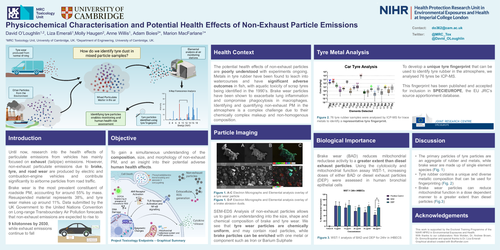
Figure 1. A-C Electron Micrographs and Elemental analysis overlay of a tyre wear particle
Figure 1. D-F Electron Micrographs and Elemental analysis overlay of a brake abrasion dusts.
SEM-EDS Analysis of non-exhaust particles allows us to gain an understanding into the size, shape and chemical composition of brake and tyre wear. We see that tyre wear particles are chemically uniform, and may contain road particles, while brake particles can be enriched with one metal or component such as Iron or Barium Sulphate
Tyre Metal Analysis
Figure 2. 76 tyre rubber samples were analysed by ICP-MS for trace metals to identify a representative tyre fingerprint
To develop a unique tyre fingerprint that can be used to identify tyre rubber in the atmosphere, we analysed 76 tyres be ICP-MS.
This fingerprint has been published and accepted for inclusion in SPECIEUROPE, the EU JRC’s source apportionment database.
Biological Importance
Brake wear (BAD) reduces mitochondrial reductase activity to a greater extent than diesel exhaust particles. Using the cytotoxicity and mitochondrial function assay WST-1, increasing doses of either BAD or diesel exhaust particles (DEP) were assessed in human bronchial epithelial cells
Figure 3. WST-1 analysis of BAD and DEP for 24hr in iHBECS
Discussion
Acknowledgements
This work is supported by the Doctoral Training Programme of the NIHR HPRU in Environmental Exposures and Health.
With thanks to our collaborators: Nick Molden, Dr, Andrew Brown, Dr. Emma Braysher and special thanks to Dr. Liza Emerali
Graphical abstract created with BioRender.com