253 posters, 14 videos, 27 audios, 14 topics, 392 authors, 132 institutions
ePostersLive by SciGen Technologies S.A. All rights reserved.
4th Commonwealth Chemistry Posters
October 4 - 5, 2023 | Online, United Kingdom

P88
Impact of climate change on national development: the climate change phenomena and its current impacts in Papua New Guinea
Poster Presenter
Authors
Part of Topic
Climate action
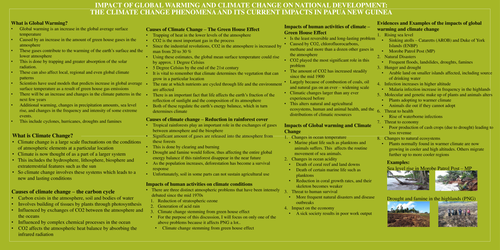
IMPACT OF GLOBAL WARMING AND CLIMATE CHANGE ON NATIONAL DEVELOPMENT:THE CLIMATE CHANGE PHENOMENA AND ITS CURRENT IMPACTS IN PAPUA NEW GUINEA
What is Global Warming?
•Global warming is an increase in the global average surface temperature
•Caused by an increase in the amount of green house gases in the atmosphere
•These gasescontributetothewarmingoftheearth’s surface and the lower atmosphere
•This isdonebytrappingandgreaterabsorption of the solar radiation.
•These can also affect local, regional and even global climate patterns
•Scientists have used models that predicts increase in global average surface temperature as a result of green house gas emissions
•There will be an increase and changes in the climate patterns in the next few years
•Additional warming, changes in precipitation amounts, sea level rise, and changes in the frequency and intensity of some extreme events.
•This include cyclones, hurricanes, droughts and famines
What is Climate Change?
•Climate change is a large scale fluctuations on the conditions of atmospheric elements at a particular location
•Climate is now thought of as a part of a larger system
•This includes the hydrosphere, lithosphere, biosphere and extraterrestrial features such as the sun
•So climate change involves these systems which leads to a new and lasting conditions
Evidences and Examples of the impacts of global warming and climate change
1.Rising sea level
•Sinking atolls –Cataretts (AROB) and Duke of York Islands (ENBP)
•MorobePatrolPost(MP)
2.Natural Disasters
•Frequent floods, landslides, droughts, famines
3.Hunger and drought
•Arable land on smaller islands affected, including source of drinking water
4.Infection increases in higher altitude
•Malaria infection increase in frequency in the highlands
5.Molecular and genetic make up of plants and animals alters
•Plants adopting to warmer climate
•Animals dieoutif they cannot adopt
6.Threat to health
•Rise of waterborne infections
7.Threat toeconomy
•Poorproduction of cash crops (due to drought) leading to less revenue
8.Changes to natural ecosystems
•Plants normally found in warmer climate are now growing in cooler and high altitudes. Others migrate further up to more cooler regions