253 posters, 14 videos, 27 audios, 14 topics, 392 authors, 132 institutions
ePostersLive by SciGen Technologies S.A. All rights reserved.
4th Commonwealth Chemistry Posters
October 4 - 5, 2023 | Online, United Kingdom

P231
Reconfigurable Pickering emulsions
Part of Topic
Responsible consumption and production
Reconfigurable Pickering Emulsions
Shivangi Chourasia, Catherine P. Whitby
School of Natural Sciences, Massey University
INTRODUCTION
Overview
Emulsions are a mixture of two or more immiscible liquids with one phase dispersed in another phase.
Reconfigurable emulsion systems have emerged as a growing field in colloidal science, offering the ability to undergo changes in droplet shape and morphology with variations in environmental conditions.
These systems can potentially serve as dynamically tunable materials with wide-ranging applications.
Motivation
Emulsions stabilised by particles (rather than surfactant) offer various advantages like long-lasting stability and lower environmental impact.
The ability to combine the advantages of Pickering emulsions and the adaptability of reconfigurable systems can offer new opportunities.
Investigating particle-stabilized reconfigurable emulsions is a critical area that requires further exploration and understanding.
Research question to address
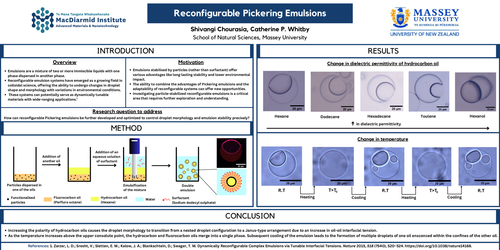
How can reconfigurable Pickering emulsions be further developed and optimized to control droplet morphology and emulsion stability precisely?
METHOD
Addition of another oil
Addition of an aqueous solution of surfactant
Particles dispersed in one of the oils
Emulsification of the mixture
Double emulsion
Functionalised particles
Fluorocarbon oil (Perfluro octane)
Hydrocarbon oil (Hexane)
Water
Surfactant (Sodium dodecyl sulphate)
RESULTS
Change in dielectric permittivity of hydrocarbon oil
Hexane
Dodecane
Hexadecane
Toulene
Hexanol
increase in dielectric permittivity
Change in temperature
R.T
T>TC
R.T
T>TC
R.T
Heating
Cooling
Heating
Cooling
CONCLUSION
Increasing the polarity of hydrocarbon oils causes the droplet morphology to transition from a nested droplet configuration to a Janus-type arrangement due to an increase in oil-oil interfacial tension.
As the temperature increases above the upper consolute point, the hydrocarbon and fluorocarbon oils merge into a single phase. Subsequent cooling of the emulsion leads to the formation of multiple droplets of one oil ensconced within the confines of the other oil.
REFERENCES
1. Zarzar, L. D.; Sresht, V.; Sletten, E. M.; Kalow, J. A.; Blankschtein, D.; Swager, T. M. Dynamically Reconfigurable Complex Emulsions via Tunable Interfacial Tensions. Nature 2015, 518 (7540), 520–524. https://doi.org/10.1038/nature14168.