253 posters, 14 videos, 27 audios, 14 topics, 392 authors, 132 institutions
ePostersLive by SciGen Technologies S.A. All rights reserved.
4th Commonwealth Chemistry Posters
October 4 - 5, 2023 | Online, United Kingdom

P227
ANALYSIS OF SELECTED ELEMENTS IN SOME BABY FOODS IN UYO, AKWA IBOM STATE, NIGERIA
Poster Presenter
Authors
Affiliations
Part of Topic
Responsible consumption and production
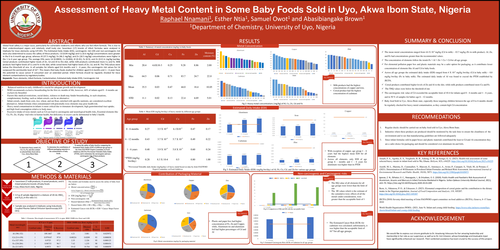
Global food safety is a major issue, particularly for vulnerable newborns and infants who are fed infant formula. This is due to their underdeveloped organs and relatively small body size. Seventeen (17) brands of infant formulas were analyzed in triplicate for trace elements using ICP-OES. The Estimated Daily Intake (EDI), carcinogenic risk (CR) and non-carcinogenic risk were also determined to assess the safety of these products. Cd (0.04 mg/kg) and Cu (0.6 mg/kg) concentrations were greater in the 0 to 6 month age group, whereas Al (37.5 mg/kg), Fe (46.2 mg/kg), and Zn (18.5 mg/kg) concentrations were higher in the 1 to 6 year age group. The average EDIs were Cd (0.0003), Cu (0.006), Al (0.41), Fe (0.5), and Zn (0.2) in mg/kg bw/day. Cereal products contributed higher levels of Zn, Cd and Al to the diet, while milk products contributed more Cu and Fe. Milk products had higher levels of Cu and Fe in the diet, while cereal items had higher levels of Zn, Cd, and Al. The THQ values were below the threshold of one. In all samples for infants aged 0-6 months and 1 - 6 years, the carcinogenic risk values for Cd surpassed the permissible level of 10-4. This means that baby foods studied for children aged 0–6 months and 1 – 6 years have the potential to cause cancer if consumed over an extended period. Infant formula should be regularly checked for trace element contaminations by regulatory bodies.