253 posters, 14 videos, 27 audios, 14 topics, 392 authors, 132 institutions
ePostersLive by SciGen Technologies S.A. All rights reserved.
4th Commonwealth Chemistry Posters
October 4 - 5, 2023 | Online, United Kingdom

P225
Tecoma stans essential oils: a useful additive in food industries
Poster Presenter
Authors
Part of Topic
Responsible consumption and production
Tecoma stans Essential Oils: A Useful Additive in Food Industries
Adekemi Temitope Alade1,2, Sherifat Adeyinka Aboaba1, Olusegun Ekundayo1
1Department of Chemistry, University of Ibadan, Ibadan, Nigeria
2Department of Chemical Sciences, Joseph Ayo Babalola University, Ikeji-Arakeji, Nigeria
Email address:
atalade@jabu.edu.ng (Adekemi Temitope Alade)
To cite this article:
Adekemi Temitope Alade, Sherifat Adeyinka Aboaba, Olusegun Ekundayo. Tecoma stans Essential Oils: A Useful Additive in Food Industries. World Journal of Food Science and Technology. Vol. 7, No. 2, 2023, pp. 30-34. doi: 10.11648/j.wjfst.20230702.13
Received: April 2, 2023; Accepted: April 24, 2023; Published: May 25, 2023
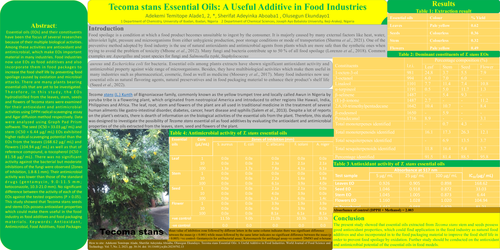
Abstract: Essential oils (EOs) and their constituents have been the focus of several researches because of their multiple biological activities. Among these activities are antioxidant and antimicrobial, which make EOs important material in many industries. Food industries now use EOs as food additives and also incorporate them in food packages to increase the food shelf life by preventing food spoilage caused by oxidation and microbial attacks. There are many plants bearing essential oils that are yet to be investigated. Therefore, in this study, the EOs hydrodistilledfrom the leaves, stem, seeds and flowers of Tecoma stans were examined for their antioxidant and antimicrobial activities using DPPH radical-scavenging assay and Agar diffusion method respectively. Data were analyzed using Graph Pad Prism software. The seed (IC50 = 33.03 μg/ mL) and stem (IC50 = 6.44 μg/ mL) EOs exhibited higher radical-scavenging potential than the EOs from the leaves (168.62 μg/ mL) and flowers (104.94 μg/ mL) as well as that of reference compound, α-tocopherol (IC50 = 81.58 μg/ mL). There was no significant activity against the bacterial but moderate inhibitions of the fungi were observed (Zones of Inhibition, 1.8-8.1 mm). Their antimicrobial activity was lower than those of the standard drugs (gentamycin, 9.0-11.5 mm; ketoconazole, 10.3-21.0 mm). No significant difference between the activity of each of the EOs against the tested organisms (P ˃ 0.05). This study showed that Tecoma stans seeds and stems EOs possess antioxidant properties which could make them useful in the food industry as food additives and food packaging materials.
Keywords: Antioxidant, Antimicrobial, Food Additives, Food Packages
1. Introduction
Food spoilage is a condition at which a food product becomes unsuitable to ingest by the consumer. It is majorly caused by many external factors like heat, water, ultraviolet light, pressure and microorganisms from either unhygienic production, poor storage conditions or mode of transportation [1]. One of the preventive method adopted by food industry is the use of natural antioxidants and antimicrobial agents from plants which are more safe than the synthetic ones when trying to avoid the problem of toxicity [2]. Many fungi and bacteria contribute up to 50 % of all food spoilage [3]. Common examples are Aspergillus and yeast species for fungi and Salmonellatyphi, Staphylococcus aureus and Escherichia coli for bacteria. Essential oils among plants extracts have shown significant antioxidant activity and antimicrobial property against wide range of microorganisms. Besides, they have multibiological activities which make them useful in many industries such as pharmaceutical, cosmetic, food as well as medicine [4]. Many food industries now use essential oils as natural flavoring agents, natural preservatives and in food packaging material to enhance their product’s shelf life [5].
Tecoma stans(L.) Kunth of Bignoniaceae family, commonly known as the yellow trumpet tree and locally called Awun in Nigeria by yoruba tribe is a flowering plant, which originated from neotropical America and introduced to other regions like Hawaii, India, Philippines and Africa [6]. Tecoma and many species of Bignoniaceae have either commercial or ethnobotanical uses, although most common among them are those planted as ornamentals. The leaf, root, stem and flowers of Tecoma stans are all used in traditional medicine in the treatment of several human ailments like gastro-intestinal disorder, diabetes, cancer, heart disease and syphilis [7]. The plant also provides wood for construction purpose, firewood, charcoal and also used in the synthesis of nanoparticles [8]. Wound healing, anti-inflammatory, mosquitocidal, antidiabetic, antibacterial, antifungal, antioxidant, hypoglycemic and antitumor properties of both aqueous and organic extracts from different parts of the plant have been examined [7, 9-11]. Despite a lot of reports on the antioxidant and antimicrobial activities of the plant’s extracts, there is dearth of information on the biological activities of the essential oils from the plant. Therefore, this study was carried out to evaluate the antioxidant and antimicrobial properties of essential oils extracted from the leaves, stem, seeds and flowers of the plant.