92 posters, 1 audios, 567 authors, 81 institutions
ePostersLive by SciGen Technologies S.A. All rights reserved.
Data-driven Cancer Research Conference 2026
24-26 February 2026 | Edinburgh, Scotland

P93
Smarter use of Routinely Collected Data: External validation of Prostate Specific Antigen dynamics for prediction of biochemical recurrence with variable androgen deprivation therapy duration
Poster Presenter
Authors
Jane Shortall, Kimberely Reeves, Vodathi Bamunuarachchi, Conor McGarry, Joe O'Sullivan, Suneil Jain, Guillermo Lorenzo, Nadia di Muzio, Chiara Deantoni, Peter Hoskin, Marcel Van Herk, Ananya Choudhury, Alan McWilliam
Affiliations
University of Manchester, Manchester Cancer Research Centre, The University of Manchester, Division of Cancer Sciences, The University of Manchester, UK, Clinical Oncology, The Christie NHS Foundation Trust, UK, The Patrick G Johnston Centre for Cancer Research, Queen's University Belfast, Belfast, Ireland, Group of Numerical Methods in Engineering, Department of Mathematics, and CITEEC, University of A Coruña, A Coruna, Spain, Department of Radiation Oncology, IRCCS San Raffaele Hospital and Scientific Institute, Milan, Italy, Department of Radiation Oncology, IRCCS San Raffaele Hospital and Scientific Institute, Milan, Italy
Part of Topic
Background: Biochemical recurrence (BCR) after prostate radiotherapy is currently detected using static Prostate Specific Antigen (PSA) thresholds. This means failure is only identified after it has occurred., and the opportunity for early intervention is often missed.
PSA dynamics show potential for predicting long-term outcome. Current studies do not account for androgen deprivation therapy (ADT), only including patients who have not received ADT, or after recovery, limiting generalisability.
Aim: To determine whether PSA dynamic trajectories can characterise risk of BCR across heterogeneous radiotherapy techniques and ADT durations across three independent centres.
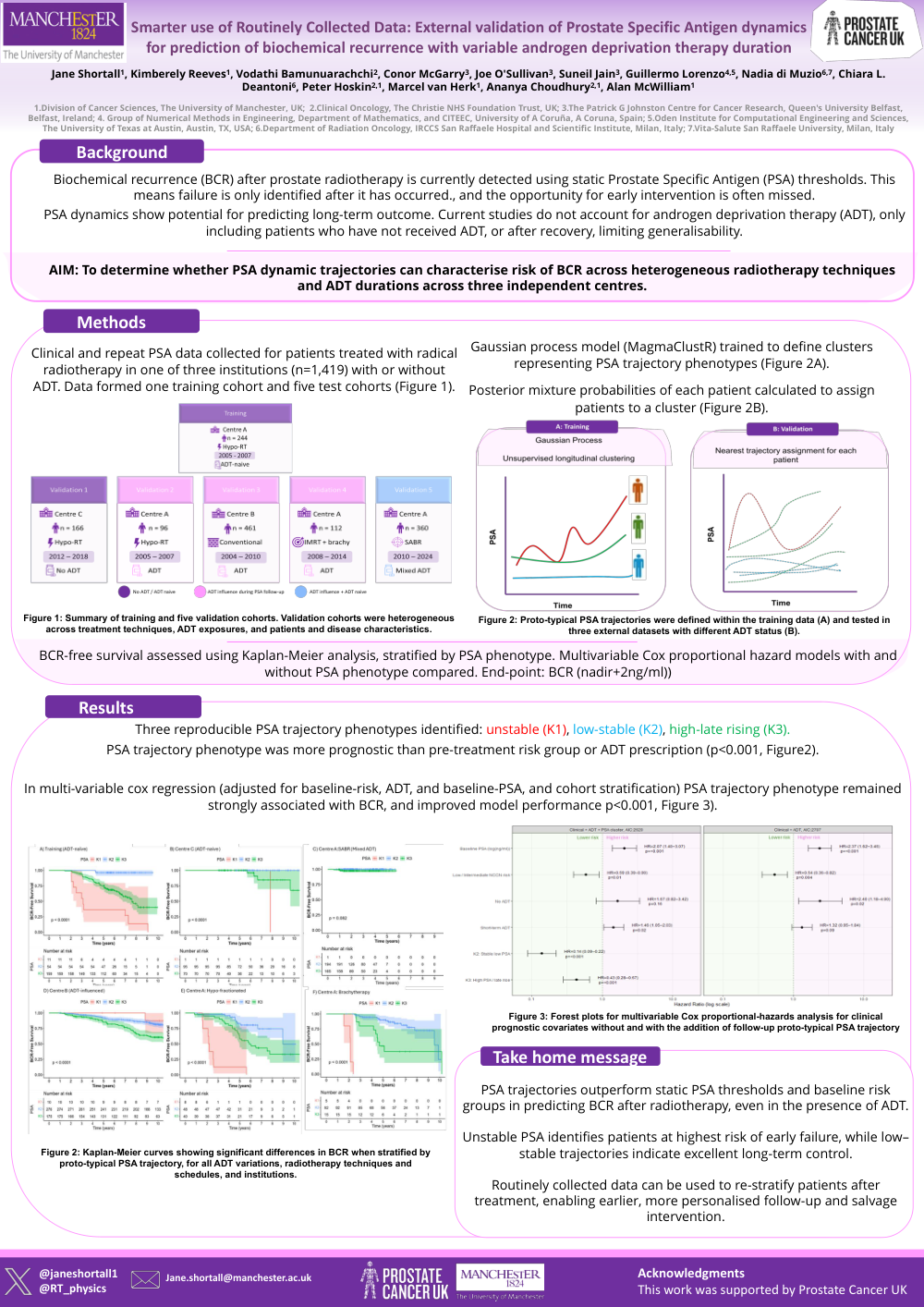
Method: Clinical and repeat PSA data collected for patients treated with radical radiotherapy in one of three institutions (n=1,419) with or without ADT. Data formed one training cohort and five test cohorts (Figure 1). Gaussian process model (MagmaClustR) trained to define clusters representing PSA trajectory phenotypes (Figure 2A). Posterior mixture probabilities of each patient calculated to assign patients to a cluster (Figure 2B).
BCR-free survival assessed using Kaplan-Meier analysis, stratified by PSA phenotype. Multivariable Cox proportional hazard models with and without PSA phenotype compared. End-point: BCR (nadir+2ng/ml))
Results: Three reproducible PSA trajectory phenotypes identified: unstable (K1), low-stable (K2), high-late rising (K3). PSA trajectory phenotype was more prognostic than pre-treatment risk group or ADT prescription (p<0.001, Figure2).
In multi-variable cox regression (adjusted for baseline-risk, ADT, and baseline-PSA, and cohort stratification) PSA trajectory phenotype remained strongly associated with BCR, and improved model performance p<0.001, Figure 3).
Take home message: PSA trajectories outperform static PSA thresholds and baseline risk groups in predicting BCR after radiotherapy, even in the presence of ADT.
Unstable PSA identifies patients at highest risk of early failure, while low–stable trajectories indicate excellent long-term control.
Routinely collected data can be used to re-stratify patients after treatment, enabling earlier, more personalised follow-up and salvage intervention.
Comments
Email is required but is not shown publicly.
Loading comments...