92 posters, 1 audios, 567 authors, 81 institutions
ePostersLive by SciGen Technologies S.A. All rights reserved.
Data-driven Cancer Research Conference 2026
24-26 February 2026 | Edinburgh, Scotland

P85
Long-term infection risks in haematological cancer survivors compared with individuals with no cancer history: a systematic review aided by artificial intelligence-based methods
Poster Presenter
Part of Topic
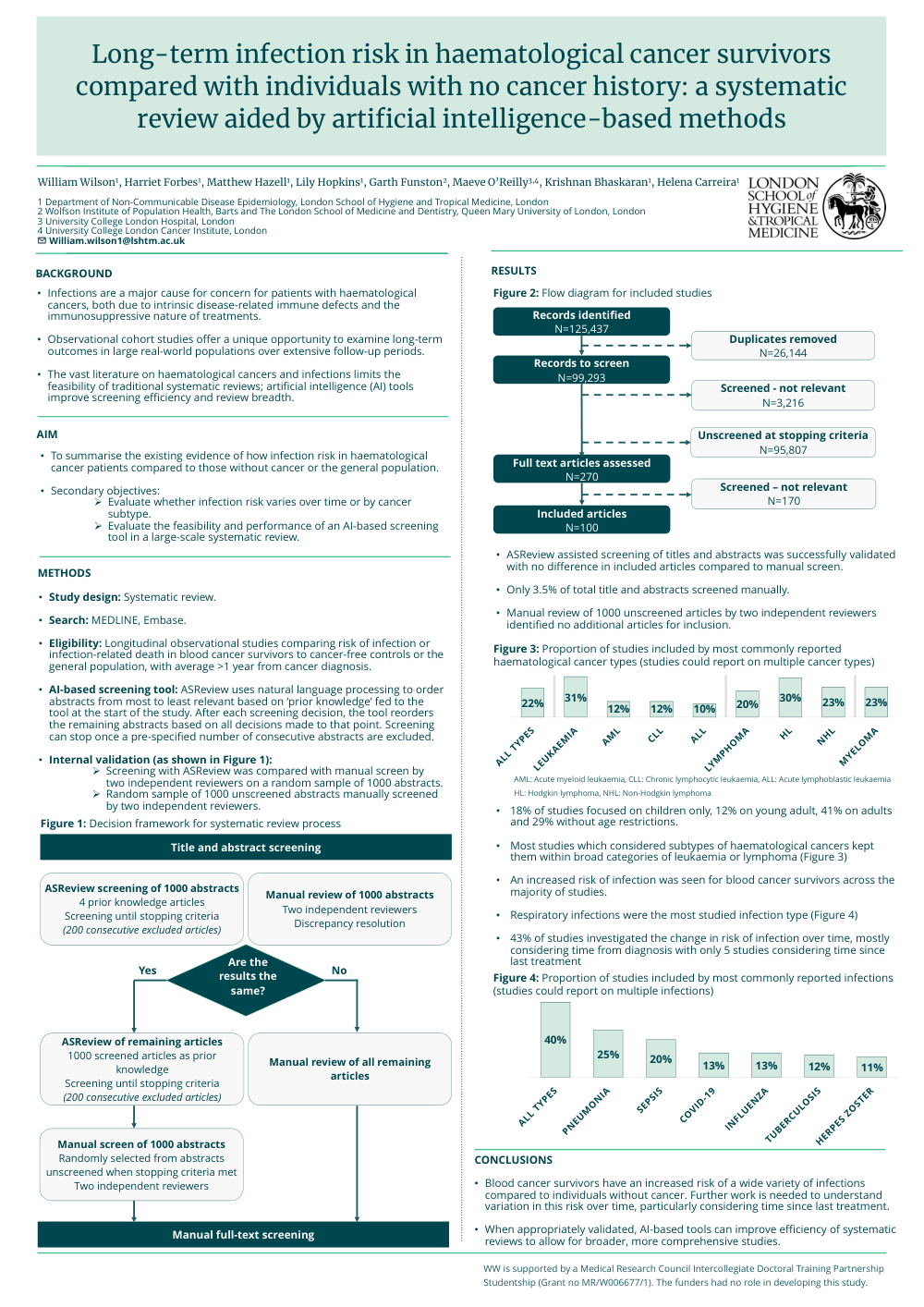
Long-term infection risk in haematological cancer survivors compared with individuals with no cancer history: a systematic review aided by artificial intelligence-based methods
BACKGROUND
•Infections are a major cause for concern for patients with haematological cancers, both due to intrinsic disease-related immune defects and the immunosuppressive nature of treatments.
•Observational cohort studies offer a unique opportunity to examine long-term outcomes in large real-world populations over extensive follow-up periods.
•The vast literature on haematological cancers and infections limits the feasibility of traditional systematic reviews; artificial intelligence (AI) tools improve screening efficiency and review breadth.
AIM
•To summarise the existing evidence of how infection risk in haematological cancer patients compared to those without cancer or the general population.
•Secondary objectives:
ØEvaluate whether infection risk varies over time or by cancer subtype.
ØEvaluate the feasibility and performance of an AI-based screening tool in a large-scale systematic review.
METHODS
•Study design: Systematic review.
•Search: MEDLINE, Embase.
•Eligibility: Longitudinal observational studies comparing risk of infection or infection-related death in blood cancer survivors to cancer-free controls or the general population, with average >1 year from cancer diagnosis.
•AI-based screening tool: ASReview uses natural language processing to order abstracts from most to least relevant based on ‘prior knowledge’ fed to the tool at the start of the study. After each screening decision, the tool reorders the remaining abstracts based on all decisions made to that point. Screening can stop once a pre-specified number of consecutive abstracts are excluded.
•Internal validation (as shown in Figure 1):
ØScreening with ASReview was compared with manual screen by two independent reviewers on a random sample of 1000 abstracts.
ØRandom sample of 1000 unscreened abstracts manually screened by two independent reviewers.
RESULTS
•ASReview assisted screening of titles and abstracts was successfully validated with no difference in included articles compared to manual screen.
•Only 3.5% of total title and abstracts screened manually.
•Manual review of 1000 unscreened articles by two independent reviewers identified no additional articles for inclusion.
•18% of studies focused on children only, 12% on young adult, 41% on adults and 29% without age restrictions.
•Most studies which considered subtypes of haematological cancers kept them within broad categories of leukaemia or lymphoma (Figure 3)
•An increased risk of infection was seen for blood cancer survivors across the majority of studies.
•Respiratory infections were the most studied infection type (Figure 4)
•43% of studies investigated the change in risk of infection over time, mostly considering time from diagnosis with only 5 studies considering time since last treatment
CONCLUSIONS
•Blood cancer survivors have an increased risk of a wide variety of infections compared to individuals without cancer. Further work is needed to understand variation in this risk over time, particularly considering time since last treatment.
•When appropriately validated, AI-based tools can improve efficiency of systematic reviews to allow for broader, more comprehensive studies.
Comments
Email is required but is not shown publicly.
Loading comments...