92 posters, 1 audios, 567 authors, 81 institutions
ePostersLive by SciGen Technologies S.A. All rights reserved.
Data-driven Cancer Research Conference 2026
24-26 February 2026 | Edinburgh, Scotland

P77
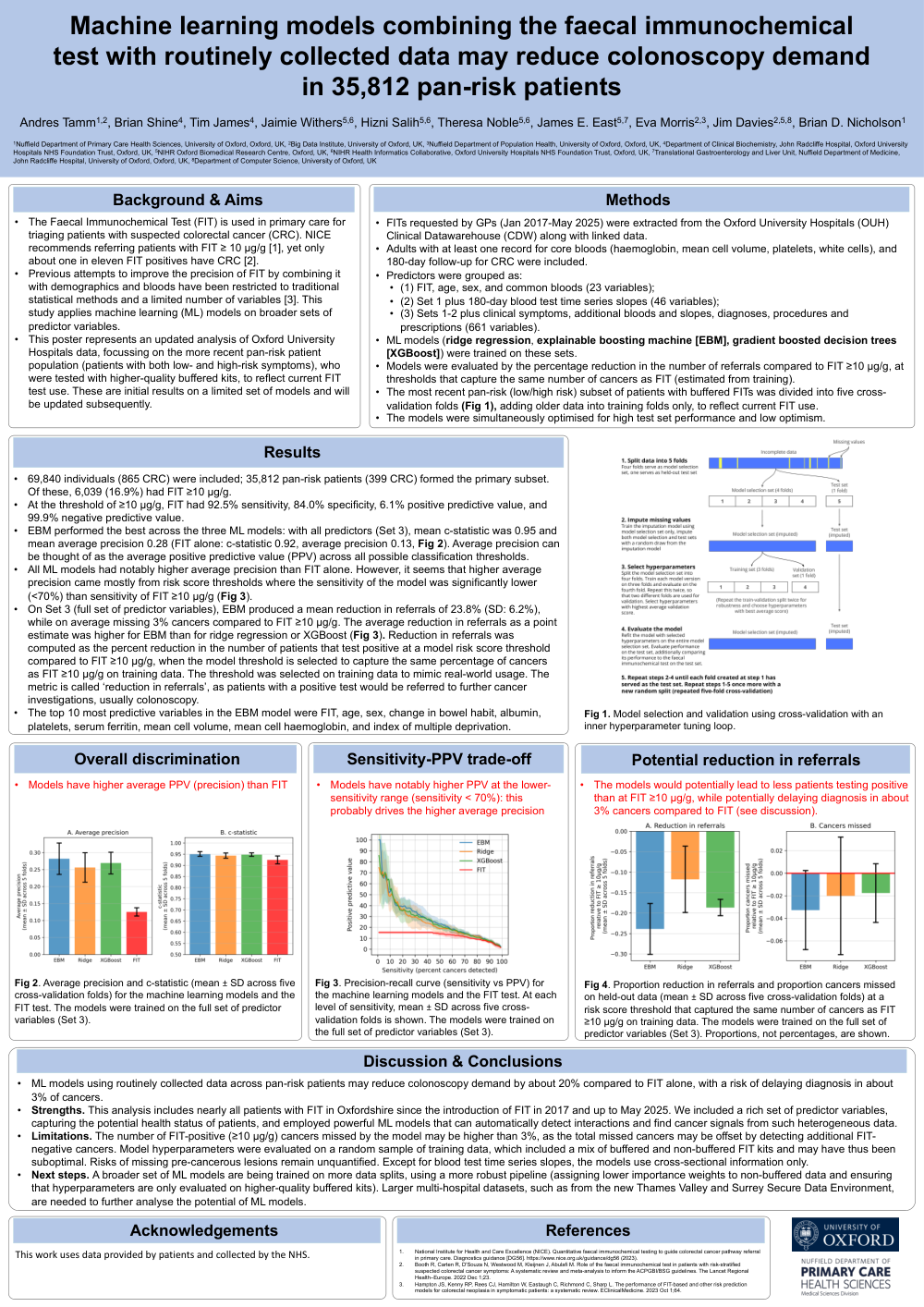
Machine learning models combining the faecal immunochemical test with routinely collected data may reduce colonoscopy demand in 35,812 pan-risk patients
Poster Presenter
Authors
Andres Tamm, Brian Shine, Tim James, Jaimie Withers, Hizni Salih, Theresa Noble, James East, Eva Morris, Jim Davies, Brian Nicholson
Affiliations
Part of Topic
Machine learning models combining the faecal immunochemical test with routinely collected data may reduce colonoscopy demand in 35,812 pan-risk patients
Andres Tamm1,2, Brian Shine4, Tim James4, Jaimie Withers5,6, Hizni Salih5,6, Theresa Noble5,6, James E. East5,7, Eva Morris2,3, Jim Davies2,5,8, Brian D. Nicholson1
Affiliations: 1Nuffield Department of Primary Care Health Sciences, University of Oxford, Oxford, UK; 2Big Data Institute, University of Oxford, UK; 3Nuffield Department of Population Health, University of Oxford, Oxford, UK; 4Department of Clinical Biochemistry, John Radcliffe Hospital, Oxford University Hospitals NHS Foundation Trust, Oxford, UK; 5NIHR Oxford Biomedical Research Centre, Oxford, UK; 6NIHR Health Informatics Collaborative, Oxford University Hospitals NHS Foundation Trust, Oxford, UK; 7Translational Gastroenterology and Liver Unit, Nuffield Department of Medicine, John Radcliffe Hospital, University of Oxford, Oxford, UK; 8Department of Computer Science, University of Oxford, UK
BACKGROUND
The Faecal Immunochemical Test (FIT) is used in primary care for triaging patients with suspected colorectal cancer (CRC). NICE recommends referring patients with FIT ≥ 10 µg/g, yet only about one in eleven FIT positives have CRC. Previous attempts to improve the precision of FIT by combining it with demographics and bloods have been limited to traditional methods and few variables. This study applies machine learning (ML) models on broader sets of predictor variables.
METHODS
FITs requested by GPs (Jan 2017-May 2025) were extracted from the Oxford University Hospitals (OUH) Clinical Datawarehouse (CDW) along with linked data. Adults with at least one record for core bloods (haemoglobin, mean cell volume, platelets, white cells), and 180-day follow-up for CRC were included. Predictors were grouped as: (1) FIT, age, sex, and common bloods (23 variables); (2) Set 1 plus 180-day blood test time series slopes (46 variables); (3) Sets 1-2 plus clinical symptoms, additional bloods and slopes, diagnoses, procedures and prescriptions (661 variables). ML models (ridge regression, explainable boosting machine [EBM], gradient boosted decision trees) were trained on these sets. Models were evaluated by the percentage reduction in the number of referrals compared to FIT ≥10 µg/g, at thresholds that capture the same number of cancers as FIT (estimated from training). The most recent pan-risk (low/high risk) subset of patients with buffered FITs was divided into five cross-validation folds, adding older data into training folds only, to reflect current FIT use. The models were simultaneously optimised for high test set performance and low optimism.
FINDINGS
69,840 individuals (865 CRC) were included; 35,812 pan-risk patients (399 CRC) formed the primary subset. Of these, 6,039 (16.9%) had FIT ≥10 µg/g. At the threshold of ≥10 µg/g, FIT had 92.5% sensitivity, 84.0% specificity, 6.1% positive predictive value, and 99.9% negative predictive value. EBM performed the best: with all predictors (Set 3), mean c-statistic was 0.95 and mean average precision 0.28 (FIT alone: c-statistic 0.92, average precision 0.13). The EBM produced a mean reduction in referrals of 12.3% (SD, standard deviation: 4.5%) on Set 1; 16.3% (SD: 7%) on Set 2; and 23.8% (SD: 6.2%) on Set 3. On average 3% cancers were missed compared to FIT ≥10 µg/g on held-out data. The top 10 most predictive variables were FIT, age, sex, change in bowel habit, albumin, platelets, serum ferritin, mean cell volume, mean cell haemoglobin, and index of multiple deprivation.
INTERPRETATION
ML models using routinely collected data across pan-risk patients may reduce colonoscopy demand by about 20% compared to FIT alone with a risk of delaying diagnosis in about 3% of cancers. Gains would be smaller with conservative risk thresholds, and risks of missing pre-cancerous lesions remain unquantified. Larger multi-hospital datasets, such as from the new Thames Valley and Surrey Secure Data Environment, are needed to further analyse the potential of ML models. A broader set of ML models will be trained on more data splits to further verify these findings.
ACKNOWLEDGMENTS
This work uses data provided by patients and collected by the NHS.
Comments
Email is required but is not shown publicly.
Loading comments...