92 posters, 1 audios, 567 authors, 81 institutions
ePostersLive by SciGen Technologies S.A. All rights reserved.
Data-driven Cancer Research Conference 2026
24-26 February 2026 | Edinburgh, Scotland

P68
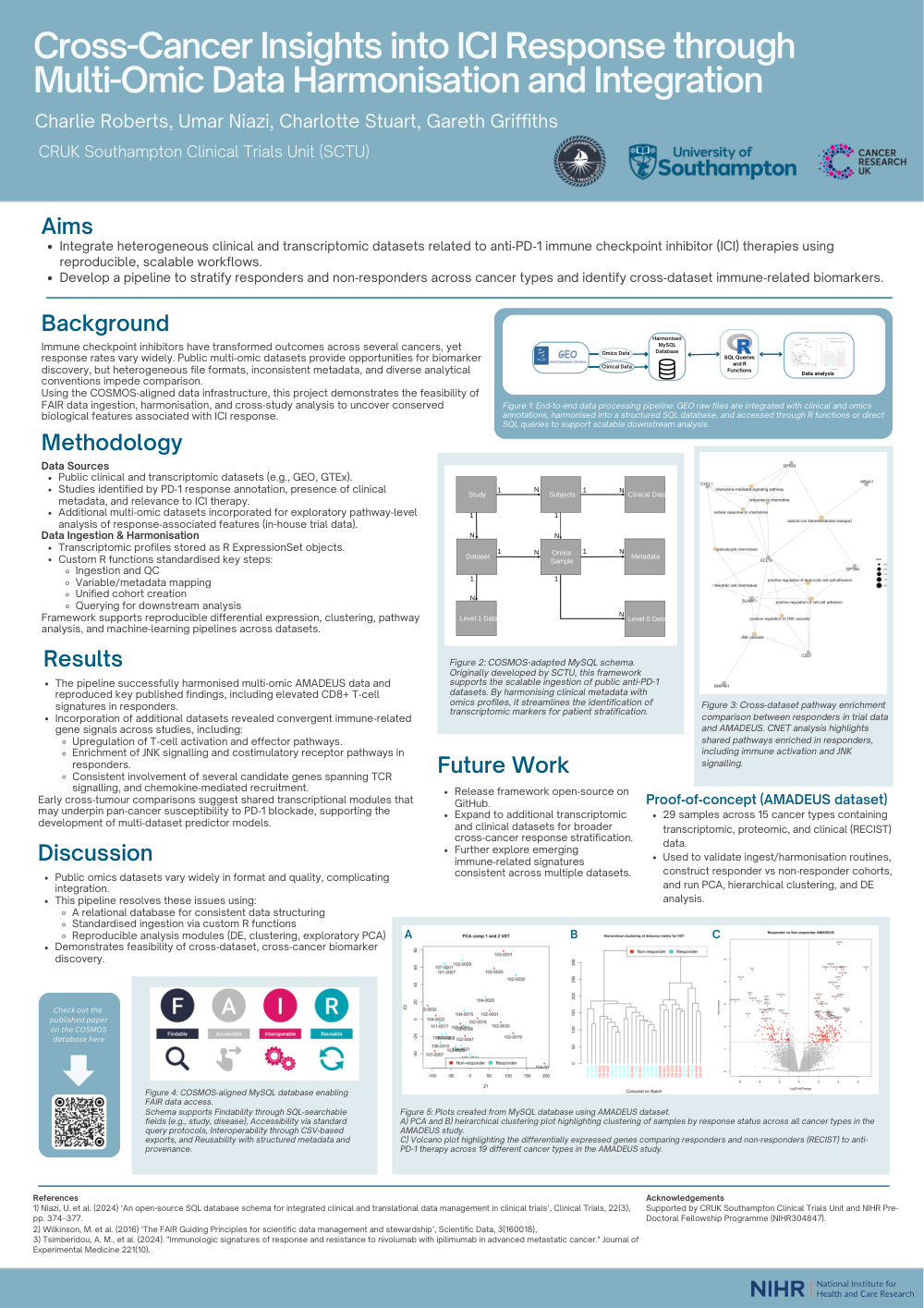
Cross-Cancer Insights into ICI Response through Multi-Omic Data Harmonisation and Integration
Poster Presenter
Authors
Charlie Roberts, Umar Niazi, Charlotte Stuart, Gareth Griffiths
Affiliations
Part of Topic
Aims
- Integrate heterogeneous clinical and transcriptomic datasets related to anti‑PD‑1 immune checkpoint inhibitor (ICI) therapies using reproducible, scalable workflows.
- Develop a pipeline to stratify responders and non‑responders across cancer types and identify cross‑dataset immune‑related biomarkers.
Background
Immune checkpoint inhibitors have transformed outcomes across several cancers, yet response rates vary widely. Publicmulti‑omic datasets provide opportunities for biomarker discovery, but heterogeneous file formats, inconsistentmetadata, and diverse analytical conventions impede comparison.
Using the COSMOS‑aligned data infrastructure, this project demonstrates the feasibility of FAIR data ingestion, harmonisation, and cross‑study analysis to uncover conserved biological features associated with ICI response.
Methodology
Data Sources
- Public clinical and transcriptomic datasets (e.g., GEO, GTEx).
- Studies identified by PD‑1 response annotation, presence of clinical metadata, and relevance to ICI therapy.
- Additional multi‑omic datasets incorporated for exploratory pathway‑level analysis of response‑associated features (in-house trial data).
- Data Ingestion & Harmonisation
- Transcriptomic profiles stored as R ExpressionSet objects.
- Custom R functions standardised key steps:
- Ingestion and QC
- Variable/metadata mapping
- Unified cohort creation
- Querying for downstream analysis
- Framework supports reproducible differential expression, clustering, pathway analysis, and machine‑learning pipelines across datasets.
Discussion
- Public omics datasets vary widely in format and quality, complicating integration.
- This pipeline resolves these issues using:
- A relational database for consistent data structuring
- Standardised ingestion via custom R functions
- Reproducible analysis modules (DE, clustering, exploratory PCA)
- Demonstrates feasibility of cross‑dataset, cross‑cancer biomarker discovery.
Results
- The pipeline successfully harmonised multi‑omic AMADEUS data and reproduced key published findings, including elevated CD8+ T‑cell signatures in responders.
- Incorporation of additional datasets revealed convergent immune‑related gene signals across studies, including:
- Upregulation of T‑cell activation and effector pathways.
- Enrichment of JNK signalling and costimulatory receptor pathways in responders.
- Consistent involvement of several candidate genes spanning TCR signalling, and chemokine‑mediated recruitment.
Early cross‑tumour comparisons suggest shared transcriptional modules that may underpin pan‑cancer susceptibility to PD‑1 blockade, supporting the development of multi‑dataset predictor models.
Future Work
- Release framework open‑source on GitHub.
- Expand to additional transcriptomic and clinical datasets for broader cross‑cancer response stratification.
- Further explore emerging immune‑related signatures consistent across multiple datasets.
Comments
Email is required but is not shown publicly.
Loading comments...