Loading...

92 posters, 1 audios, 567 authors, 81 institutions

ePostersLive by SciGen Technologies S.A. All rights reserved.

Data-driven Cancer Research Conference 2026

24-26 February 2026 | Edinburgh, Scotland

Data-driven Cancer Research Conference 2026 banner

P61

An assessment of trajectory analysis for disease risk prediction: a scoping review
Part of Topic

Background

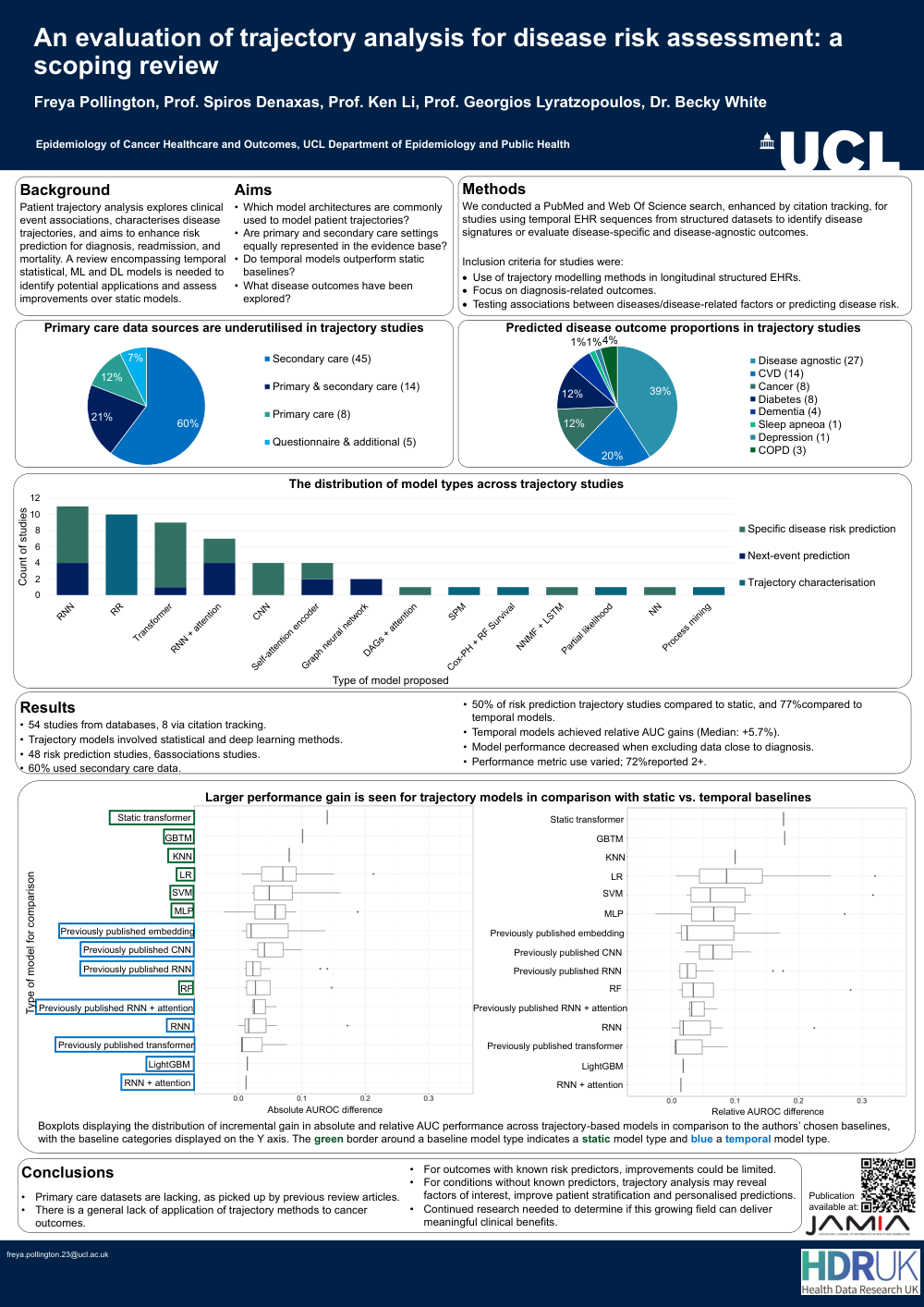
Patient trajectory analysis explores clinical event associations, characterises disease trajectories, and aims to enhance risk prediction for diagnosis, readmission, and mortality. A review encompassing temporal statistical, ML and DL models is needed to identify potential applications and assess improvements over static models.

Aims

•Which model architectures are commonly used to model patient trajectories?
•Are primary and secondary care settings equally represented in the evidence base?
•Do temporal models outperform static baselines?
•What disease outcomes have been explored?
 

Methods

We conducted a PubMed and Web Of Science search, enhanced by citation tracking, for studies using temporal EHR sequences from structured datasets to identify disease signatures or evaluate disease-specific and disease-agnostic outcomes.

•

Inclusion criteria for studies were:

·Use of trajectory modelling methods in longitudinal structured EHRs.
·Focus on diagnosis-related outcomes.
Testing associations between diseases/disease-related factors or predicting disease risk
 

Results

•54 studies from databases, 8 via citation tracking. 
•Trajectory models involved statistical and deep learning methods.
•48 risk prediction studies, 6associations studies.
•60% used secondary care data.
•50% of risk prediction trajectory studies compared to static, and 77%compared to temporal models.
•Temporal models achieved relative AUC gains (Median: +5.7%).
•Model performance decreased when excluding data close to diagnosis.
•Performance metric use varied; 72%reported 2+.
 

Conclusions

•Primary care datasets are lacking, as picked up by previous review articles. 
•There is a general lack of application of trajectory methods to cancer outcomes.
•For outcomes with known risk predictors, improvements could be limited. 
•For conditions without known predictors, trajectory analysis may reveal factors of interest, improve patient stratification and personalised predictions.
•Continued research needed to determine if this growing field can deliver meaningful clinical benefits.

Comments

Email is required but is not shown publicly.

Loading comments...

crc2026 banner
Copyright © 2015-2026, ePostersLive® SciGen is a registered trademark of SciGen Technologies S.A. Patent pending.

This website and third-party tools we use rely on cookies for the best user experience. By selecting "I agree", you agree to cookie usage as described in our Privacy Policy.