92 posters, 1 audios, 567 authors, 81 institutions
ePostersLive by SciGen Technologies S.A. All rights reserved.
Data-driven Cancer Research Conference 2026
24-26 February 2026 | Edinburgh, Scotland

P58
Inequalities in routes to diagnosis, time to diagnosis and time to treatment for individuals with breast cancer in England
Poster Presenter
Part of Topic
Background
•People from marginalised groups are more likely to be diagnosed with, and treated for, breast cancer at a late stage.
•This may be due to experiencing differences in routes to diagnosis, a longer time to diagnosis and/or a longer time to treatment.
Aims
1.Test whether inequalities in route to diagnosis exist (Study 1);
2.Test whether inequalities in time to diagnosis exist (Study 2);
3.Test whether inequalities in time to treatment exist (Study 3).
Methods
Data source
•Data was acquired from the Cancer Registry (CR) linked with primary care data derived from the Clinical Practice Research Datalink (CPRD).
Study population
•Data were extracted for individuals with a diagnosis made between 01/01/2009 and 31/12/2018.
Outcomes
•Route to diagnosis were grouped as screening, urgent suspected cancer (USC) referral, emergency presentation, primary care elective referral, hospital, and other.
•Time to diagnosis was defined as the time between symptom presentation and diagnosis.
•Time to treatment was defined as the time between diagnosis and first treatment.
Co-variates
•Groups of interest included:
1.People from ethnic minority groups
2.People living in deprived areas
3.People of non-female gender
4.People with learning disabilities (LD)
5.People with severe mental illness (SMI)
• All models were adjusted for age, region and year of diagnosis
Analysis
•Study 1: Differences in the proportions of each route to diagnosis was compared using binary logistic regression models.
•Study 2: Differences in the median time to diagnosis were compared using accelerated failure time (AFT) models.
•Study 3: Differences in the median time to treatment were compared using AFT models.
Results
Study 1.
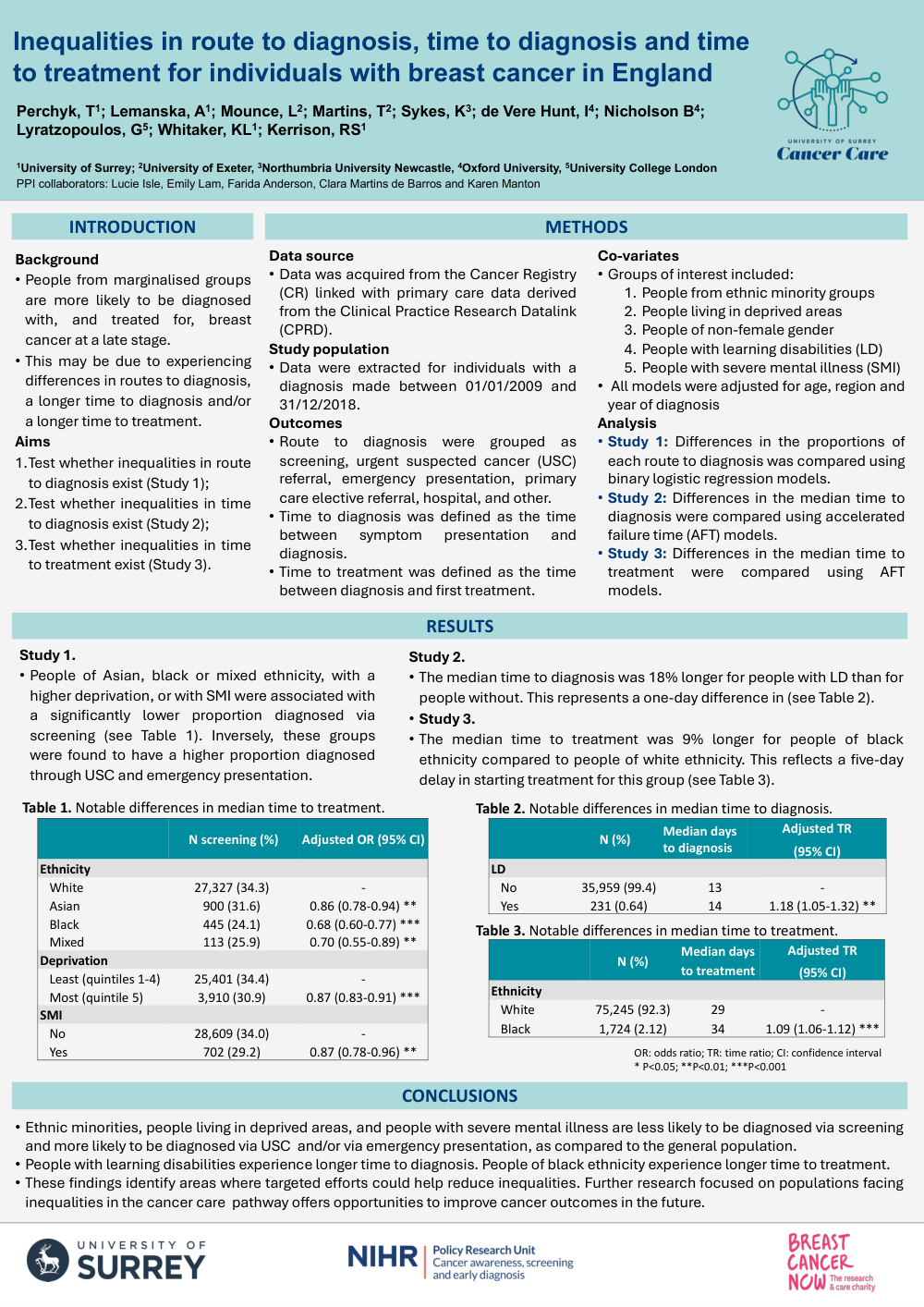
•People of Asian, black or mixed ethnicity, with a higher deprivation, or with SMI were associated with a significantly lower proportion diagnosed via screening (see Table 1). Inversely, these groups were found to have a higher proportion diagnosed through USC and emergency presentation.
Study 2.
•The median time to diagnosis was 18% longer for people with LD than for people without. This represents a one-day difference in (see Table 2).
Study 3.
•The median time to treatment was 9% longer for people of black ethnicity compared to people of white ethnicity. This reflects a five-day delay in starting treatment for this group (see Table 3).
Conclusions
•Ethnic minorities, people living in deprived areas, and people with severe mental illness are less likely to be diagnosed via screening and more likely to be diagnosed via USC and/or via emergency presentation, as compared to the general population.
•People with learning disabilities experience longer time to diagnosis. People of black ethnicity experience longer time to treatment.
•These findings identify areas where targeted efforts could help reduce inequalities. Further research focused on populations facing inequalities in the cancer care pathway offers opportunities to improve cancer outcomes in the future.
Comments
Email is required but is not shown publicly.
Loading comments...