92 posters, 1 audios, 567 authors, 81 institutions
ePostersLive by SciGen Technologies S.A. All rights reserved.
Data-driven Cancer Research Conference 2026
24-26 February 2026 | Edinburgh, Scotland

P53
Horizon scanning technologies with quantum sensing, quantum imaging and quantum computation as exemplars
Poster Presenter
Authors
Aoife O'Brien, Benjamin M. Jacob, Catherine Devereux, Patrick Redmond
Affiliations
Part of Topic
ABNORMAL PLATELET COUNTS AND SHORT-TERM CANCER RISK IN IRISH PRIMARY CARE
Authors: Aoife O’Brien1,2, Benjamin Jacob1,2, Hazel Healy,1, Patrick Redmond,1.
Affiliations: : Dept. of General Practice, RCSI University of Medicine and Health Sciences, Dublin 2 2: Population Health Team, Centric Health, Dublin 16
Background:
Early cancer detection in primary care is challenged by the non-specific nature of early symptoms. Platelet abnormalities are routinely recorded but difficult to interpret in isolation, particularly given variation by age and sex. Evidence from UK primary care suggests predictive value, but applicability to Ireland remains uncertain.
Aim:
To estimate short-term cancer risk following abnormal platelet counts using time-to-event methods, and to identify clinically relevant diagnostic windows in Irish primary care.
Data & Design:
CRADLE primary care EHR (~500,000 adults; 66 GP practices)
Platelet tests recorded 2008–2025
Prior cancer excluded (5-year washout)
Each platelet test initiated a 12-month follow-up episode
Follow-up censored at cancer diagnosis or death.
Survival Analysis:
Cancer incidence over 12 months was estimated using Kaplan–Meier survival curves stratified by platelet band. Cox proportional hazards models were used to estimate adjusted hazard ratios, accounting for age, sex, and prior test frequency.
Kaplan-Meier Results:
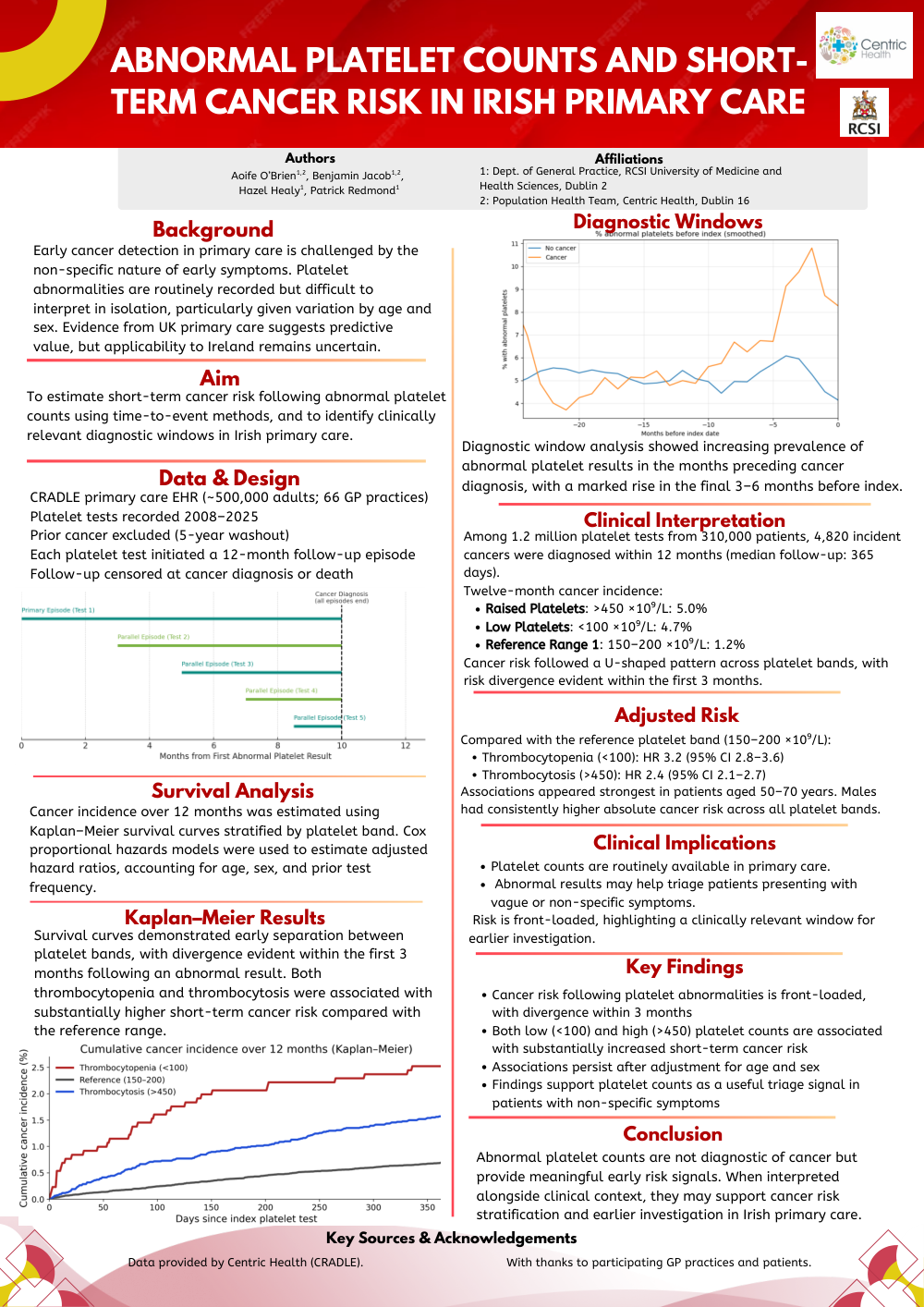
Survival curves demonstrated early separation between platelet bands, with divergence evident within the first 3 months following an abnormal result. Both thrombocytopenia and thrombocytosis were associated with substantially higher short-term cancer risk compared with the reference range.
Diagnostic Windows:
Diagnostic window analysis showed increasing prevalence of abnormal platelet results in the months preceding cancer diagnosis, with a marked rise in the final 3–6 months before index.
Clinical Interpretation:
Among 1.2 million platelet tests from 310,000 patients, 4,820 incident cancers were diagnosed within 12 months (median follow-up: 365 days).
Twelve-month cancer incidence:
Raised Platelets: >450 ×10⁹/L: 5.0%
Low Platelets: <100 ×10⁹/L: 4.7%
Reference Range 1: 150–200 ×10⁹/L: 1.2%
Cancer risk followed a U-shaped pattern across platelet bands, with risk divergence evident within the first 3 months.
Adjusted Risk:
Compared with the reference platelet band (150–200 ×10⁹/L):
Thrombocytopenia (<100): HR 3.2 (95% CI 2.8–3.6)
Thrombocytosis (>450): HR 2.4 (95% CI 2.1–2.7)
Associations appeared strongest in patients aged 50–70 years. Males had consistently higher absolute cancer risk across all platelet bands.
Clinical Implications:
Platelet counts are routinely available in primary care.
Abnormal results may help triage patients presenting with vague or non-specific symptoms.
Risk is front-loaded, highlighting a clinically relevant window for earlier investigation.
Key Findings:
Cancer risk following platelet abnormalities is front-loaded, with divergence within 3 months.
Both low (<100) and high (>450) platelet counts are associated with substantially increased short-term cancer risk.
Associations persist after adjustment for age and sex.
Findings support platelet counts as a useful triage signal in patients with non-specific symptoms.
Conclusion:
Abnormal platelet counts are not diagnostic of cancer but provide meaningful early risk signals. When interpreted alongside clinical context, they may support cancer risk stratification and earlier investigation in Irish primary care.
Comments
Email is required but is not shown publicly.
Loading comments...