92 posters, 1 audios, 567 authors, 81 institutions
ePostersLive by SciGen Technologies S.A. All rights reserved.
Data-driven Cancer Research Conference 2026
24-26 February 2026 | Edinburgh, Scotland

P52
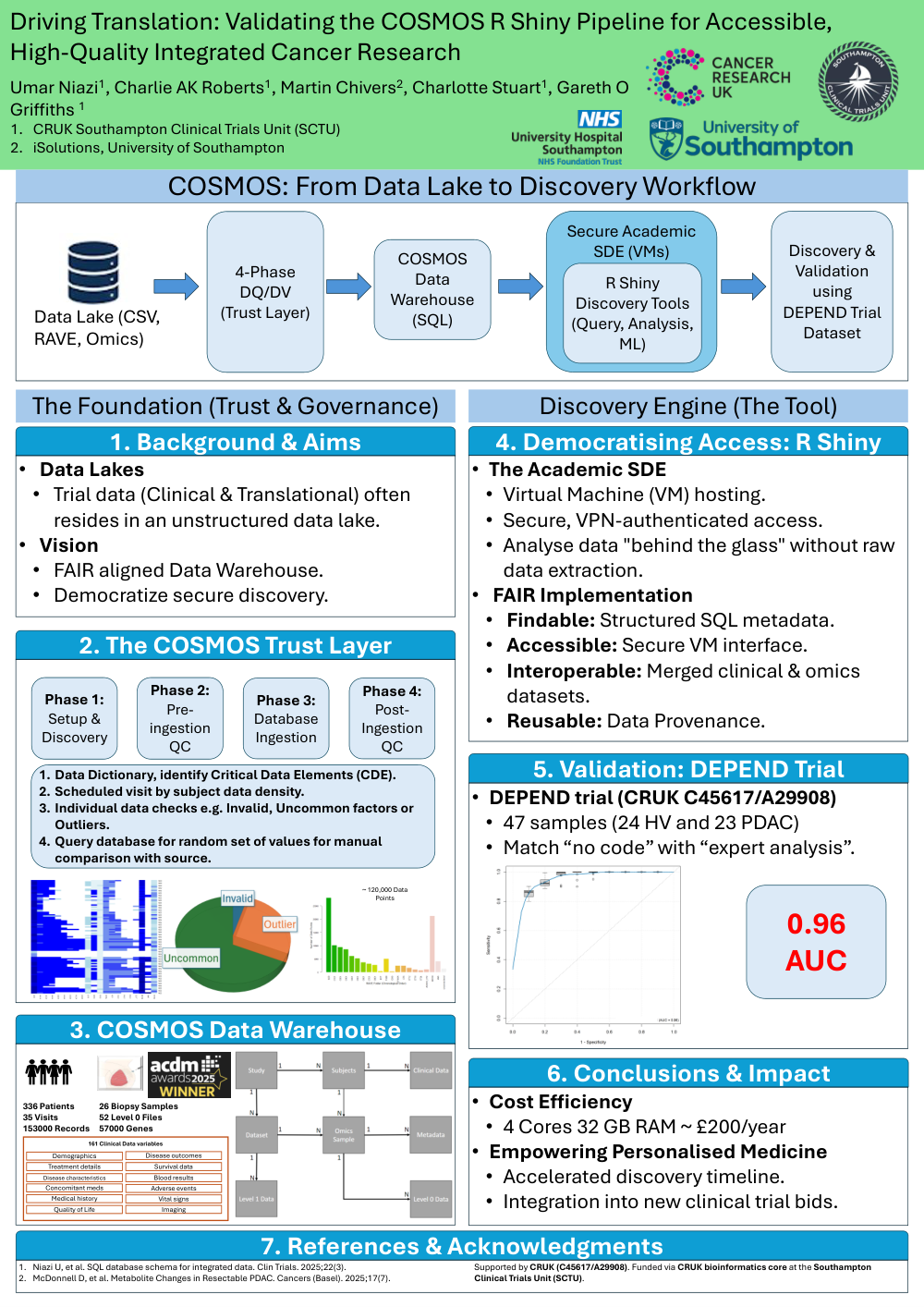
Driving Translation: Validating the COSMOS R Shiny Pipeline for Accessible, High-Quality Integrated Cancer Research
Poster Presenter
Part of Topic
Poster Abstract
Theme: Personalising Cancer Medicine: The Power of Health Data
Title: Driving Translation: Validating the COSMOS R Shiny Pipeline for Accessible, High-Quality Integrated Cancer Research
Abstract (Word Count ~ 220)
As a Cancer Research UK core funded Clinical Trials Unit, our vision is to make complex, integrated data more accessible to the discovery community. The Southampton Clinical Trials Unit COSMOS database [PMID: 39720844] was designed with discovery at the heart, bridging the gap between raw clinical and translational data and curated assets necessary for secure sharing.
To ensure the trustworthiness of this asset, we have implemented a systematic, four-phase Data Quality (DQ) and validation (DV) workflow. This process enforces pre-ingestion checks for completeness, integrity, and range validity, creating an auditable governance layer for all data entering the warehouse.
Building on this high-integrity foundation, we developed the COSMOS R Shiny Exploratory Analysis Tool. This application democratises access to advanced analytics for non-programming researchers by enabling researchers to perform analyses such as differential expression and machine learning feature selection, without requiring specialized programming expertise.
As validation, the R Shiny tool was applied to data from the DEPEND study (a CRUK pancreatic cancer early diagnosis trial CRUK C45617/A29908). The tool's differential analysis outputs were rigorously compared to results derived from complex custom R/Stan models published previously [PMID: 40227642]. We confirm high concordance between the tool’s results and established findings, validating the pipeline's reliability. This approach accelerates the translation of integrated data into clinical insights, empowering researchers to focus on hypothesis generation for personalised cancer treatment.
Comments
Email is required but is not shown publicly.
Loading comments...