92 posters, 1 audios, 567 authors, 81 institutions
ePostersLive by SciGen Technologies S.A. All rights reserved.
Data-driven Cancer Research Conference 2026
24-26 February 2026 | Edinburgh, Scotland

P50
MANIFEST: Multiomic Platform for Cancer Immunotherapy
Poster Presenter
Authors
Kevin Mulder, Ruby Wood, Matous Elphick, Naomi van den Berg, Qingli Guo, Chris Soelistyo, Amy Strange, Samra Turajlic
Affiliations
Part of Topic
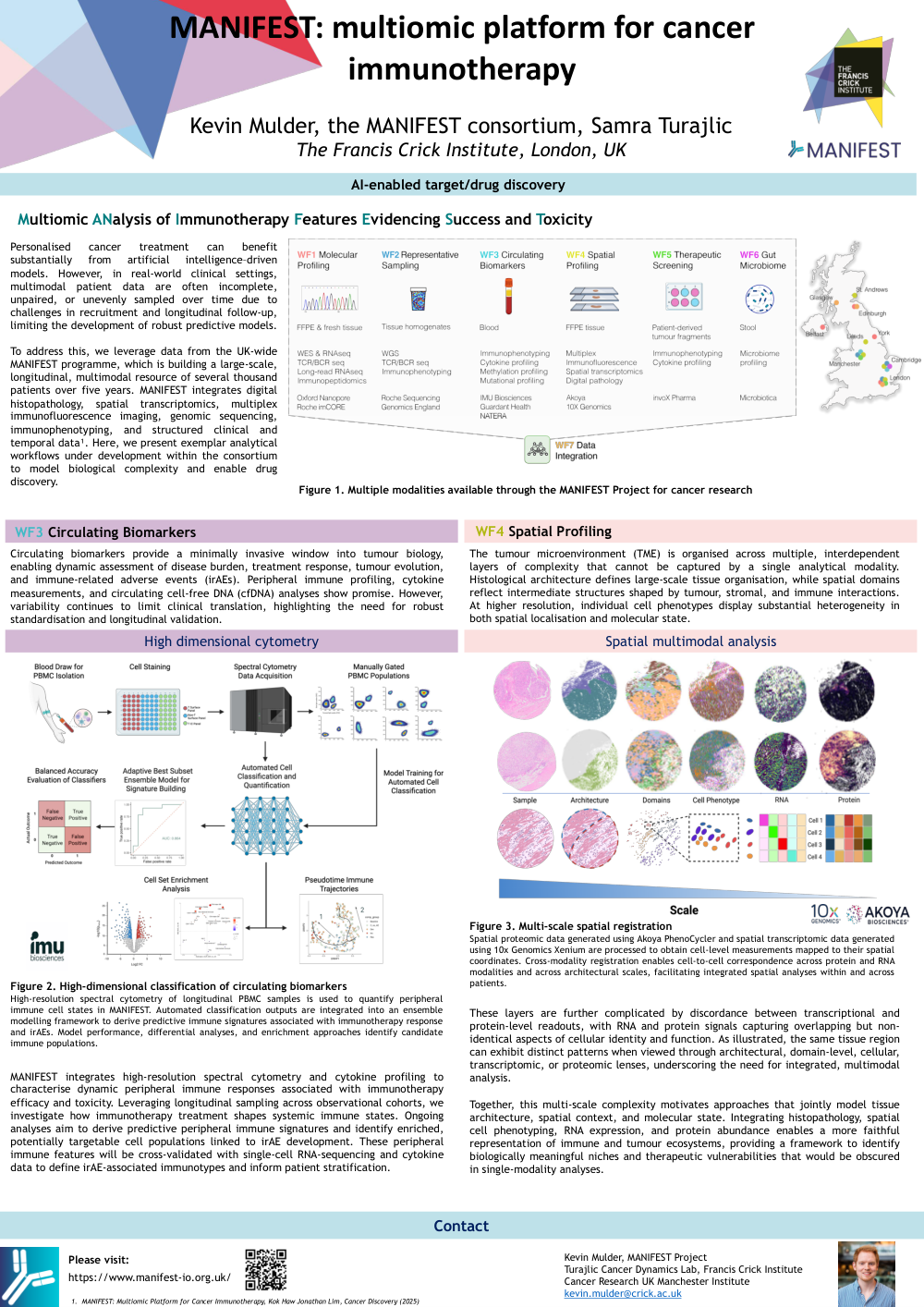
Personalised cancer treatment can benefit substantially from artificial intelligence–driven models. However, in real-world clinical settings, multimodal patient data are often incomplete, unpaired, or unevenly sampled over time due to challenges in recruitment and longitudinal follow-up, limiting the development of robust predictive models.
To address this, we leverage data from the UK-wide MANIFEST programme, which is building a large-scale, longitudinal, multimodal resource of several thousand patients over five years. MANIFEST integrates digital histopathology, spatial transcriptomics, multiplex immunofluorescence imaging, genomic sequencing, immunophenotyping, and structured clinical and temporal data¹. Here, we present exemplar analytical workflows under development within the consortium to model biological complexity and enable drug discovery.
Circulating biomarkers provide a minimally invasive window into tumour biology, enabling dynamic assessment of disease burden, treatment response, tumour evolution, and immune-related adverse events (irAEs). Peripheral immune profiling, cytokine measurements, and circulating cell-free DNA (cfDNA) analyses show promise. However, variability continues to limit clinical translation, highlighting the need for robust standardisation and longitudinal validation.
MANIFEST integrates high-resolution spectral cytometry and cytokine profiling to characterise dynamic peripheral immune responses associated with immunotherapy efficacy and toxicity. Leveraging longitudinal sampling across observational cohorts, we investigate how immunotherapy treatment shapes systemic immune states. Ongoing analyses aim to derive predictive peripheral immune signatures and identify enriched, potentially targetable cell populations linked to irAE development. These peripheral immune features will be cross-validated with single-cell RNA-sequencing and cytokine data to define irAE-associated immunotypes and inform patient stratification.
The tumour microenvironment (TME) is organised across multiple, interdependent layers of complexity that cannot be captured by a single analytical modality. Histological architecture defines large-scale tissue organisation, while spatial domains reflect intermediate structures shaped by tumour, stromal, and immune interactions. At higher resolution, individual cell phenotypes display substantial heterogeneity in both spatial localisation and molecular state.
These layers are further complicated by discordance between transcriptional and protein-level readouts, with RNA and protein signals capturing overlapping but non-identical aspects of cellular identity and function. As illustrated, the same tissue region can exhibit distinct patterns when viewed through architectural, domain-level, cellular, transcriptomic, or proteomic lenses, underscoring the need for integrated, multimodal analysis.
Together, this multi-scale complexity motivates approaches that jointly model tissue architecture, spatial context, and molecular state. Integrating histopathology, spatial cell phenotyping, RNA expression, and protein abundance enables a more faithful representation of immune and tumour ecosystems, providing a framework to identify biologically meaningful niches and therapeutic vulnerabilities that would be obscured in single-modality analyses.
Comments
Email is required but is not shown publicly.
Loading comments...