92 posters, 1 audios, 567 authors, 81 institutions
ePostersLive by SciGen Technologies S.A. All rights reserved.
Data-driven Cancer Research Conference 2026
24-26 February 2026 | Edinburgh, Scotland

P47
Identification of real-world androgen deprivation therapy exposure in prostate cancer survivors: a population-based electronic health records study in England
Part of Topic
Identification and validation of real-world androgen-deprivation therapy use among prostate cancer survivors in electronic health records in England
Background and Aim
Prostate cancer is the most common male cancer in the UK. Androgen deprivation therapy (ADT) lowers testosterone to control prostate cancer growth but has serious adverse effects.
Risk prediction and safety monitoring rely on accurate exposure data, yet ADT data in England are fragmented across multiple electronic health record (EHR) systems, risking incomplete capture and misclassification.
We aimed to develop an algorithm to identify ADT exposure in linked population-based EHR datasets in England.
Methods
- Linked Data Sources: Clinical Practice Research Datalink (CPRD) Aurum/GOLD, Hospital Episode Statistics Admitted Patient Care (HES APC), National Cancer Registry (NCRAS), and the Systemic Anti-Cancer Therapy (SACT) dataset.
- Study Population: Men with an incident prostate cancer diagnosis in NCRAS between 1999-2018, with no prior invasive cancer.
- ADT Identification: Clinician-validated codelists were used to identify surgical (orchidectomy) and pharmacological ADT across linked sources. Events were extracted, harmonised, and completeness validated using several methods.
Results
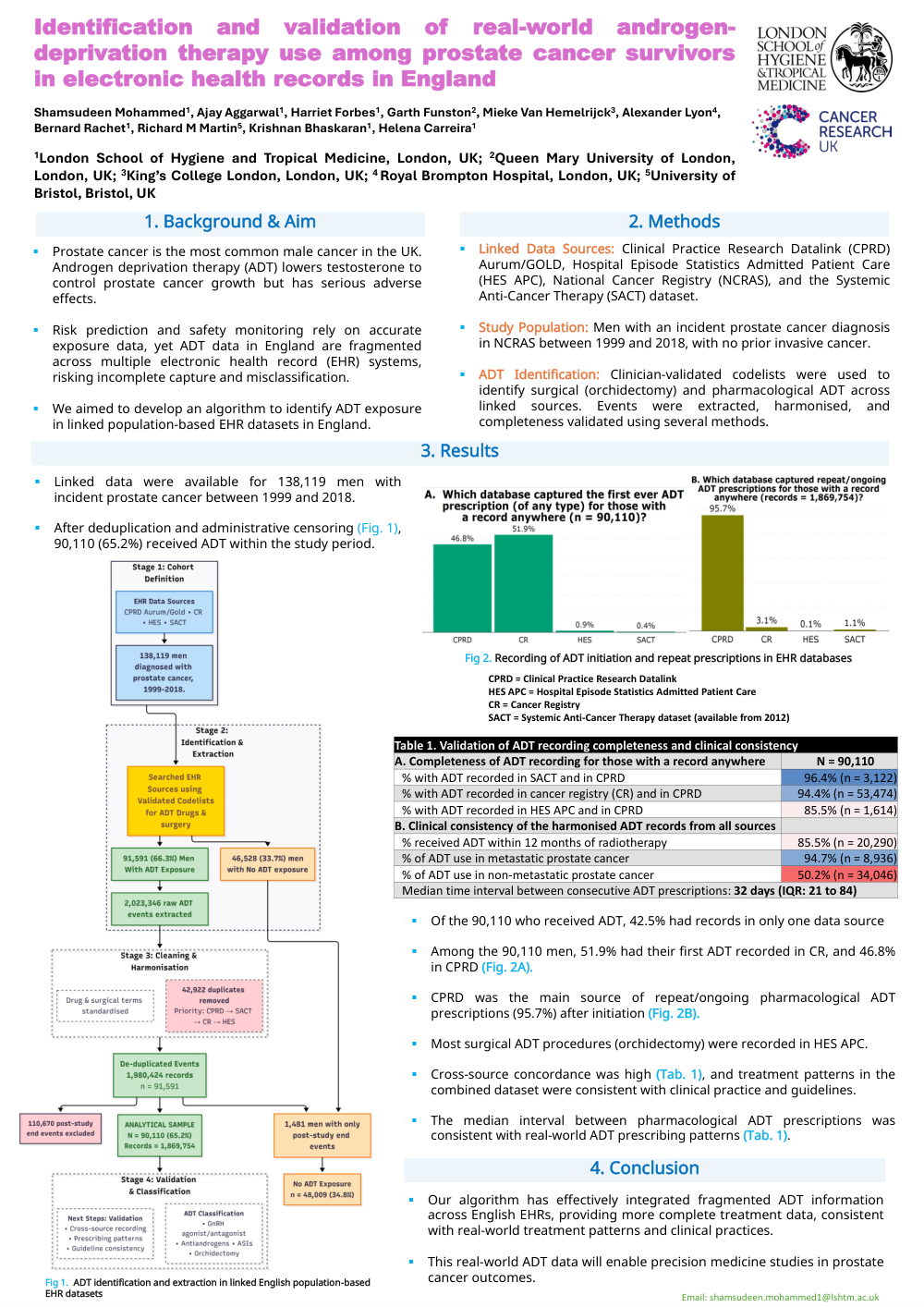
Linked data were available for 138,119 men with incident Prostate cancer between 1999 and 2018.
After deduplication and administrative censoring (Fig. 1), 90,110 (65.2%) received ADT within the study period.
Of the 90,110 who received ADT, 42.5% had records in only one data source
Among the 90,110 men, 51.9% had their first ADT recorded in CR, and 46.8% in CPRD.
CPRD was the main source of repeat/ongoing pharmacological ADT prescriptions (95.7%) after initiation.
Most surgical ADT procedures (orchidectomy) were recorded in HES APC.
Cross-source concordance was high, and treatment patterns in the combined dataset were consistent with clinical practice and guidelines.
The median interval between pharmacological ADT prescriptions was consistent with real-world ADT prescribing patterns.
Conclusion
Our algorithm has effectively integrated fragmented ADT information across English EHRs, providing more complete treatment data, consistent with real-world treatment patterns and clinical practices. This real-world ADT data will enable precision medicine studies in prostate cancer outcomes
Comments
Email is required but is not shown publicly.
Loading comments...