92 posters, 1 audios, 567 authors, 81 institutions
ePostersLive by SciGen Technologies S.A. All rights reserved.
Data-driven Cancer Research Conference 2026
24-26 February 2026 | Edinburgh, Scotland

P40
AI-defined Molecular Classifications in Ovarian Cancer (AAIMC-OC) for Equitable Access to Molecular Diagnostics
Poster Presenter
Authors
Elaine Leung, J Teuwen, H Horlings, A Dekker, C Gourley, M Churchman, A Mukhopadhyay, M Mungania, E Walong, K Koelzer, T Bosse, R Ganesan, AP Karkala, S Pires De Oliveira, A Shauriq, L Cole, A Beggs
Affiliations
Part of Topic
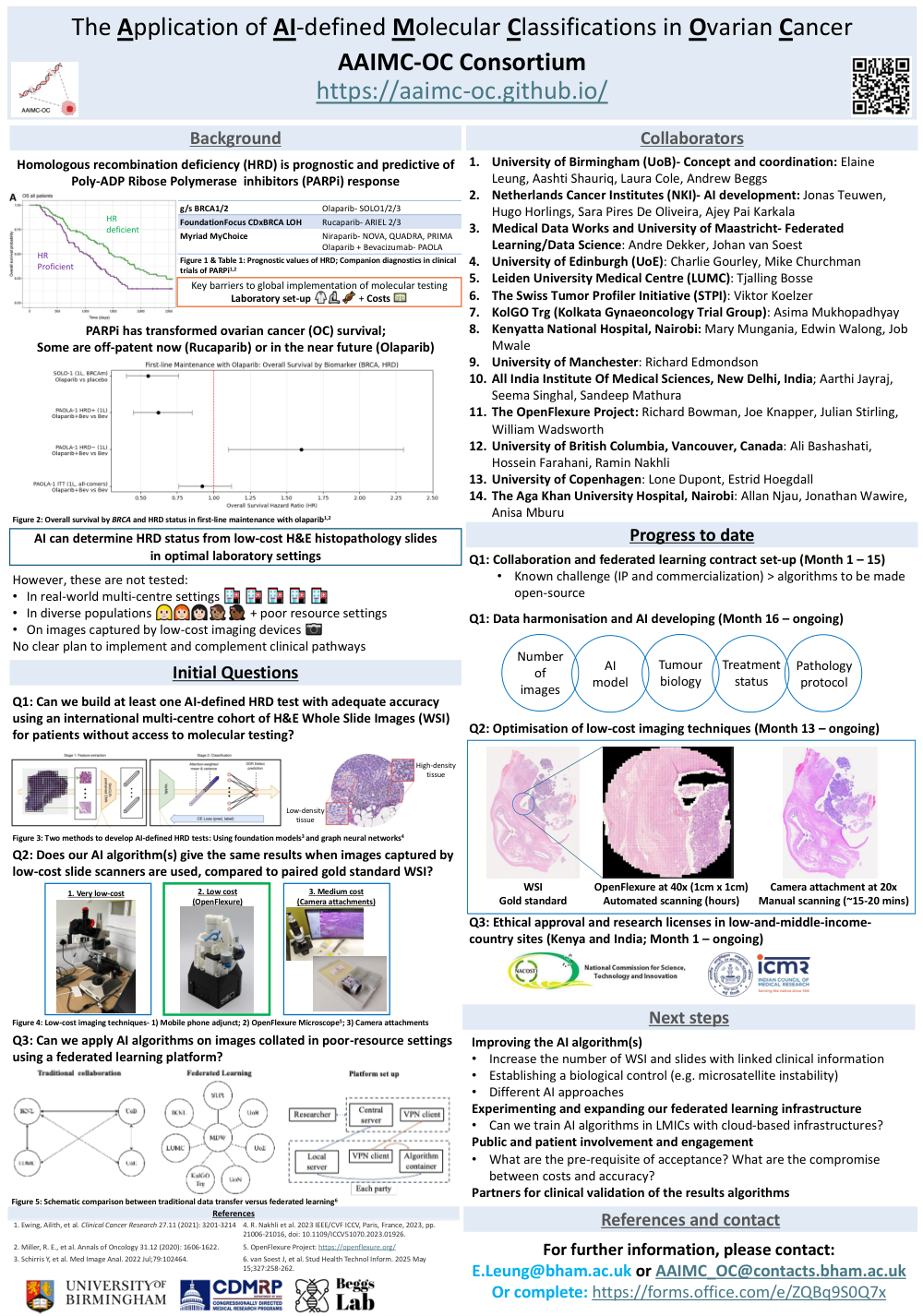
The Application of AI-defined Molecular Classifications in Ovarian Cancer (AAIMC-OC) Consortium (https://aaimc-oc.github.io/) aims to make expensive but important clinical cancer tests available to women around the world, especially in places where resources are limited. In ovarian cancer, tumours are unable to repair DNA easily— this defect is called homologous recombination deficiency (HRD). Clarifying HRD can help doctors predict who will benefit most from certain medicines known as PARP inhibitors. These medicines have already improved survival for many women, and some are becoming cheaper as patents expire. However, testing for HRD currently requires expensive laboratory equipment that many hospitals cannot access. Patients also need to make informed decision about their cancer treatments, as these are also costly and have potential life-threatening side effects.
Researchers across multiple countries are working together to create a new, low‑cost way to identify HRD using artificial intelligence (AI) from tests used in routine testing to detect cancers (what is known as a diagnostic test). Instead of relying on complex genetic tests, the team is training AI to recognise signs of HRD from standard microscope slides that all pathology labs already use. The goal is to ensure the AI works accurately not only in well‑resourced hospitals but also when slides are scanned with affordable devices in low reource settings– including open‑source microscopes or a simple camera attachment to the microscopes we already use to diagnose cancers.
The team is also using a method called federated learning, which allows hospitals in different countries to help train the AI without sharing patient data. Ultimately, this project aims to create a reliable, accessible test that could help more women receive the right treatment, no matter where they live.
The next stage of the project focuses on improving the AI tools by adding more microscope slide images from hospitals worldwide and testing different AI methods to make the system as accurate and reliable as possible. The team will also trial low‑cost scanning devices in real healthcare settings across Kenya, India, and other regions, ensuring the technology is practical, affordable, and acceptable to patients and clinicians. Alongside this, partners in each country are securing local ethical approvals and expanding the federated learning network so that hospitals can help train the AI without sharing patient data. Researchers will also continue working closely with patient and public groups to understand what matters most to them—helping shape a final test that is effective, affordable, and genuinely usable across different healthcare systems.
Our full collaborators' list could be found at: https://aaimc-oc.github.io/members/
For further information, please contact: E.Leung@bham.ac.uk or AAIMC_OC@contacts.bham.ac.uk
Or complete an expression of interest form to joing AAIMC-OC: https://forms.office.com/e/ZQBq9S0Q7x
Comments
Email is required but is not shown publicly.
Loading comments...